


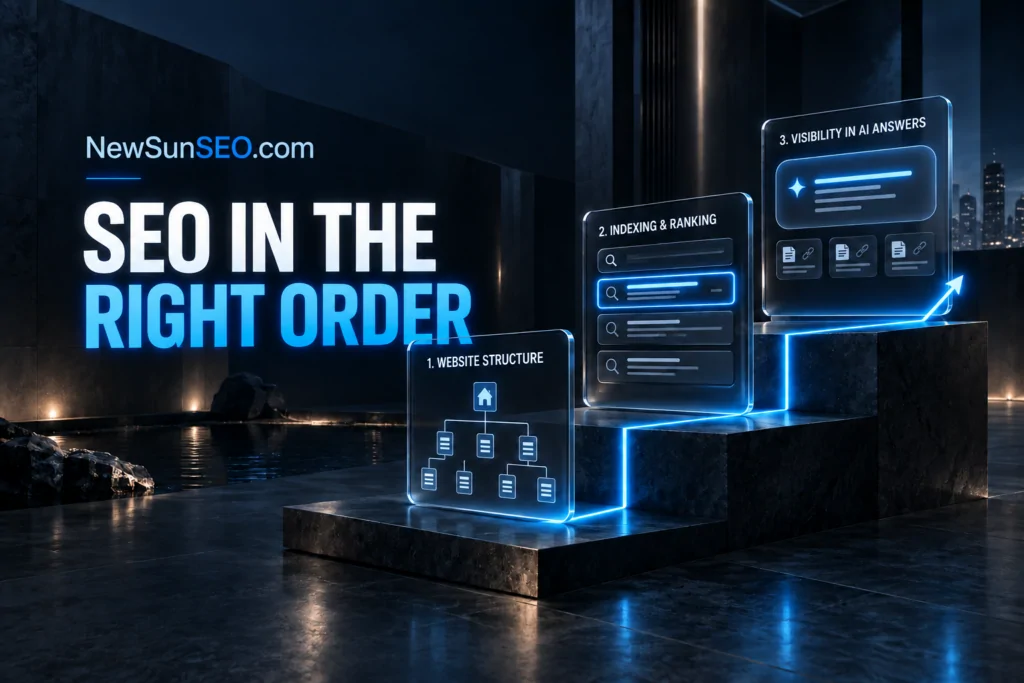
SEO for a new website gives you a source of traffic that keeps working for months or years after you publish, sending people who are actively searching for what you offer. The payoff comes from sequence: making a few structural decisions in the right order before you publish, then doing steady ongoing work once you are live. Skip the order and you end up with redirects, lost link equity, and pages that never rank.
A brand-new domain has no authority buffer to absorb mistakes. An established site can publish in the wrong order and still rank on domain strength; a site launched last month cannot. That is why order is the strategy for a new website.
What SEO does for a new website
For a new website, SEO is less about how much work you do and more about the order you do it in, because early structural decisions get expensive to reverse once content and links pile on top of them. Two examples make the point:
- Choosing your URL structure before you publish costs nothing. Changing it after 80 pages are indexed and linked means redirects, lost equity, and a week of rework.
- Picking keywords you can realistically win before you write saves you from a library of well-crafted pages that never rank.
Search sends strangers who are looking for what you sell, and unlike paid ads, that traffic does not stop when you stop paying. Early SEO builds authority that grows slowly, and the same signals that help you rank can also help AI systems find and cite you.
How search engines and AI answers work
Search engines find your pages by crawling, store them by indexing, and order them by ranking:
- Crawling is when a bot such as Googlebot follows links to discover your pages.
- Indexing is when the engine stores and understands those pages so it can serve them later.
- Ranking is when it decides, for a given search, which indexed pages appear and in what order.
If a page is not crawled, it cannot be indexed, and if it is not indexed, it cannot rank. That is why the first thing to confirm on a new site is that search engines can reach and index your pages, not whether you have polished a title tag.
AI systems add a fourth step: generating a response. Tools like ChatGPT, Perplexity, and Google AI Overviews pull passages from sources they trust and synthesize an answer, sometimes citing you by name. Earning a place in those answers is an extension of SEO, called generative engine optimization (GEO) or answer engine optimization (AEO). ChatGPT alone reached 900 million weekly active users in early 2026, according to OpenAI, which is a growing channel where people discover brands they have never heard of.
These tools draw on two sources of information and often blend them in one answer. The first is training data, the snapshot of text a model learned from when it was built: powerful but frozen, with nothing published after the training cutoff and no reliable attribution of where a fact came from. The second is live web results, which the tool retrieves in real time, pulling passages from current pages and often citing the sources by name. That live retrieval is where a new site can realistically show up.
What to lock in before launch versus after
The cheapest SEO wins happen before launch, so set the structural decisions first and treat everything after launch as ongoing work. The same sequence applies to a local service site or a SaaS product:
- Technical foundation: before launch, choose HTTPS, a mobile-friendly build, and a fast host, and plan your robots.txt. After launch, verify indexing, submit your sitemap, and fix crawl issues.
- Site architecture: before launch, decide your URL structure and how pages nest. After launch, add new pages into that structure instead of creating ad hoc URLs.
- Keywords: before launch, map a few winnable targets to your core pages. After launch, expand into new terms and questions as you publish.
- Content: before launch, draft your core pages and outline your first cluster. After launch, publish on a steady cadence and refresh regularly.
- Authority: before launch, claim your brand name, profiles, and key directories. After launch, earn backlinks and brand mentions.
- AI visibility: from day one, write clear, extractable, entity-rich pages, then monitor AI mentions and build presence in sources AI systems cite.
- Measurement: set up Google Analytics 4 and Google Search Console, then track rankings and watch indexing before rankings.
The step-by-step sequence
Work top to bottom, with each step assuming the one before it is done: set up the technical essentials, lock your architecture, choose winnable keywords, create content worth citing, build authority, and make yourself visible to AI answer engines. Across your first 90 days, that maps to pre-launch decisions and drafting, launch-week setup and indexing checks, a first content cluster in the first 30 days, and authority and AI-visibility work from days 30 to 90.
1. Set up the technical essentials
Confirm that search engines can crawl and index your site before any keyword or content work. Start with the accounts and files that give you visibility: create a robots.txt file to tell crawlers which pages to access and which to skip, set up Google Search Console to see how Google crawls and ranks you, submit an XML sitemap through it, and connect Google Analytics 4 to track visitor behavior. Search Console will show little at first, which is normal, so set it up early and let it fill in. Then run a technical crawl, fix indexability problems such as noindex tags or blocked resources first, and confirm the basics: every page over HTTPS, a mobile-friendly design (Google indexes the mobile version first), and fast loading with a Largest Contentful Paint under 2.5 seconds.
2. Plan your site architecture and URLs
Decide how pages are organized and how URLs are structured before you publish, since this is easy now and time-consuming to reverse later. Sketch the skeleton first: most new sites need a homepage, an about page, core product or service pages, a contact page, and a blog, each with room to expand into subpages. Decide your URL slugs too, and keep them short, descriptive, and keyword-focused while avoiding numbers and special characters. Once a URL is indexed and linked, changing it means redirects, and every redirect is a small tax on equity and a new chance for errors.
3. Find keywords and prompts you can win
Keyword research shows what your audience types into search so you can build pages around terms worth ranking for. For a new site, target the terms you can realistically win and that lead to revenue, not the highest-volume ones. A useful rule of thumb on a brand-new domain is to filter for a personal keyword difficulty under 20 and look for terms with 100 or more monthly searches. Long-tail questions are usually easier to win because they are more specific and less contested. Prioritize by intent and revenue potential, starting with commercial, lower-funnel terms closest to a purchase, then expanding into informational topics through your blog. A keyword gap comparison against competitors surfaces winnable targets you would otherwise miss. Then find the prompts buyers type into AI tools, which are longer and more conversational than keywords, and map each keyword and prompt to a target page.
4. Create content people and AI systems want to cite
Content earns rankings and AI citations the same way: by being useful, organized into topics you cover in depth, and structured so a specific passage can be lifted out and cited. Start with topic clusters, a pillar page on a broad topic plus supporting pages on its subtopics, all internally linked, and build one topic out fully before moving to the next. The single biggest differentiator for a new site is original input: your own data, tests, or first-hand experience, which gives both Google and AI systems a reason to recommend you over a bigger competitor that only summarizes. Then tighten on-page SEO so search engines and AI systems understand each page: match the search intent behind the target query, write a clear title tag under about 550 pixels that includes the keyword, add a meta description that earns the click, use descriptive H2s and H3s that answer real questions from your research, and write accurate alt text for images.
5 and 6. Build authority and AI visibility
From days 30 to 90, earn backlinks and brand mentions through PR, guest posts, and community participation, and build presence in the sources AI systems cite while monitoring where your brand already appears. Watch indexing before rankings, since data accumulates before positions move.
FAQ
What is the first thing to do when starting SEO on a new website?
Confirm that search engines can crawl and index your pages. Set up robots.txt, Google Search Console, an XML sitemap, and Google Analytics 4, then fix indexability issues such as noindex tags or blocked resources before any keyword or content work, because a page that cannot be indexed cannot rank.
What keyword difficulty should a brand-new website target?
On a brand-new domain, a good rule of thumb is to filter for a personal keyword difficulty under 20 and look for terms with 100 or more monthly searches. Long-tail questions are usually easier to win because they are more specific and less contested, and you should prioritize commercial, lower-funnel terms by intent and revenue rather than by search volume.
How do new websites show up in AI answers like ChatGPT and Google AI Overviews?
AI tools blend frozen training data with live web results they retrieve in real time, and when they retrieve, they pull passages from current pages and often cite the sources by name. A new site can appear there by publishing clear, extractable, entity-rich pages backed by original data or first-hand experience that these systems can lift and attribute.
Want help with this in Myrtle Beach or Long Island? Talk to us.
NewSunSEO
Grow in Google and AI Search
AI-SEO, local search, paid ads and websites from one team, with offices on Long Island and in Myrtle Beach.
- AI-SEO
- Local AI-SEO
- AI Consulting
- PPC
- Web Design
- Web Development
- Long Island Office(631) 320-1700
- Myrtle Beach Office(843) 492-7131
Request a Free Proposal
Tell us about your business and where you want to grow.
We will reply by email to talk through your goals and what a proposal would include.
We use your details only to reply to you and send what you asked for. See our Privacy Policy.

