


Quick Answer
Set up and optimize your Google Business Profile by choosing the correct business model, preparing the client website details, completing Google’s claim and verification process, and comparing the listing with the website before launch.
What Are the Four Stages of Profile Setup?
Start with the business model, prepare the website as the source of truth, complete the claim and verification process, then run an agency quality-assurance check and schedule recurring reviews.
1. Choose a Storefront or Service-Area Business
A business that receives customers at a physical location can publish its street address, while a service-area business can define the areas it serves without displaying a street address. The University of New Hampshire guide to Google Business Profile management explains that a service area can include city names, ZIP codes, counties, or other geographic areas, with support for up to 20 locations.
The University of New Hampshire also gives a practical storefront test: select a public address when customers visit the farm for activities such as a farm stand, CSA pickup, or events. Select a service area when customers do not receive services at the address.
The primary category should describe the main business rather than an individual service. A golf resort, for example, should use “Golf Resort,” not “Swimming Pool.” The University of New Hampshire guide recommends selecting the category that best fits the main business and adding secondary categories when needed.
2. Prepare the Client Website Details
Prepare the legal business name, address or service-area boundaries, primary phone number, website URL, operating hours, primary category, business description, and current service information. Ask the client which document or page controls each field. Record the source of truth, any mismatch, the person responsible for the correction, the due date, and proof of correction in the agency handoff record.
The Mississippi State University Extension guide identifies the business name, category, description, hours, physical location, service area, website, and phone number as the basic information used to create a profile. It also recommends precise and consistent business information across the website and other online locations.
The profile description can explain what the client sells, the problems it addresses, and what distinguishes the business. Mississippi State University Extension recommends relevant keywords while advising writers to use natural language rather than machine-sounding copy. Google’s description field provides 750 characters, according to the University of New Hampshire guide.
Confirm the cities, ZIP codes, counties, or other areas with the client before entering them into the profile.
3. Claim and Verify the Profile
According to the University of New Hampshire guide, open your web browser and go to business.google.com, then click “Sign in” if you have an existing Google Account for the business. The guide says a Gmail account is not required, so a business can create an account with an existing business email address. Search for the business name and location, select an existing listing when one appears, or create a business with that name when it does not.

Google then guides the manager through the category, location or service area, phone number, and website. A profile can be created without a website and updated later, according to the University of New Hampshire guide.
Verification confirms that the business is real and that the person managing the profile is authorized. Available methods can include a phone call, text message, email, video recording, live video call, or mail, and Google may require more than one method. The University of New Hampshire guide says Google can take up to five business days to review the information. Most mailed verification codes arrive within 14 days when mail is the selected method.
When Google verifies the business, it sends a confirmation email. If a “Get Verified” prompt returns, the University of New Hampshire guide says to follow the prompts and try another available method when offered.
4. Run the Agency QA Gate and Recurring Review
Before marking the listing live, compare the legal business name, address or service area, primary phone number, URL, hours, primary category, description, and service-area boundaries with the client website. Ask the client to confirm each discrepancy. Record the source of truth, mismatch, owner, due date, and proof of correction before handoff.
The Mississippi State University Extension guide recommends checking the name, address, and phone number for accuracy and consistency across online locations. It also recommends updating the profile, using photos and videos, posting updates, requesting customer reviews, and responding to reviews. Google archives updates after seven days, according to that guide, which places recurring profile work on the agency’s maintenance list.
For agencies that need visibility data across individual towns and suburbs, SEOScanPro provides GEO Grids that map rank position across a service area.
How Should an Agency Review an Incorrect or Conflicting Listing?
Use normal profile management for edits to a listing the client controls, including hours, description, photos, categories, services, posts, questions and answers, and messaging. Use Google’s ownership and management process when another party has claimed the listing or when the client cannot access the profile.
Prepare the client’s legal business name, ownership evidence, business identifiers, website, phone number, address or service-area details, and any requested corrections. Ask the client to confirm which details agree with the website and which records should control a dispute. Keep copies of the submitted evidence and the outcome of the request in the handoff record.
What Does the Evidence Show About Profile Completeness?
Blogging Wizard’s Google Business Profile statistics review reports that Localo analyzed two million profile pages. In that analysis, 75% of businesses ranking in the top three search results had completed profile descriptions, compared with 65% of businesses in positions six through 10 and fewer than 40% in positions 11 through 20. Businesses in the top three also used descriptions averaging just under 70 words, while businesses in positions four through 20 used fewer than 50 words.

The same review reports Localo’s finding that businesses in the top three positions had more than 200 reviews on average. Those businesses averaged almost 250 reviews, compared with fewer than 200 on average for positions four through 10 and just over 150 for positions 11 through 20. This is an analysis of two million pages, not a controlled test establishing that adding reviews causes a ranking improvement.
Localo’s 21-month case study followed one e-bike rental business in Poland’s Beskid Niski mountain region from June 9, 2024, through February 28, 2026. Its profile views peaked during the May-to-September season, averaging 10 to 15 daily views, and fell to zero through seven daily views from October through February. The study recorded 2,235 summer profile views and 883 winter profile views, but it covered one business at one location, excluded booking data, revenue, and direct customer feedback, and did not establish causation.
The same case study recorded a difference between winter intent and winter clicks. Direction requests reached 99% of summer levels during winter, while calls and website clicks remained low. This finding applies to one seasonal rental business and should not be treated as a general benchmark for other client profiles.
What to Do Now
- Ask the client to choose a storefront or service-area model and confirm the applicable boundaries.
- Record the legal business name, address or service area, primary phone number, URL, hours, categories, and description.
- Complete the claim and verification process using an available Google method.
- Run the prelaunch QA gate and record each mismatch, owner, due date, and correction in the handoff record.
- Schedule recurring reviews of hours, reviews, photos, updates, questions and answers, and the website link.
Key Considerations
- The source business model determines whether a public street address or a service area is appropriate.
- If you do not have a website yet, you can continue without one and update your profile later.
- Google determines which verification methods are available and may require more than one.
- The cited studies report patterns and associations, not proof that profile changes directly cause ranking gains.
Sources and Limitations
The setup instructions and field limits come from the University of New Hampshire Extension guide and the Mississippi State University Extension publication. Localo’s analysis covers two million profile pages, according to Blogging Wizard. Its separate 21-month case study covers one e-bike rental business at one location and does not include bookings, revenue, or direct customer feedback. The available research does not provide a universal effect size for profile completion, reviews, descriptions, or updates.
FAQ
Can a Google Business Profile Be Created Without a Website?
Yes. The University of New Hampshire guide says a business can continue without a website and update the profile later.
How Many Service-Area Locations Can a Google Business Profile Include?
The University of New Hampshire guide says a service area can include up to 20 locations using city names, ZIP codes, counties, or other geographic areas.
Which Verification Methods May Google Offer?
Available methods can include a phone call, text message, email, video recording, live video call, or mail. Some businesses may need more than one method, according to the University of New Hampshire guide.
How Long Does Google Business Profile Verification Take?
The University of New Hampshire guide says Google can take up to five business days to review the information. Most mailed verification codes arrive within 14 days when mail is the selected method.
What Should an Agency Review Before Marking a Profile Live?
Compare the legal business name, address or service area, primary phone number, URL, hours, categories, description, and service-area boundaries with the client website. Record the source of truth, mismatch, owner, due date, and proof of correction in the handoff record.
Related Coverage
SEOScanPro
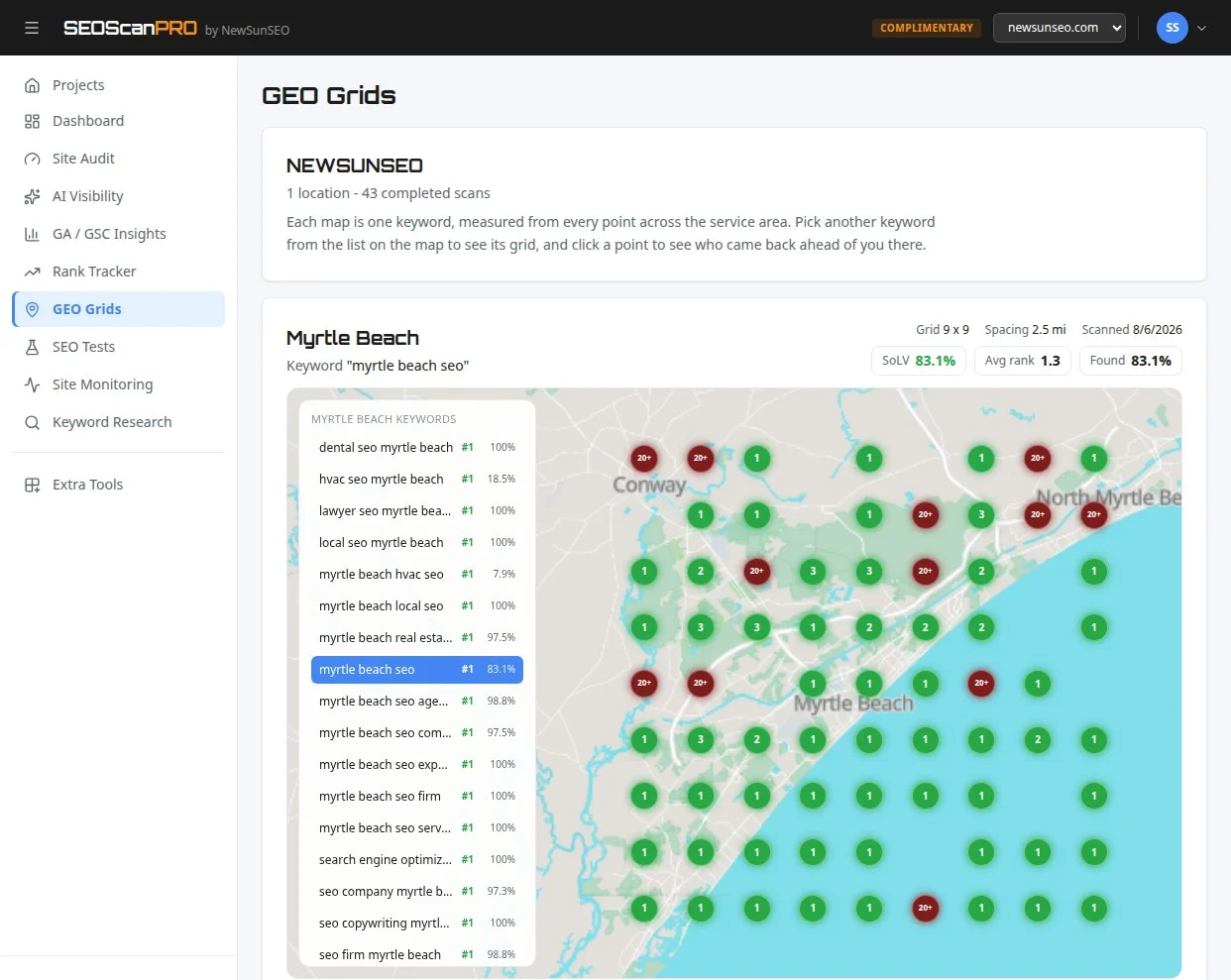
SEOScanPro runs a full technical audit of a site and shows the measured result behind every check. Open the geo grid tool.
Sources
Do you want help with your SEO or website development? Then Contact Us Here.
NewSunSEO
Grow in Google and AI Search
AI-SEO, local search, paid ads and websites from one team, with offices on Long Island and in Myrtle Beach.
- AI-SEO
- Local AI-SEO
- AI Consulting
- PPC
- Web Design
- Web Development
- Long Island Office(631) 320-1700
- Myrtle Beach Office(843) 492-7131
Request a Free Proposal
Tell us about your business and where you want to grow.
We will reply by email to talk through your goals and what a proposal would include.

