


Readers now stay inside a single session longer, asking several questions in a row and refining what they need instead of restarting each search. Even when a page satisfies the first question, it can lose the choice if it does not address what comes next.
What conversational search actually means
Conversational search lets people ask natural questions, carry context from one request to the next, and refine their needs along the way. It can happen in a search engine, AI assistant, voice interface, on-site chatbot, shopping assistant, or visual search tool.
Three qualities set it apart from conventional search:
- Context carries forward. “What about one under $200?” only makes sense because the system remembers what “one” refers to.
- Intent can evolve: a user researching running shoes may compare models in the same session and then complete a purchase before leaving the chat.
- The format can change. A journey may combine typed text, speech, images, video, maps, charts, or product feeds.
The defining test is simple: can the person continue the task without rebuilding the context? If yes, the experience is conversational.
How search became conversational
Conversational search predates AI assistants; its foundations developed over decades alongside shifting user behavior.
Keywords and reformulation
Early web search encouraged short noun phrases stripped of natural grammar. If results missed the central need, users manually reformulated: “running shoes,” then “running shoes flat feet,” then “best stability running shoes women.” The user carried context between searches, and SEO centered on keyword matching and landing pages built around primary phrases.
Semantic and contextual understanding
Search engines gradually improved at understanding entities, relationships, intent, and natural phrasing. Google’s 2019 BERT update emphasized the context and relationships among words in a query. Small terms such as “to,” “for,” and “no” could materially change intent. For SEO, that shift reduced the value of repetitive exact-match language and increased the importance of satisfying underlying needs.
Voice and answer-first interfaces
Voice assistants normalized complete questions and concise spoken answers, and they introduced hands-free situations such as driving, cooking, and asking for nearby businesses while away from a screen. Many voice interactions stayed single-turn, but the lasting lesson was that answers had to be brief enough to be heard and reread once when heard.
Complex and multimodal understanding
Google’s 2021 MUM update framed complex tasks as journeys that could require multiple searches. In 2022, Lens multisearch enabled people to combine an image with text such as a color, attribute, or question. The direction was already clear: let people authentically express their needs while the system performs more of the work behind the scenes.
What conversational search looks like now
Generative AI interprets natural language, retrieves up-to-date information, combines sources, and retains context within a single interface, so a question about, for example, lawn care fans out into searches on treatment, prevention, safety, cost, climate, and timing, while the user keeps typing in natural phrasing.
One question can trigger many searches
Google says AI Overviews and AI Mode may use query fan-out, running multiple related searches across subtopics and data sources. A lawn care question may prompt research into treatment, prevention, safety, cost, climate, and timing. The visible prompt does not tell the whole story, and a page can support part of an answer even when it does not mirror the wording of the initial question.
Keyword datasets still reveal demand, but they represent only part of the picture. Support questions, on-site searches, reviews, sales conversations, and prompt testing can expose the needs that come next.
Follow-ups turn results into journeys
Google has made the shift visible by connecting follow-up questions in AI Overviews to a continuing conversation in AI Mode. ChatGPT search similarly blends conversational responses with timely web information and source links.
Consider a heat-pump journey: “Explain heat pumps.” Then, “Would one work in a 1920s house?” Next, “What if the electrical panel is only 100 amps?” Followed by, “Estimate the trade-offs in Southern California.” And finally, “What should I ask contractors?” Each question changes the best answer. A page that only handles the definition may support the opening request and disappear from the rest of the journey.
The initial query identifies the topic. The follow-ups reveal what truly matters: budget, risk, location, use case, or deadline.
Multimodal inputs make the conversation more natural
People do not need to translate everything they see into keywords. They can show a system an object, screen, plant, product, room, or broken part and ask a direct question. In May 2025, Google reported that Lens handles more than 25 billion queries per month. Search Live has further expanded this behavior by allowing people to discuss a live camera view and ask free-flowing follow-ups.
For brands, visual SEO cannot stop at filenames and alt text. The image or video must be useful. Clear angles, close-ups, scale, labels, captions, demonstrations, and transcripts can help a person and a search system understand what the visual is trying to prove.
Search is moving closer to action
Conversational systems increasingly connect research with execution. Search experiences can already assist with tickets, reservations, local appointments, shopping, and forms. As agentic capabilities develop, accurate availability, pricing, policies, product details, and accessible conversion paths become an increasingly important part of discoverability. A great article cannot rescue inaccurate inventory or a broken booking flow.
More needs are being satisfied before a click
Visits containing a Google AI summary resulted in a traditional result click 8% of the time, compared with 15% when no AI summary appeared, per a Pew Research Center study. Links inside the summaries received clicks in only 1% of visits.
One study cannot provide a universal click-through forecast, but the direction matters. A brand can influence a decision without receiving a visit. The clicks that remain may also represent a later, more qualified need, such as verifying a claim, viewing the original demonstration, using a tool, joining a community, or checking current availability.
The click increasingly means: “Give me the proof, experience, or utility the summary cannot,” such as verifying a claim, viewing the original demonstration, using a tool, joining a community, or checking current availability. That dynamic raises the value of original reporting, testing, research, and firsthand experience, along with methodology, sources, corrections, datasets, templates, maps, and interactive tools.
Trust becomes part of the conversion
Good self-service handles routine questions, flags what it cannot resolve, and connects the caller to a human when empathy or accountability are needed.
Search is not only a channel for acquiring anonymous traffic; it can also start a relationship that continues before and after the click, through tools, newsletters, expert responses, or community participation.
The strategic shift: Optimize the conversation, not just the keyword
This shift can feel bigger than it is. Brands do not need to predict every prompt, nor do they need to rebuild their content program overnight. They need to match their strongest existing pages to the follow-up questions users actually ask and make those pages easier to find.
Map follow-up paths around real decisions
Start with the audience journey, not the newest AI feature. Identify the most common next question after a first answer, and decide what evidence or action that follow-up requires.
Build topic systems rather than prompt pages
One article rarely serves an entire decision. Cluster pages that cover definition, comparison, use cases, limitations, pricing, and next steps, then link them so a person and a search system can follow the thread.
Make every key claim easy to verify
Source data, dates, methods, and authors. Link to the underlying study, the original report, or the firsthand experience. Verification is now a ranking factor as well as a trust factor.
Design for retrieval and reading
Use clear headings, concise definitions near the top of each section, structured data where it fits, and plain language. Retrieval systems pull short passages; readers want a clear path from summary to detail.
Treat images and video as answer assets
A photograph showing exactly where a reset button sits on an appliance is more useful than a polished lifestyle image of the same appliance. Add captions, labels, and transcripts that make the visual searchable and useful to both people and machines.
Create a strong next turn on owned surfaces
Offer a calculator, checklist, template, or newsletter that gives a reason to return directly. The most resilient traffic is the traffic a brand can earn again, not just the traffic it can rent from a search result.
Build authority people can remember
Bylines tied to named authors, a point of view stated up front, and repeatable formats like the calculator or checklist already mentioned help readers remember the brand when they are ready to act.
Measurement: A scorecard for conversational search
Rank position alone no longer captures the journey. A useful scorecard tracks how often a brand appears in AI Overviews and AI Mode for the questions that matter, how often it is cited as a source, how its content supports follow-up questions, and whether its owned surfaces convert the people who do click. Combine search console data with prompt testing, brand mention monitoring, and on-site behavior to see the full picture.
Where a brand needs to know how it appears across a whole service area, rank position varies by town and suburb, and a single city-wide average hides the gaps. SEOScanPRO’s GEO Grids map rank position across that area so the invisible zones become visible.
What comes next
Conversational search is likely to handle a growing share of the user journey, from the initial question typed into a search bar to the final action taken in a browser. Some brands will gain an advantage by treating the follow-up query as the most valuable element on the page and as the key moment in the customer relationship.
FAQ
What is conversational search?
Conversational search is a way of searching where a person can ask natural questions, carry context from one request to the next, and refine their needs across several turns. It can happen in search engines, AI assistants, voice interfaces, on-site chatbots, and visual search tools. The defining test is whether the person can continue the task without rebuilding the context.
Why is the follow-up query important for SEO?
The follow-up query often reveals what the person actually needs: budget, risk, location, deadline, or use case. A page that only matches the first question can lose the rest of the journey. Optimizing for follow-ups means creating connected resources that serve the evolving decision, not isolated pages for individual keywords.
How does AI search change click-through rates?
A Pew Research Center study found that visits containing a Google AI summary resulted in a traditional result click 8% of the time, compared with 15% when no AI summary appeared, and links inside the summaries received clicks in only 1% of visits. The clicks that remain tend to be more qualified, driven by people seeking proof, firsthand experience, or a tool the summary cannot provide.
Related coverage
- ChatGPT SEO: 8 Proven Strategies to Show Up in AI Search Results (2026)
- 35+ Local SEO Statistics That Prove Local Search Is Your Most Valuable Marketing Channel in 2026
SEOScanPRO
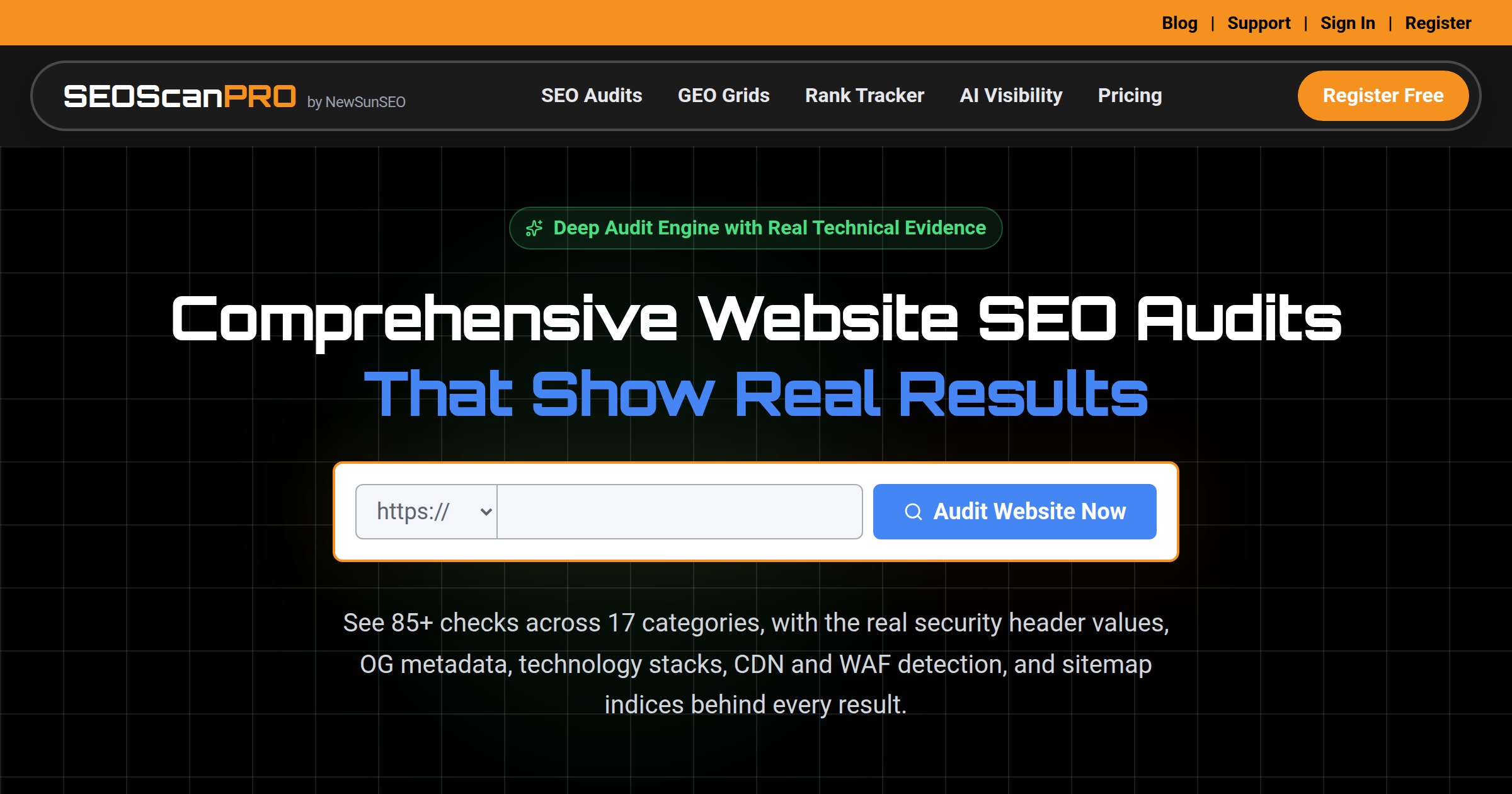
The SEOScanPRO AI visibility report runs a full technical audit of a site and shows the measured result behind every check. Open the AI visibility report.
Want help with this in Myrtle Beach or Long Island? Talk to us.
NewSunSEO
Grow in Google and AI Search
AI-SEO, local search, paid ads and websites from one team, with offices on Long Island and in Myrtle Beach.
- AI-SEO
- Local AI-SEO
- AI Consulting
- PPC
- Web Design
- Web Development
- Long Island Office(631) 320-1700
- Myrtle Beach Office(843) 492-7131
Request a Free Proposal
Tell us about your business and where you want to grow.
We will reply by email to talk through your goals and what a proposal would include.
We use your details only to reply to you and send what you asked for. See our Privacy Policy.

