



Enterprise teams get a clearer read on SEO changes by running controlled experiments on groups of pages instead of shipping “obvious” fixes on faith. The approach turns SEO expertise into testable hypotheses and produces evidence for or against changes that once went live on instinct.
Many widely accepted SEO recommendations have never been rigorously proven. Controlled tests show varying results, with some recommendations increasing traffic, others reducing it, and others producing no measurable change, depending on the specific site, template, vertical, competitor set, search result layout, and timing.
What controlled SEO A/B testing actually is
A traditional CRO test splits users into buckets that see different versions of a page. SEO testing cannot work that way. Googlebot is part of the system, and serving it a separate version of a page would amount to cloaking and would break the test.
The solution is to split pages, not users. A group of pages is selected as the control. A comparable group is selected as the variant. The variant group receives the change. The control group does not. The two groups are balanced statistically so that historical traffic patterns are as similar as possible. The change is made server-side and is visible to every visitor to those pages: users, search engine crawlers, and crawlers associated with large language models.
Because the page experience is consistent for everyone who loads a page in the test, there is no cloaking risk and no separate crawler-only version to maintain.
What a site needs before testing is worthwhile
The practical ingredients are traffic and page count. A rough rule of thumb is around 30,000 organic sessions per month, or about 1,000 per day, distributed across a useful number of pages. Dozens of pages can sometimes work. Hundreds or thousands are better.
That scale is why large ecommerce, retail, marketplace, and travel sites are a strong fit. Templates across these properties often produce thousands of pages receiving meaningful organic traffic, which gives testing enough statistical sensitivity to detect real effects.
Conversions matter for the business, but they are often noisy as a test metric. Discounts, competitor pricing, promotions, seasonality, and macro conditions all move revenue. Organic traffic is usually a cleaner primary metric for detecting whether a page change worked. The business can then translate the expected traffic impact into revenue using its own models.
Why a strong hypothesis matters more than a clever idea
A test idea is a change someone wants to make. A hypothesis explains the mechanism by which that change should affect search performance.
Consider the difference. “Add FAQ content to these pages” is an idea. “Adding concise FAQ content to category pages will help them rank for additional long-tail queries and improve relevance for existing queries, increasing organic sessions to the tested page group” is a hypothesis. The second version names the expected effect and the page-level outcome, which is what a test needs to measure against.
Weak hypotheses lead to weak tests. Tests fail when the expected effect is unclear or when the change is too small to produce a measurable result, the same pattern described below for image alt attributes. Tooling that flags underpowered ideas before they consume engineering time can stop changes that look sensible but are unlikely to move organic traffic in either direction, such as alt attribute tweaks on large retail and ecommerce catalogues.
Image alt attributes are a useful example. There are solid reasons to add them: accessibility, usability, compliance, and sometimes image search. Testing on large retail and ecommerce catalogues has not produced evidence that changing alt attributes moves standard organic SEO traffic in either direction. That does not make alt attributes unimportant. It makes them a weak candidate for a traffic-focused A/B test.
Why test backlogs grow faster than teams can run them
Large SEO teams rarely run out of ideas. Ideas come from in-house SEOs, agencies, product teams, content teams, merchandising teams, technical audits, competitor analysis, internal politics, and old recommendations waiting for engineering capacity.
Prioritisation means ranking proposed changes by where commercially meaningful gains meet practical implementation, then testing the highest-ranked changes first.
The larger blocker is often organisational. Some teams cannot test above the fold on product pages because product owns that space. Some cannot change templates because engineering capacity is scarce. Some cannot test certain content modules because brand or merchandising owns them. Some get stuck in sign-off loops. When test velocity is low or win rates disappoint, the issue is not always the quality of the SEO ideas. It may be that the team is only allowed to test low-impact parts of the page.
Enterprise SEO experimentation is as much an operating model as a tool, and teams need the mandate to test parts of the page such as title tags, where change can move the needle.
Why title tags are still high-variance
Title tag tests are among the most likely to produce very large positive results and among the most likely to produce very large negative results. Title tags affect two things at once: rankings and click-through rate. Search engines rewrite some titles, but not all of them, and the wording the team writes often contributes to the snippet a searcher sees.
Old SEO guidance encouraged careful keyword research followed by adding those keywords into title tags. In hindsight, that recommendation carried more variance than many SEOs treated it with at the time. Paid search analysts have long known that one advert can dramatically outperform another because the copy is better, not because it contains a different number of keywords. Organic snippets work the same way: the wording matters.
One title tag test produced a decline of more than 20% in organic traffic on the first version. The underlying idea was still sound. The team iterated on the copy and found a version that produced a large positive result. The lesson is not “title tags work” or “title tags do not work.” The lesson is that implementation matters.
What a breadcrumb schema test actually showed
Breadcrumb schema is the kind of fix SEOs usually ship without much hesitation. If the markup is broken, fix it. The test produced a negative result.
The lesson is not that breadcrumb schema is bad. The lesson is that search result changes can affect user behaviour in ways that are hard to predict. Structured data can change how a result appears. A technically cleaner result is not always a more clickable result. In some cases, the older appearance was more compelling, or the rich result shifted user expectations in a way that reduced clicks. A page-level A/B split is what surfaces that kind of effect, because it isolates the markup change from every other variable in play.
What controlled testing changes for an SEO team
Controlled testing does not make SEO expertise redundant. It turns that expertise into testable hypotheses. A strong SEO team still brings instincts, pattern recognition, and experience shaped by prior changes like the breadcrumb schema test. The shift is that those instincts feed an experimentation programme rather than replacing one.
For large sites, recommendations backed by controlled-test evidence move from the discovery backlog onto the roadmap within the same planning cycle that the test concludes, while recommendations that have never been measured are either queued for their own test or deprioritised, which means fewer unmeasured changes reach production and each shipped fix can be tied to a documented lift in organic traffic rather than to an untested assumption.
Rank position across a service area is what a geo grid report shows, and SEOScanPRO’s GEO Grids do this for local businesses that want to see which towns and suburbs they are visible in.
FAQ
What is SEO A/B testing?
SEO A/B testing is a controlled experiment that splits pages into a control group and a variant group, applies a change to the variant group only, and measures the difference in organic traffic between the two groups. The change is server-side and visible to every visitor, including search engine crawlers, so there is no cloaking risk.
Why split test pages instead of users for SEO?
Splitting users works for CRO because the goal is to measure user behaviour. SEO testing has to include the crawler in the test, and serving Googlebot a separate version of a page would amount to cloaking. Splitting pages keeps the experience consistent for users and crawlers while still producing a clean comparison.
How much traffic does a site need for SEO A/B testing?
A rough rule of thumb is around 30,000 organic sessions per month, or about 1,000 per day, distributed across a useful number of pages. Dozens of pages can sometimes work, but hundreds or thousands give stronger statistical sensitivity.
Related coverage
- Outdated SEO Practices Businesses Need to Drop in 2026
- Alt Tag and Image SEO Best Practices Every Business Should Follow in 2026
SEOScanPRO
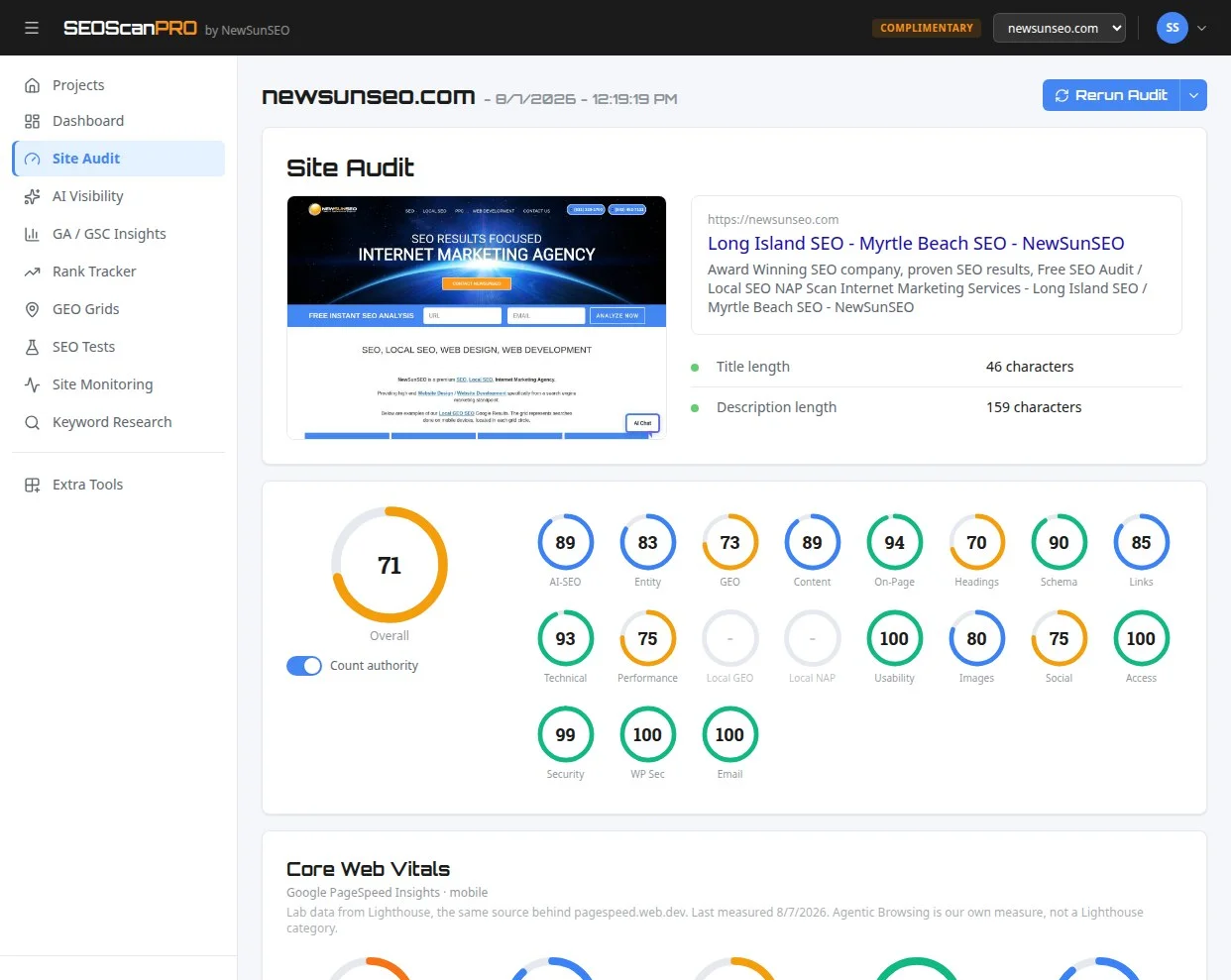
The SEOScanPRO site audit tool runs a full technical audit of a site and shows the measured result behind every check. Open the site audit tool.
Want help with this in Myrtle Beach or Long Island? Talk to us.
NewSunSEO
Grow in Google and AI Search
AI-SEO, local search, paid ads and websites from one team, with offices on Long Island and in Myrtle Beach.
- AI-SEO
- Local AI-SEO
- AI Consulting
- PPC
- Web Design
- Web Development
- Long Island Office(631) 320-1700
- Myrtle Beach Office(843) 492-7131
Request a Free Proposal
Tell us about your business and where you want to grow.
We will reply by email to talk through your goals and what a proposal would include.
We use your details only to reply to you and send what you asked for. See our Privacy Policy.

