


Content teams now face a question that matters more than any keyword volume: should I update an existing page or publish something brand-new for AI search? The answer determines whether your business gets cited inside ChatGPT, Gemini, and Google AI Overviews-or watched from the sidelines while a competitor’s decade-old blog post gets the mention. The framework that decides this isn’t guesswork. It’s built on two standards that define how answer engines and generative models pick their sources: Answer Engine Optimization (AEO) and Generative Engine Optimization (GEO).
Why It Matters
AI-generated answers now sit above the traditional ten blue links in billions of searches every day. Google’s AI Overviews are live in over 100 countries, and large language models inside search engines, social feeds, and voice assistants all rely on the same underlying logic: surface the most trustworthy, clearly structured page that directly answers the query. If your content has the authority but lacks the structure, you don’t get cited. If you have neither, a new page won’t climb fast enough to matter.
Google’s own documentation on AI Overviews confirms that the system looks for pages that demonstrate “strong experience, expertise, authoritativeness, and trustworthiness” and present information in a scannable, answer-forward layout. A small-business website can compete with a giant if it plays the structure game right-but playing it wrong on a fresh URL wastes months of trust-building.
What’s New / How It Works
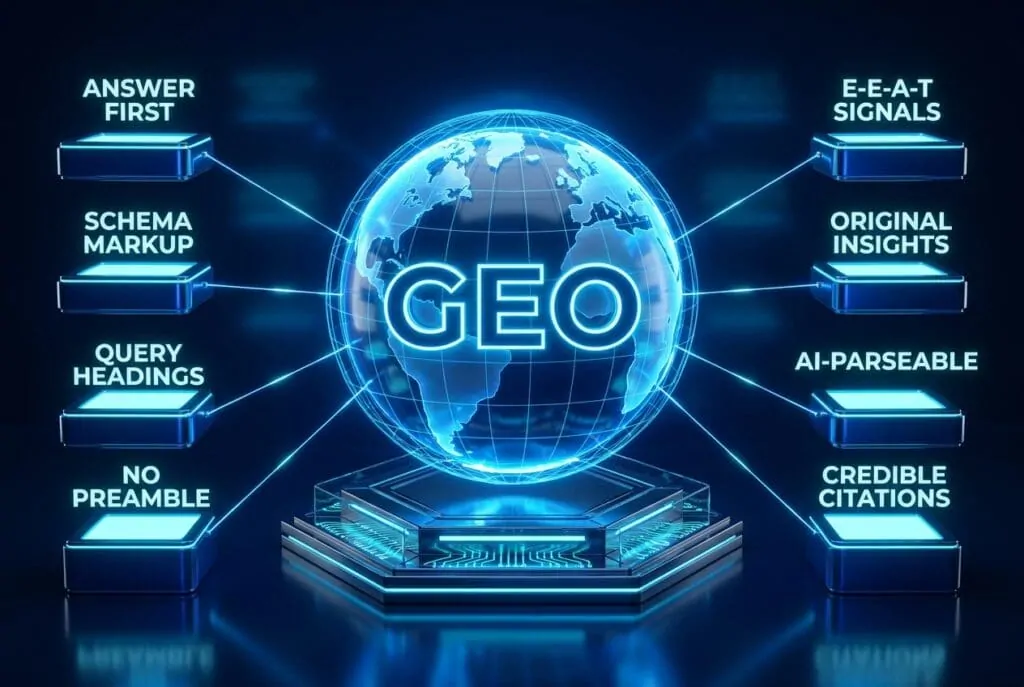
AEO and GEO are two sides of the same AI-visibility coin. AEO focuses on being the single source that answer engines extract for featured snippets, voice replies, and quick-answer panels. It demands a direct answer inside the first 100 words, well-organized headings that mirror real question phrasing, and structured data markup like FAQ and HowTo schema. GEO goes further: it aims to be one of the multiple sources that a generative model synthesizes into a longer response. That requires raw E-E-A-T signals-original data, named expert perspectives, and citation-rich formatting-so that AI models treat the page as a credible reference rather than a superficial summary.
The key mechanic that makes “update vs. create” so lopsided is how AI search handles freshness. When you update an existing URL that already has backlinks, entity recognition, and a known trust score, search crawlers reprocess only the changed portions and instantly carry forward the page’s accumulated standing. A brand-new URL starts with a zero-trust baseline and must earn every signal from scratch. For business owners, that means a strategic refresh on an established page almost always produces AI-visibility gains faster than building a new one topically.
The Numbers
- 70/30 split: Allocate roughly 70% of your content resources toward refreshing existing pages, and 30% toward capturing entirely new topics that you’ve never covered.
- Pages with 100+ quality backlinks but zero AI citations are the highest-ROI update targets. The authority is already in place; the missing piece is usually structured formatting and answer-first content.
- Pages ranking positions 11-30 often sit closest to AI citation territory. A structured refresh-updated data, FAQ additions, schema-can move them into the sources AI Overviews and generative engines pull from.
- Keyword cannibalization across multiple URLs confuses AI models and dilutes citation potential. When two or more pages overlap by more than roughly 60% in core subject matter, merging them into one authoritative pillar page consolidates link equity and creates a single strong signal.
“AI Overviews give you a quick synthesis of a topic with links to high-quality web pages for deeper exploration.”
- Google Search Blog
What Comes Next
Google’s AI Overviews are evolving toward multi-step reasoning and agentic capabilities that complete tasks directly from search results. As the answer engine gets smarter about pulling from sources that maintain fresh, structured data, the gap between sites that update deliberately and sites that keep publishing thin new pages will widen. Voice-search and AI assistants will further reward answer-engine-optimized pages because they demand a single clean answer, not a list of links. The businesses that bake regular refresh cycles into their marketing calendar now are the ones that will own the audio, visual, and agentic AI search experiences during the next 18 months.
What This Means for You
You don’t need a content team of 20 to win AI citations. Start with a one-afternoon audit: pull your pages that rank between position 11 and 30, check your backlink profile in Search Console, and identify which URLs already carry trust but show thin formatting. Update those pages first. Add a direct answer above the fold, implement FAQ or HowTo schema, and replace outdated statistics with the current year’s data. If you serve a local market, every refreshed service page that includes clear NAP details and structured data improves your chances of surfacing in AI-generated local recommendations. Our local SEO services can handle those citation and listing updates systematically. If your page copy is still aimed at old keyword dumping, a SEO copywriting overhaul that writes answer-first, schema-ready content will close the structure gap fast.
Once your on-page structure is tight, you need the off-page signals that AI models scan: consistent social profiles, fresh reviews, and brand mentions across the web. Tools like Feedsta.ai keep your social presence active and uniform without turning marketing into a full-time job. And if you’re not sure where you stand, run a free scan on BizScoreAI to see your AI Visibility Score across ChatGPT, Gemini, and Perplexity-because you can’t fix what you haven’t measured.
For a deeper tactical walk-through, our post on 10 ways to help AI find your business outlines the exact signals that ChatGPT and Gemini reward. If you want to understand how AI models evaluate multiple sources before citing, read how multi-model AI panels outperform solo models-the same principle applies when generative search picks its source list.
In the AI search era, updating a proven page almost always beats starting from scratch.
The Bigger Picture
AI search isn’t an algorithm tweak-it’s a permanent shift in how customers discover and evaluate businesses before ever clicking a link. The owners who treat their existing content library as an appreciating asset, and who default to “refresh with purpose” instead of “publish more,” are building a citability footprint that new-entrant competitors will struggle to replicate. The framework is straightforward: update when you have authority to carry forward, create when the topic is genuinely new, and consolidate when you have multiple pages fighting for the same AI attention.
Frequently Asked Questions
What is the difference between AEO and GEO?
When should I update existing content rather than create a new page?
When is it better to create new content from scratch?
How often should I refresh content for AI search visibility?
Does updating a page hurt its current search rankings?
What is the first step to optimize a page for AI Overviews and generative search?
How do I know if my content is cannibalizing itself for AI search?
Want help with this in Myrtle Beach or Long Island? Talk to us.
NewSunSEO
Grow in Google and AI Search
AI-SEO, local search, paid ads and websites from one team, with offices on Long Island and in Myrtle Beach.
- AI-SEO
- Local AI-SEO
- AI Consulting
- PPC
- Web Design
- Web Development
- Long Island Office(631) 320-1700
- Myrtle Beach Office(843) 492-7131
Request a Free Proposal
Tell us about your business and where you want to grow.
We will reply by email to talk through your goals and what a proposal would include.
We use your details only to reply to you and send what you asked for. See our Privacy Policy.

