


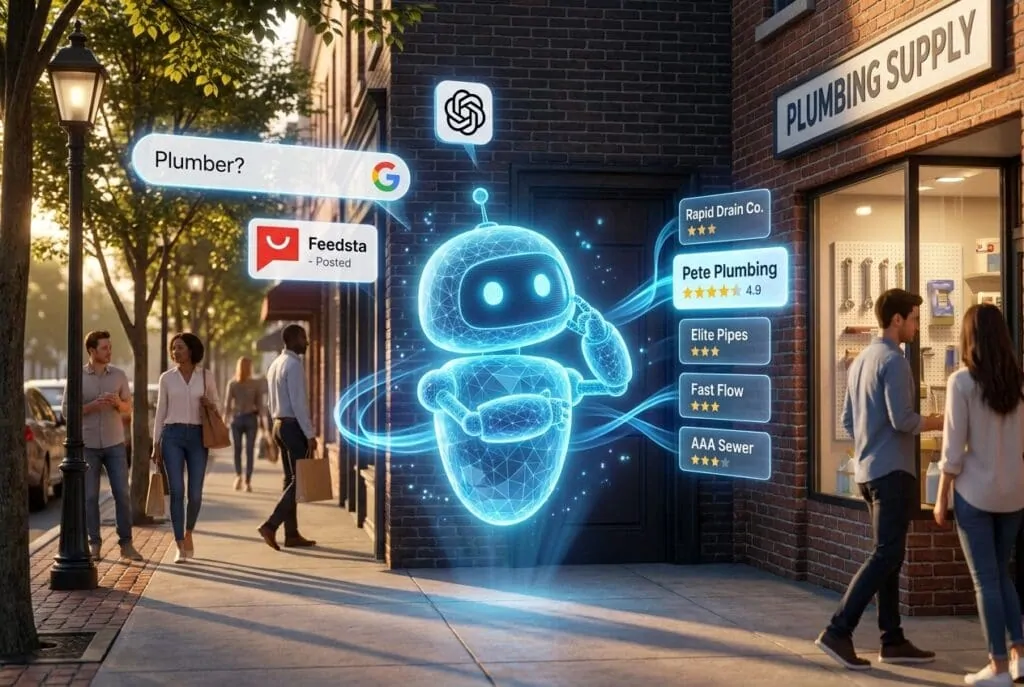
When a homeowner in Massapequa asks Google’s AI Mode for “a plumber who does weekend emergency repairs and takes credit cards,” the businesses that appear aren’t the ones with the most backlinks. They’re the ones that make it easy for AI to understand what they do, where they serve, and why a neighbor would trust them. AI search-whether it’s ChatGPT, Gemini, or Google’s AI Overviews-is already sending local leads to businesses on Long Island. The question isn’t whether you’ll show up; it’s whether the AI can read your business clearly enough to recommend you.
Why It Matters
AI-powered search isn’t a niche lab experiment anymore. Google AI Overviews now appear in billions of queries each month, and zero-click searches-where the user never visits a website-have surged to 68% of all Google searches in the U.S., according to SparkToro’s 2026 study. The same report found that AI platforms are now the destination for nearly one in five local service lookups. For a Long Island owner, that means a homeowner who used to scroll through a map pack is now reading a single AI-generated answer that names three “best” businesses. If your business isn’t among them, you’re invisible.
Getting recommended by AI isn’t about chasing an algorithm. It’s about being the obvious answer. AI systems pull from what they can understand: your Google Business Profile description, the clarity of your service pages, the depth of your reviews, and how consistently your business is mentioned across the web. When those ingredients are weak, AI defaults to competitors who’ve done the work.
How AI Finds a Local Business-and How You Make It Easy
Think of AI like a newcomer to Long Island who can read every document about your business in seconds. It scans your website, your GBP listing, your reviews, and mentions of your name on other sites. Then it builds a mental model: What do they do? Where exactly do they serve? How do customers feel about them? What’s the price range? That model decides whether you get recommended.
Ten ways to become more legible to AI so machines can trust and recommend you.
- Explain your services in plain language, not keyword soup. A page that says “HVAC installation, repair, and maintenance in Huntington, Dix Hills, and Commack” is immediately useful. One that stuffs “Long Island heating and cooling experts near me” without specifics reads like noise. AI rewards clarity over density.
- Answer the five Ws on your website. Who you are, what you do, where you serve, when you’re available, and why a customer should choose you. This isn’t copywriting fluff-it’s the structured information AI extracts to match you to a “plumber open tomorrow near Port Jefferson” query.
- State your pricing, payment methods, and availability. AI can compare costs when you’re transparent. A landscaping company that writes “starting at $45 per visit; accepts cash, check, and Venmo; 24-hour storm response” gives the assistant hard facts to work with. Leaving these out leaves you out of the comparison.
- Make your Google Business Profile a full introduction, not a stub. Every field matters. Write a description that leads with your value proposition in the first 80 characters. Fill out each service category and add service descriptions. Post updates that reinforce what you do, ideally videos under 30 seconds that AI can parse via captions.
- Solicit detailed reviews that name the service and problem solved. “Five stars” is fine; “The team replaced my septic pump on a Sunday morning after I called at 6 a.m., and they took my HSA card.” is a signal machine. AI models prize specificity because it matches real-world intent.
- Diversify reviews across platforms. BrightLocal’s 2025 Consumer Review Survey found that 98% of consumers read reviews for local businesses. AI pays attention to volume and freshness across Google, Yelp, BBB, and industry-specific directories. A strong Google review profile alone isn’t enough when generative engines cross-reference multiple sources.
- Get mentioned where AI already looks. Search your main keywords in ChatGPT or Perplexity. Note which articles, directories, or news pieces the AI cites. Then earn mentions in those same outlets-local news websites, Chamber of Commerce pages, industry blog posts, or community podcasts.
- Build a presence across blogs, podcasts, YouTube, and Reddit. AI pulls from conversational platforms. A plumber who answers questions on a local Reddit thread becomes part of the knowledge base. A podcast interview where you explain “what it really costs to rewire a 1920s house in Garden City” creates a semantic footprint that outlasts any single Google update.
- Structure content with semantic triples. These are simple subject-predicate-object statements: “Our company serves Suffolk County” / “Emergency HVAC repair costs start at $150” / “We are licensed in Nassau and Suffolk.” AI giants like Google and OpenAI extract such triples from your pages. Writing them out deliberately shortens the path from query to recommendation.
- Keep your social profiles active and consistent. AI agents check for recent activity. A dormant Facebook page with an outdated phone number creates a trust gap. Tools like Feedsta can maintain a steady cadence of accurate posts so your business always looks alive and AI-ready.
The Numbers That Prove This Isn't Optional
- 68% of Google searches in the U.S. end without a click (SparkToro, 2026). AI-generated answers are increasingly the final destination.
- 97% of consumers use the internet to find local businesses, and 43% now use AI chatbots as a search tool, according to SOCi’s 2024 Localized Marketing Benchmark Report.
- 98% of consumers read online reviews for local businesses, per BrightLocal’s 2025 Local Consumer Review Survey. Detailed reviews are the strongest trust signal for both humans and AI.
- Google AI Overviews appear in more than one billion queries per month (Google Keyword Blog, 2024), and that number is climbing fast.
- Business profiles with complete service descriptions see a 39% higher engagement rate in Google Maps, according to internal Google Business Profile data shared in 2025.
Your business’s AI readiness is determined by how clearly it answers the five Ws-who you are, what you do, where you serve, when you’re available, and why customers choose you.
“Online reviews remain the most influential factor for consumers choosing a local business. When AI systems evaluate trust, they look at review volume, recency, and the detail in what customers say.”
What Comes Next
AI search will only deepen. Google’s agentic AI already books appointments and completes tasks directly from search results, as we covered in our Agentic AI in Local Search analysis. The next phase is AI agents that repeatedly compare providers over time, building persistent preferences. Businesses that lay the data foundation now-explicit service details, current reviews, consistent citations-will be the defaults when that shift happens. Expect AI search engines to place even more weight on real-time availability signals, pricing transparency, and social proof from platforms like Reddit and YouTube.
What This Means for Your Long Island Business
This isn’t about hiring an AI whisperer. It’s about doing the basics exceptionally well so that machines can read you as easily as a neighbor would. Start by auditing your Google Business Profile: if you haven’t updated the description and service list since 2023, you’re invisible to the current generation of AI. Our local SEO services handle this from citations to GBP optimization, so you don’t have to guess.
Next, look at your website. Each service page should answer who, what, where, when, and why in plain paragraphs. Not hidden in meta tags-right in the visible copy that AI crawls. If your copy was written before AI search became mainstream, a content refresh can close the gap without a full redesign.
Finally, measure your AI visibility. Run a free BizScoreAI scan to see your AI Visibility Score across ChatGPT, Gemini, and Perplexity. It’ll show exactly where you’re being recommended and where competitors are outranking you. For a complete picture, also review our breakdown of the 68% zero-click surge-it explains why traditional traffic metrics are becoming less reliable and what to track instead.
AI is already choosing which Long Island businesses to recommend.
The Bigger Picture
Local search is shifting from a directory model-where you earned rankings-to a recommendation model, where you earn trust through clarity and consistency. The mechanics are different, but the core truth hasn’t changed: the business that explains itself best wins. On Long Island, with tight competition in towns from Huntington to Southampton, that clarity is your chief advantage. Give the AI the facts, and it will give you the leads.
Frequently Asked Questions
How do AI search engines decide which local businesses to recommend?
What exactly should my website include to be AI-readable?
How important are reviews for AI search visibility?
Do I need to be on Reddit or YouTube to appear in AI search results?
What can I do with my Google Business Profile right now to improve AI visibility?
How can I check if my business is already visible to AI search tools?
Will optimizing for AI search replace my traditional local SEO efforts?
Want help with this in Myrtle Beach or Long Island? Talk to us.
NewSunSEO
Grow in Google and AI Search
AI-SEO, local search, paid ads and websites from one team, with offices on Long Island and in Myrtle Beach.
- AI-SEO
- Local AI-SEO
- AI Consulting
- PPC
- Web Design
- Web Development
- Long Island Office(631) 320-1700
- Myrtle Beach Office(843) 492-7131
Request a Free Proposal
Tell us about your business and where you want to grow.
We will reply by email to talk through your goals and what a proposal would include.
We use your details only to reply to you and send what you asked for. See our Privacy Policy.

