


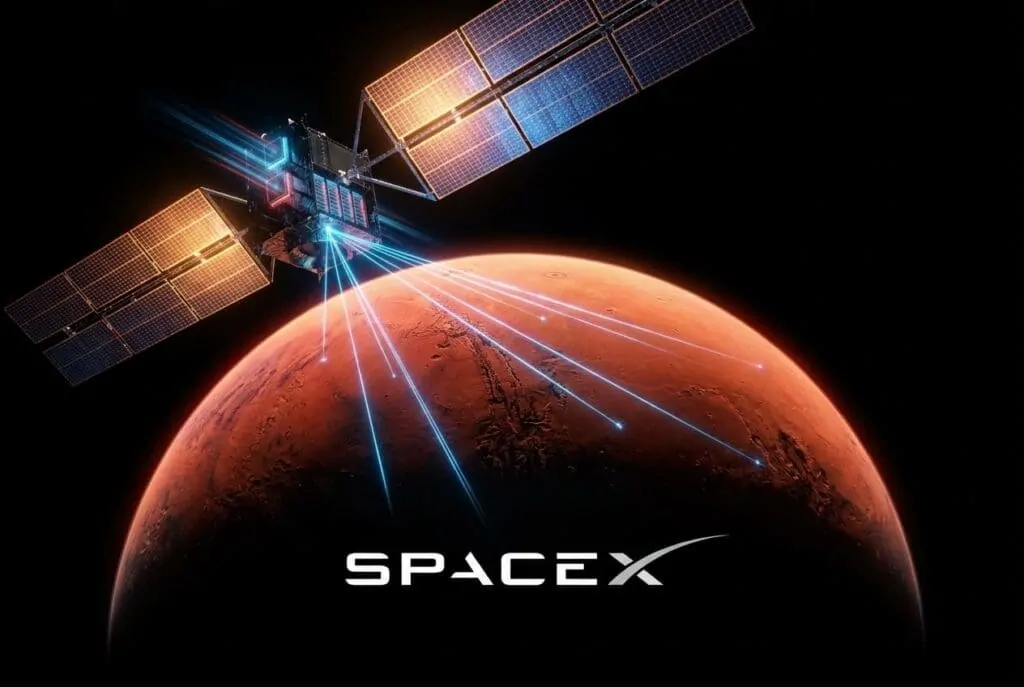
SpaceX is building a solar-powered AI datacenter in orbit, and it already has two of the world’s largest AI companies as customers. The AI1 satellite network, each unit packing the compute of a full Nvidia server rack, will serve Google and Anthropic. The first satellites are expected to launch ahead of SpaceX’s planned IPO. For Long Island business owners, the news isn’t just a spectacle-it’s a signal that where AI models run is about to change, and with it, how AI-powered search engines find and rank your business.
Why It Matters
AI search is no longer a future concern. A 2025 SparkToro study found that 65% of Google searches now end without a click-users get answers directly from AI snapshots or featured boxes. When someone asks ChatGPT or Gemini for “best plumber near me in Suffolk County,” the model’s answer depends on its training data and its real-time search capability, both of which rely on massive data center compute.
Today, that compute happens in ground-based server farms owned by Google, Microsoft, or Amazon. A 2024 BrightLocal survey showed 93% of consumers use the internet to find a local business-most through search or AI-powered assistants. Moving the compute to low Earth orbit (LEO) could reshape latency, data sovereignty, and the economics of AI inference-factors that directly influence how quickly and accurately a local business appears in an AI-generated answer.
What’s New / How It Works
SpaceX’s AI1 constellation puts the hardware in space, powered by solar energy, and beams the results down to Earth. Each satellite is designed to carry a compute payload equivalent to an Nvidia H100 server rack-the kind that drives today’s most advanced large language models. By positioning the satellites in LEO at roughly 340 km, SpaceX aims to deliver round-trip latency of 25-50 milliseconds, comparable to, or better than, many terrestrial connections, according to Starlink’s technology specs.
The satellites will handle both AI inference (generating answers) and, eventually, full training runs. Google and Anthropic have already signed on as launch customers, planning to use AI1 capacity for their cloud and consumer AI products. SpaceX has begun hardware testing and expects the first operational units in orbit by 2027. This isn’t a speculative concept; it’s the next layer of an infrastructure company that already delivers high-speed internet from space.
The Numbers
- Nvidia H100 server rack performance: up to 32 petaflops of AI compute per satellite, per Nvidia’s official specifications.
- Orbital latency: 25-50 ms round-trip, matching or beating cable broadband, based on Starlink’s LEO architecture.
- Zero-click searches: 65% of Google searches ended without a click in 2025, up from 50% in 2019 (SparkToro).
- Local search dependency: 93% of consumers look online for a local business (BrightLocal 2024).
- Customer roster: Google and Anthropic already signed on as initial AI1 tenants.
When AI inference moves to orbit, local visibility changes for every business.
“Each AI1 satellite will carry the compute of a full Nvidia server rack-the kind that powers today’s largest AI models.” - SpaceX AI1 announcement, April 2026.
What Comes Next
SpaceX aims to launch the first batch of AI1 satellites in 2027, with commercial services starting shortly after. The initial customer list-Google and Anthropic-suggests that everyday AI tools like Gemini and Claude could soon be running partially from space. Regulatory approvals for space-based compute are still evolving, but the company’s track record with Starlink makes rapid deployment plausible.
The AI1 project is a cornerstone of SpaceX’s pre-IPO narrative, positioning the company not just as a launch provider but as a space-based infrastructure company for AI. Competitors may follow, but SpaceX’s head start in reusable rockets and LEO constellation management gives it a significant advantage. Meanwhile, the AI models that answer local queries will grow even more reliant on fresh, well-structured business data.
What This Means for You
For a Long Island business owner, this shift is a nudge to double down on AI search readiness. If large language models run on ultra-low-latency orbital networks, the platforms that answer “near me” queries will become faster and more responsive-but also more dependent on structured, consistent business data. That’s where local SEO becomes non-negotiable.
Your Google Business Profile, your website’s schema markup, and your online reviews form the data diet for AI models. We explore that reality in our guides to zero-click search trends and what a more powerful AI model means for your visibility. To get ahead, make sure your local citations are accurate across the web-our local SEO services can help-and that your website content is structured for AI comprehension with SEO copywriting that speaks to machines.
Keep your social profiles active and consistent across platforms with Feedsta, an AI social media manager that ensures your messaging stays uniform wherever customers look. Run a free BizScoreAI visibility scan to check your AI Visibility Score across ChatGPT, Gemini, and Perplexity-it tells you whether AI search engines already recommend your business. As AI compute literally moves into space, the businesses that get their ground-level data house in order will be the ones that stay visible when a customer speaks their next query.
The Bigger Picture
SpaceX’s orbital AI datacenter could change how AI models scale and respond. Paying attention now to AI-friendly content and local listings isn’t an SEO tactic for tomorrow; it’s infrastructure for the next decade of search.
Frequently Asked Questions
What exactly is the SpaceX AI1 satellite?
How does an orbital AI datacenter affect Google search?
Will my Long Island business appear differently in AI results if the model runs in space?
Who are the first customers of AI1?
When will AI1 be operational?
Does this news change local SEO strategies?
How can I check if my business is visible in AI search today?
Sources
- SpaceX AI1 announcement
- Nvidia H100 data center specs
- Starlink technology - LEO latency
- SparkToro 2025 zero-click search update
- BrightLocal local consumer review survey 2024
Want help with this in Myrtle Beach or Long Island? Talk to us.
NewSunSEO
Grow in Google and AI Search
AI-SEO, local search, paid ads and websites from one team, with offices on Long Island and in Myrtle Beach.
- AI-SEO
- Local AI-SEO
- AI Consulting
- PPC
- Web Design
- Web Development
- Long Island Office(631) 320-1700
- Myrtle Beach Office(843) 492-7131
Request a Free Proposal
Tell us about your business and where you want to grow.
We will reply by email to talk through your goals and what a proposal would include.
We use your details only to reply to you and send what you asked for. See our Privacy Policy.

