



Scaling programmatic SEO starts with proving it works on a small set of pages first, then expanding only after traffic, rankings, and engagement confirm the pattern. A programmatic template that ranks for ten queries can often be replicated across hundreds or thousands of intent-matched variations, and the cost of getting it wrong is wasted crawl budget, thin pages, and manual cleanup at scale.
The discipline is to treat the first batch as a controlled experiment: a defined template, a defined data source, a defined query intent, and a small enough slice to inspect every URL by hand. Only when that slice earns its keep does it make sense to multiply it.
What programmatic SEO actually is
Programmatic SEO is the practice of using a template plus a structured dataset to generate many landing pages, each targeting a distinct search query that shares the same intent shape. The classic examples are [service] + [city] combinations, + [spec] comparisons, and [company] + [statistic] pages, where the variable slot changes but the underlying question is the same.
It is not spinning, doorway pages, or scraping competitor copy. A programmatic page has a real data point in the variable slot, a unique title and meta description, and content beyond the template itself. Search engines have said repeatedly that the differentiator is whether the generated page adds value a human would not get from any single existing page.
Why scaling too early is the common failure
The most common failure mode is launching ten thousand pages at once and waiting for traffic to arrive. Two things tend to happen. First, the pages compete with each other because the template produces near-duplicates when the data is too similar. Second, the pages get indexed slowly because crawl budget is finite, and the long tail of low-quality URLs crowds out the few that could have ranked.
A smaller, validated slice avoids both problems. You can see cannibalization on a set of fifty pages. You can read every page and confirm the data is actually distinct. You can measure which query shapes the template satisfies and which it does not. Scaling without those answers means scaling blind.
How to prove the pattern on a small slice
A controlled test starts with a single template and a single dataset, scoped to a query intent you can verify by hand. Pick the variable slot, pick the intent, and pick a sample size small enough to audit every output.
1. Define the template and the intent
Write the exact page structure: the heading, the sections, the schema, the internal links, the title tag pattern, the meta description pattern. Write the search intent the page satisfies in one sentence, and list the queries a successful page would rank for. If you cannot write the intent in one sentence, the template is doing too much.
2. Build a sample of 20 to 50 URLs
Generate a small batch from the template and inspect every page. Read each one. Confirm the data populates correctly, the page reads naturally, and the variable slot actually changes the page in a way a searcher cares about. If two pages read like the same page with a word swapped, the dataset is too uniform and the template needs more differentiation.
3. Submit the sample and watch Search Console
Submit the sample URLs through Search Console, request indexing, and watch which queries each page gets impressions for. The right pages will start to appear for long-tail variations of the intent. The wrong pages will sit unindexed or appear for queries the template was never meant to satisfy.
4. Measure ranking, traffic, and engagement
Track ranking position for the target query shapes, organic sessions to each URL, and engagement signals like time on page and scroll depth. A page that ranks but bounces immediately is a sign that the template satisfies the query shape but the content does not satisfy the searcher. A page that ranks and engages is the unit to multiply.
5. Decide to scale, fix, or kill
If the sample earns rankings and engagement, scale the template to the full dataset. If it ranks but does not engage, fix the content layer before scaling. If it does not rank, the intent is wrong or the template is too thin, and scaling will multiply the failure.
What to check before you multiply the template
- Unique data in every variable slot, not just a name swap.
- Distinct titles and meta descriptions that reflect the specific data point.
- Internal links that point to related pages within the programmatic set, not just back to the homepage.
- Schema markup that matches the page type and the data on the page.
- Crawl budget headroom: confirm the sample did not crowd existing important URLs.
How this fits into broader SEO work
Programmatic SEO is one tool inside a larger organic program, not a replacement for it. A site that already has technical SEO, internal linking, and topical authority in place will get more out of a programmatic set than a site that does not. NewSunSEO has been working on SEO in one form or another since 2001, and the projects where programmatic SEO pays off are the ones where the rest of the site is already sound. Where the foundation is weak, the same template tends to expose the weakness at scale instead of fixing it.
For teams running their own audits, a technical audit that measures crawl, indexation, and on-page signals across the whole site gives a baseline before a programmatic launch. A rank tracker that checks positions frequently is useful here because programmatic pages move in clusters, and a slow rank check misses the movement pattern. SEOScanPRO runs a full technical audit and includes a rank tracker that can check positions as often as every five minutes, which fits the way programmatic sets behave.
FAQ
How many pages should I launch first for programmatic SEO?
A sample of 20 to 50 URLs is enough to inspect every page by hand, measure rankings and engagement, and confirm the template produces distinct content before scaling to hundreds or thousands.
What is the difference between programmatic SEO and doorway pages?
Programmatic SEO uses a template plus real, unique data to generate pages that each satisfy a specific intent. Doorway pages funnel searchers to a single destination without adding information. The differentiator is whether the generated page adds value a human would not get elsewhere.
Why do programmatic pages fail to rank?
The most common reasons are a template that produces near-duplicate content, a dataset where the variable changes are too uniform to matter, and a crawl budget that gets spent before the new URLs get indexed. Validating on a small slice first surfaces each of these before they multiply.
Related coverage
- 7 SEO Myths Small Businesses Still Believe in 2026 (And What Actually Works)
- How Changing Your URL Affects SEO: What to Check Before Restructuring Your Site
- SEO Trends 2026: What’s Actually Changed (And What Still Works)
SEOScanPRO
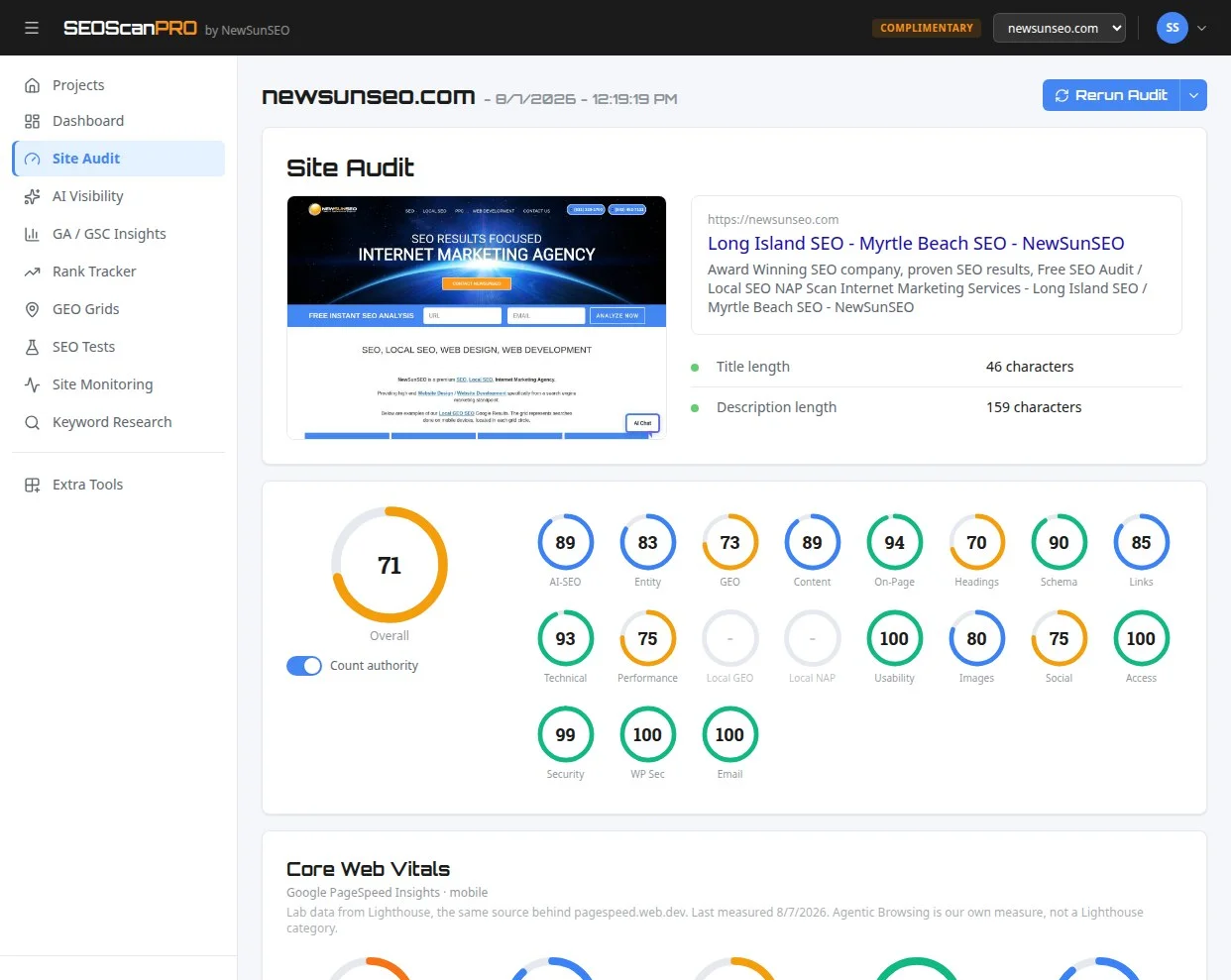
The SEOScanPRO site audit tool runs a full technical audit of a site and shows the measured result behind every check. Open the site audit tool.
Want help with this in Myrtle Beach or Long Island? Talk to us.
NewSunSEO
Grow in Google and AI Search
AI-SEO, local search, paid ads and websites from one team, with offices on Long Island and in Myrtle Beach.
- AI-SEO
- Local AI-SEO
- AI Consulting
- PPC
- Web Design
- Web Development
- Long Island Office(631) 320-1700
- Myrtle Beach Office(843) 492-7131
Request a Free Proposal
Tell us about your business and where you want to grow.
We will reply by email to talk through your goals and what a proposal would include.
We use your details only to reply to you and send what you asked for. See our Privacy Policy.

