


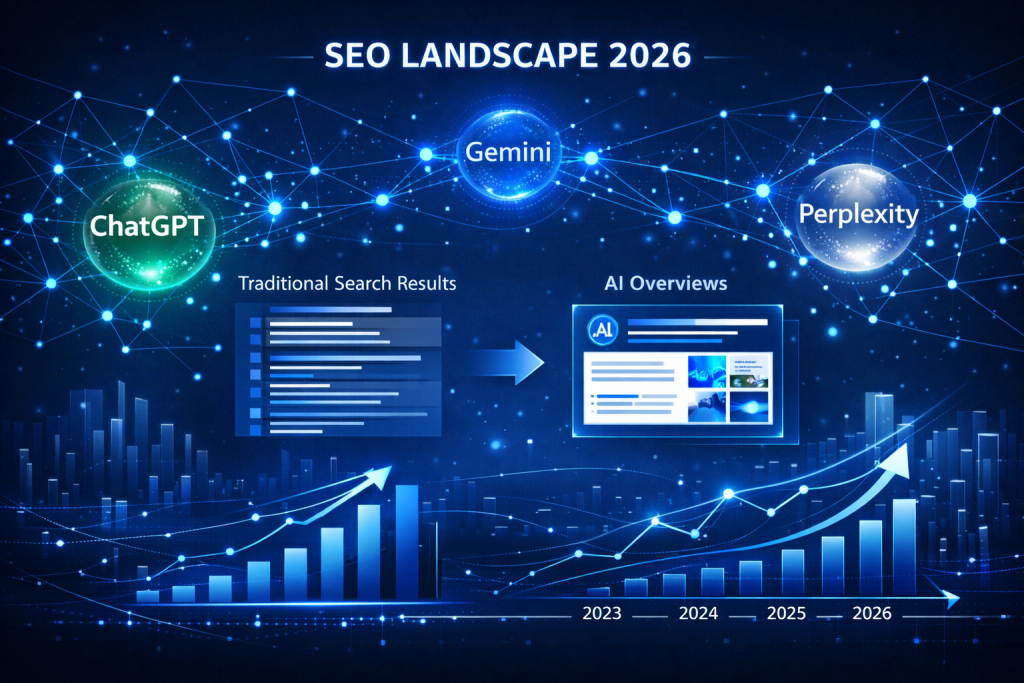
AI Overviews are now widespread in Google, and various industry reports describe the March 2026 Core Update as penalizing thin content, with zero-click searches reportedly accounting for roughly 60% of all Google queries. For businesses and the marketing teams that support them, the question is whether to adapt before competitors do.
What changed in 2026, what the data shows, and what to do about it.
The Biggest Shift: From Rankings to Citations
For about 20 years, SEO success meant ranking in the top 3 organic positions. The work was about getting your page to appear in a list. That model still exists, but it is being layered over with a new game that operates differently.
The new game is about being cited. AI Overviews, ChatGPT search, Perplexity, and Gemini answers synthesize content and attribute it to sources, rather than simply linking to pages. Getting cited in one of these AI answers is more valuable than ranking #4 in traditional results, because AI citations carry the AI platform’s credibility and because they appear before traditional results for a large share of queries.
AI referral traffic may have increased 357% year-over-year as of mid-2025, and the trend has continued into 2026. This is still a small absolute number compared to traditional search, but the trajectory is clear. Businesses that optimize for AI citation now are building a moat that traditional-only competitors will not have later.
The signals that earn AI citations are different from the signals that earn traditional rankings. Content quality and expertise matter more. Structured data (schema markup) matters more. Entity consistency, the practice of your business information appearing consistently across many sources, matters more. Keyword density and exact-match anchor text matter less.
AI Overviews Have Eaten Featured Snippets
Featured snippets, the boxed excerpts that used to appear at the top of results for question-based searches, have been almost entirely replaced by AI Overviews. If you spent years optimizing for featured snippets, that strategy now feeds into a different outcome.
AI Overviews may appear in roughly 4.5% to 12.5% of all Google searches, depending on the query type. For informational and local queries, the rate is considerably higher.
This creates a fork in strategy. For purely informational queries (such as “what does E-E-A-T mean”), the goal is to get cited in the AI Overview, not to rank below it. For commercial queries (such as “Long Island SEO agency”), traditional local ranking still drives conversions because users looking to hire someone click through to evaluate options. The strategy should match the query intent.
Generative Engine Optimization (GEO), the practice of structuring content specifically to earn AI citations, has moved from experimental to essential for businesses that publish informational content. The principles: clear source attribution, expertise signals in the content itself, structured headers that answer specific questions, and fast-loading pages that AI crawlers can access cleanly.
E-E-A-T Has Teeth Now
Google’s E-E-A-T framework (Experience, Expertise, Authoritativeness, Trustworthiness) has been around since 2018. But the March 2026 Core Update applied it more aggressively than any previous update. Thin content is being demoted. Content from credentialed, verifiable sources is gaining ground.
“Experience” is the newest addition to the acronym and the hardest to fake. It means first-hand involvement: a plumber writing about plumbing from years on job sites, not a writer summarizing what plumbers do. Google is increasingly able to distinguish between content written from genuine experience and content assembled from other sources. The former ranks. The latter does not.
Practically, this means author bios matter. If you publish content on your website, name the author, link to their credentials, and make their expertise verifiable. It means case studies and client outcomes matter more than generic service descriptions. A page that says “we fixed a persistent drain issue for a Huntington homeowner, reducing their repeat service calls by eliminating the root cause” is doing more E-E-A-T work than a page that says “we offer drain cleaning services.”
For professional service firms (legal, healthcare, financial), the bar is higher. The March 2026 update specifically tightened scrutiny on YMYL (Your Money or Your Life) content. Generic advice pages are losing ground to pages with verifiable author credentials, cited sources, and content that reflects actual professional knowledge rather than research-assembled summaries.
Core Web Vitals Got More Demanding in 2026
Core Web Vitals, Google’s measurable page experience signals, have evolved in two ways since 2023.
First, INP (Interaction to Next Paint) fully replaced FID (First Input Delay) as the responsiveness metric. INP measures how quickly your page responds when a user does something (clicks a button, opens a dropdown, submits a form) throughout the entire visit, not just at initial load. Pages with sluggish JavaScript or heavy third-party scripts that degrade the experience mid-session are now penalized in ways FID did not capture.
Second, performance thresholds are now being treated as filters rather than tiebreakers. In previous years, a page with excellent content but mediocre CWV scores could still rank well. The signal is clear from 2026 ranking data: red CWV scores consistently suppress pages, even when the content quality is strong. The targets: LCP (Largest Contentful Paint) under 2.5 seconds, INP under 200ms, CLS (Cumulative Layout Shift) under 0.1.
For business websites, the most common culprits are unoptimized images (the single biggest load-time factor), heavy page builders, and too many third-party tracking scripts. Running PageSpeed Insights on your primary service pages and treating anything below 70 on mobile as an active ranking problem is the right benchmark.
What Still Works (Nothing Changed Overnight)
The conversation around AI in SEO sometimes suggests that all pre-existing strategies are now obsolete. Everything that worked before is not irrelevant now. Existing ranking factors and on-page practices still influence how pages rank in search results.
Content with genuine expertise still ranks well. Content that demonstrates genuine expertise and answers real questions performs as well as it ever has, possibly better, because thin content is losing ground.
Backlinks still signal authority. Links from relevant, credible sources in your industry and geographic area still move rankings. Link acquisition has not been replaced; it is just less forgiving of low-quality link building than it used to be.
Local optimization still drives local business. Google Business Profile, review velocity, local citations, and location-specific content are as important as they have ever been for service businesses. The additions (AI eligibility, GEO signals) build on this foundation, not around it.
Technical SEO still creates the conditions for everything else to work. Clean crawlability, proper indexation, fast pages, and correct canonical tags have not become less important since AI Overviews arrived. If the foundation is broken, neither traditional nor AI visibility will perform.
The shift in 2026 is not abandoning what works. It is layering AI-awareness on top of a well-maintained SEO foundation. Businesses with strong traditional SEO that start working on GEO and E-E-A-T signals are well-positioned to compound gains. Businesses with neither are falling behind on two fronts simultaneously.
If you want a review of your current online presence and advice on what to do next for your specific market, get in touch here.
Wondering if your own business shows up in ChatGPT, Gemini, or Perplexity? Run a BizScoreAI scan to check your AI Visibility Score and get a prioritized list of fixes.
Keep your social presence active across platforms with Feedsta, described as an AI social media manager that can create, schedule, and analyze your posts, so your brand stays visible where customers research your business.
FAQ
What is the biggest SEO trend in 2026?
The biggest shift is from chasing rankings to earning AI citations. AI Overviews, ChatGPT search, Perplexity, and Gemini synthesize answers and attribute them to sources, making citation in those answers more valuable than ranking #4 in traditional results.
How much do AI Overviews reduce organic click-through rates?
When AI Overviews appear, fewer searchers click the organic results below them. Only 8% of users may click results below an AI Overview, compared to 15% for the same queries without one.
Do traditional SEO fundamentals still matter in 2026?
Yes. Quality content, backlinks from credible sources, local optimization (Google Business Profile, reviews, local citations), and technical SEO fundamentals remain as important as ever. GEO and E-E-A-T signals are layered on top of that foundation rather than replacing it.
Want help with this in Myrtle Beach or Long Island? Talk to us.
NewSunSEO
Grow in Google and AI Search
AI-SEO, local search, paid ads and websites from one team, with offices on Long Island and in Myrtle Beach.
- AI-SEO
- Local AI-SEO
- AI Consulting
- PPC
- Web Design
- Web Development
- Long Island Office(631) 320-1700
- Myrtle Beach Office(843) 492-7131
Request a Free Proposal
Tell us about your business and where you want to grow.
We will reply by email to talk through your goals and what a proposal would include.
We use your details only to reply to you and send what you asked for. See our Privacy Policy.

