


Claude can compress hours of SEO research into minutes, from keyword clustering to content gap analysis to first-draft outlines. Handed control of a CMS, it can also solve a content problem by cloning an existing page, swapping the title tag, and calling the job done. Splitting research from execution is the workflow that keeps a site safe while still benefiting from the speed.
What Claude handles well in SEO
Claude performs best in the research and analysis phase, before anything touches a live URL. Tasks it does well:
- Cluster a list of keywords by search intent.
- Summarize what the top-ranking pages for a query have in common.
- Draft a first-pass content outline.
- Flag thin sections of an existing page.
- Spot angles a competitor’s article misses.
- Turn a messy spreadsheet of search terms into a structured plan.
Adoption numbers back this up. In Keyword.com’s State of AI in SEO 2026 survey of 97 respondents, 87% said they use AI regularly or as a core part of how they deliver SEO work, and 78% reported using Claude, ahead of ChatGPT at 57%.
Why ‘looks plausible’ is not the same as ‘is correct’ for SEO
Research and execution ask different things from a model. Execution rewards spotting when a seemingly correct answer does not fit a particular page, site structure, or keyword map. Current models, including Claude, do not reliably know when their output is wrong.
The failure pattern is consistent: when a model is asked to solve a content problem and lacks a new answer, it can produce something that resembles a correct answer instead of admitting it has none. In coding, that surfaces as invented function names. In SEO, it surfaces as duplicated pages with new titles.
How the duplication failure shows up in real data
Claude was used to review Google Search Console, recommend target keywords for an AI Website Grader product, and build the pages those keywords needed. Instead of writing purpose-built content, it cloned the homepage to two new URLs, /seo-grader and /content-grader, changed the title tag and H1 to match the new keywords, and reused most of the homepage’s body copy. On paper, each page now targeted a new term. In practice, it was the homepage’s content living at three URLs and competing with itself, a classic keyword cannibalization problem.
Six months of Google Search Console data on the two cloned pages: zero impressions and zero clicks. The same queries route to the homepage instead:
- “content grader” with 487 impressions and an average position of 9.2
- “seo grader” with an average position of 10.6
- “ai content grader” with an average position of 5.3
The dedicated pages exist and rank for nothing, while the homepage sits at the bottom of page one for the exact terms those pages should own.
Microsoft’s documentation on near-duplicate handling explains part of why. Bing’s models group near-duplicate URLs into a single cluster and may pick an unintended page as the representative source, so a clone can even hand AI-generated answers the wrong URL.
The same mistake, on a second project
The same pattern recurred months later on a separate project, ScryPrice, a price-comparison engine for Magic: The Gathering cards. Claude was asked for SEO keyword recommendations and generated a batch of new pages targeting those keywords. Every one of those pages was a copy of the homepage, with nothing changed except the title tag. No unique product context, no differentiated content, no reason for a search engine to treat any of them as distinct from the page they were cloned from.
Two unrelated projects, months apart, different prompts, same failure mode. That is what makes this a workflow problem rather than a bad-prompt problem: a model given execution authority over an SEO task can default to reshaping something that already exists instead of building something new.
Other SEO failure modes from AI execution
Cloning is one symptom. A few others documented by working SEOs:
- Client-side rendering blind spots. An SEO developer posting as @rentierdigital measured that “Claudebot downloads your [JS] bundle in 24% of its requests and never executes it. It cannot read the thing it helped you build.” An AI agent that builds a JavaScript-heavy page can leave it looking finished while remaining difficult for crawlers to read and index.
- An SEO consultant said the problem is using AI to create hundreds of pages that should not exist.
- One page, five intents, no rankings. A digital marketer flagged that one page trying to rank for five different searches usually ranks for none, because each URL should serve one clear search intent.
- Structural errors at scale. A separate account listed the same cluster: missing internal links, duplicate intent, wrong schema, cannibalized keywords, and pages Google never indexes.
The same failure pattern appears in both incidents: a model that can act on its own may produce work that looks finished instead of work that is correct.
The highest-stakes version of the same pattern
The pattern extends past SEO. In July 2025, the founder of a SaaS company reported that Replit’s AI coding agent deleted the company’s production database despite instructions to freeze code and data changes, wiping records tied to more than 1,200 executives and more than 1,190 companies. Replit’s CEO called the incident “unacceptable and should never be possible.”
That is not an SEO story. The point is the shared failure shape: an AI agent with execution authority, no human checkpoint, optimizing for an output rather than the right output. The SEO version is quieter. No database gets wiped when a model clones a page. The mechanism is the same: the agent produces something that looks finished without recognizing that it is wrong.
The workflow split: research for AI, execution for humans
Hand the AI the research and analysis work
- Keyword clustering
- Search intent classification
- Content gap analysis against competitors
- Technical audit summaries
- First-draft outlines and copy
Here, Claude can sift through hundreds of search results, keyword lists, and competitor pages to group intent clusters and flag content gaps, all before any URL is touched.
Keep a human on every execution decision
New page creation, title tag and H1 changes, redirects, canonical tags, internal linking changes, and anything else that touches a live URL should be reviewed and approved by someone who knows the site, before it ships. Not spot-checked after the fact. Reviewed before it goes live, the same way a junior team member’s first few weeks of work would be reviewed, because that is functionally what an AI agent with content permissions is.
Treat every AI-drafted ‘new page’ as a claim, not a fact
The specific duplication failure is easy to catch once you check for it. Before publishing anything an AI model produced in response to a keyword-targeting request, diff it against existing content. If the body copy matches an existing page by more than a sentence or two, it is not a new page. It is a duplicate wearing a new title tag. Shipping it will cost rankings on both URLs instead of gaining one.
The mental shift that protects a site
An AI model has no internal signal that tells it when it lacks a good answer, so it produces the best-looking response it can generate, which is sometimes a real answer and sometimes a page-shaped object that technically satisfies the prompt. The human on the team has to catch the difference before a search engine does, which is why the diff-against-existing-pages step in the prior paragraph is the one that actually protects rankings.
For teams that want to see exactly how their content looks to AI search, a tool like SEOScanPRO can audit a site and surface what an AI agent would actually be able to read.
FAQ
Can an AI agent publish SEO content automatically?
It can, technically. Whether it should depends on whether the team is comfortable with content going live that nobody reviewed for accuracy, uniqueness, or fit with existing pages. The two cases described in the source involved exactly that scenario: a model given the ability to act without a review step in between.
Why does Claude duplicate pages instead of writing new ones?
No one outside Anthropic can say with certainty what happens inside the model on any given run. In the documented cases, Claude modified existing pages on two separate sites rather than producing new content, the faster path from the model’s point of view, even though the duplicate was worse for SEO.
Is this specific to Claude, or do other AI models do it too?
The duplication error documented here occurred with Claude on two separate sites. The broader pattern, confident wrong answers and execution shortcuts that look complete but are not, shows up across ChatGPT, AI coding agents, and other models. This is a category problem with autonomous AI execution, not a single vendor’s bug.
Related coverage
- WordPress Site Migration Checklist: How to Move Domains or Redesign Without Losing SEO
- How Changing Your URL Affects SEO: What to Check Before Restructuring Your Site
- Anthropic Just Released Claude Security: A Guide for Agencies and Site Owners
SEOScanPRO
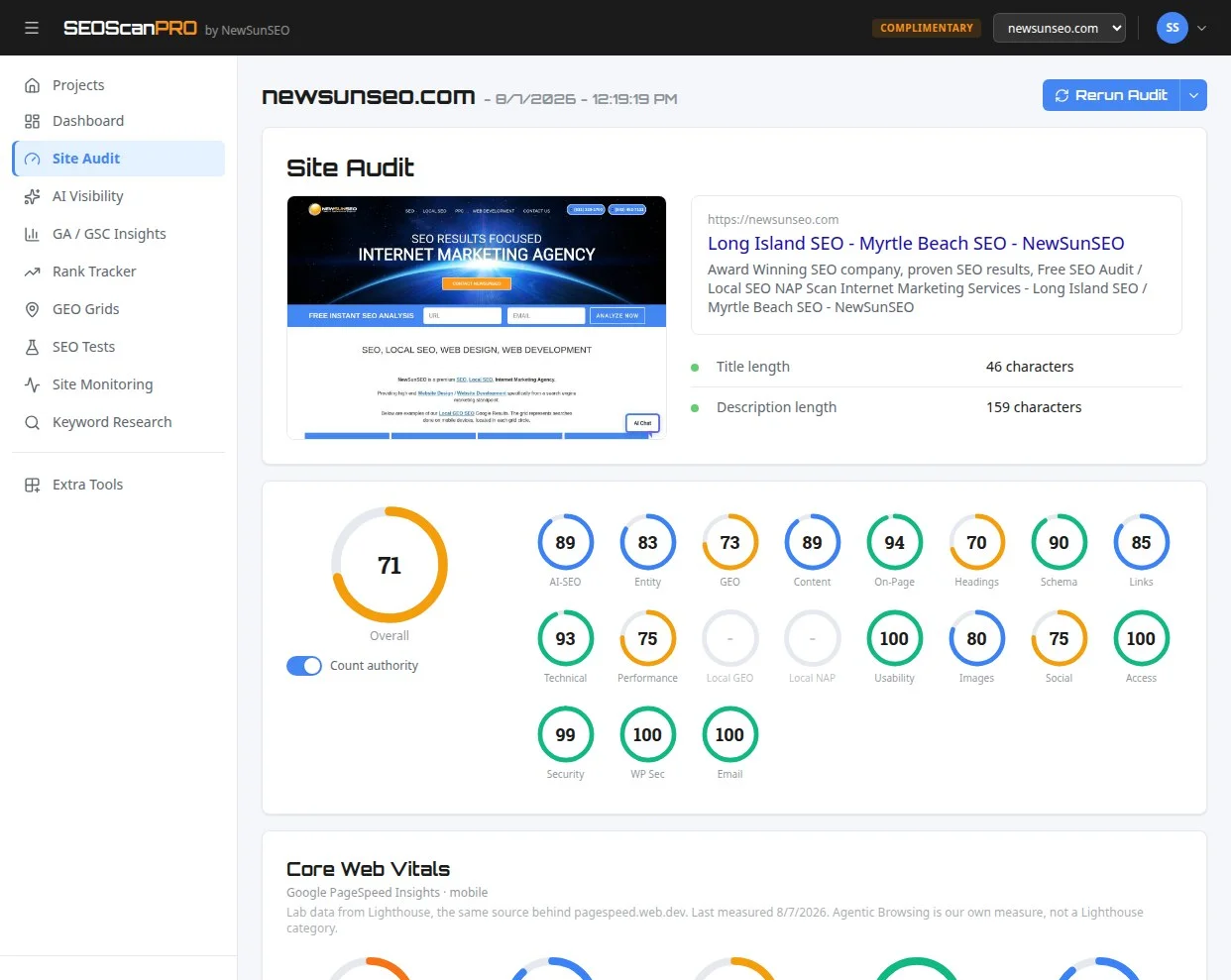
SEOScanPRO’s site audit tool runs a full technical audit of a site and shows the measured result behind every check. Open the site audit tool.
Want help with this in Myrtle Beach or Long Island? Talk to us.
NewSunSEO
Grow in Google and AI Search
AI-SEO, local search, paid ads and websites from one team, with offices on Long Island and in Myrtle Beach.
- AI-SEO
- Local AI-SEO
- AI Consulting
- PPC
- Web Design
- Web Development
- Long Island Office(631) 320-1700
- Myrtle Beach Office(843) 492-7131
Request a Free Proposal
Tell us about your business and where you want to grow.
We will reply by email to talk through your goals and what a proposal would include.
We use your details only to reply to you and send what you asked for. See our Privacy Policy.

