


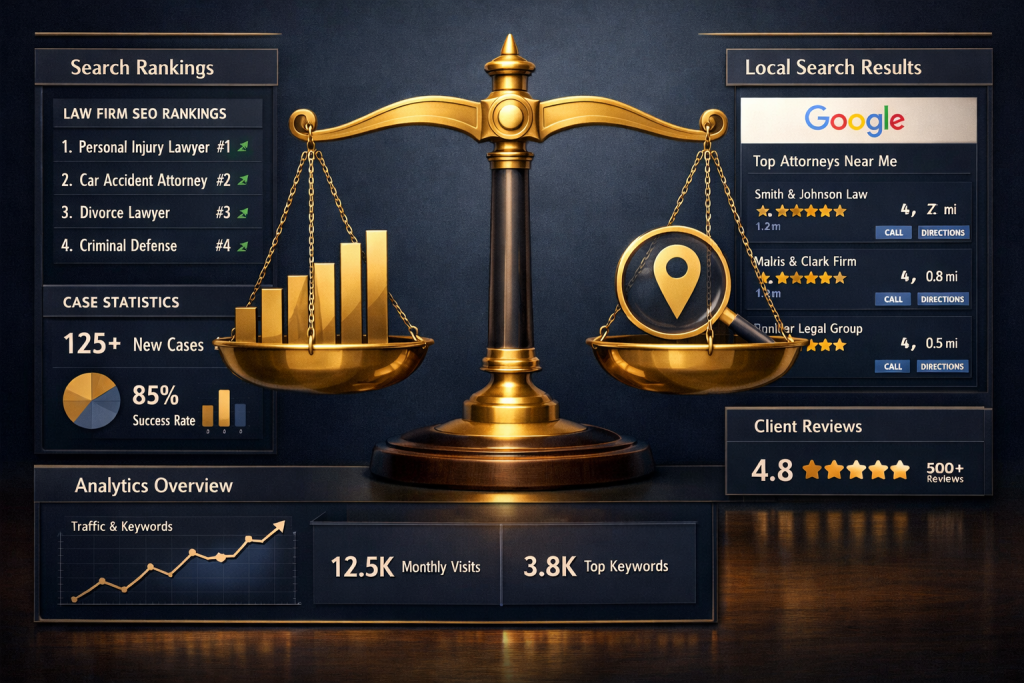
Legal is one of the most competitive local search markets in the country. There are over 175,000 attorneys in New York State, and Long Island, with 2.9 million residents across Nassau and Suffolk, generates high-intent search volume for personal injury, family law, criminal defense, and real estate legal services every day. The attorneys and firms winning that search traffic in 2026 aren’t necessarily the ones with the biggest ad budgets. They’re the ones who’ve built the most comprehensive and credible online presence, structured around real expertise, real client outcomes, and a Google Business Profile treated as a primary marketing asset.
Why does the Google Business Profile decide who gets called?
For most Long Island residents searching for legal help, the first decision point isn’t your website, it’s your Google Business Profile. The three firms that appear in the local 3-pack for “divorce lawyer Garden City” or “personal injury attorney Huntington” get the overwhelming majority of clicks. Getting into that 3-pack, and staying there, is the SEO activity that matters most for most law firms.
Category specificity is mandatory. “Lawyer” as your primary GBP category puts you in a category so broad it’s almost meaningless. “Divorce Lawyer,” “Personal Injury Attorney,” “Criminal Justice Attorney”, specific category classification is one of the strongest local ranking signals. If your firm handles multiple practice areas, your primary category should reflect the one you most want to rank for, with secondary categories covering others.
The Q&A section is free real estate. Most law firms leave the GBP Q&A section empty or unmanaged. A prospective client searching for “How much does a divorce cost in New York?” might find that question answered directly in your GBP before they ever visit your website. Populating the Q&A with accurate, useful answers to common client questions builds both visibility and credibility.
Photos of your actual firm. Interior photos of your offices, headshots of attorneys, team photos, these increase engagement with your listing. People hiring an attorney are making a high-stakes, trust-based decision. A profile that shows real humans in a real office converts better than one with no photos or stock imagery.
How do Long Island attorneys win specific practice area searches?
A homepage that says “full-service law firm serving Long Island” doesn’t rank for anything specific. A dedicated page titled “Divorce Lawyer Nassau County, [Firm Name]” has a chance to rank for “divorce lawyer Nassau County” and related queries. The difference between having 1 homepage and having 8 targeted practice area pages is the difference between being invisible and being findable.
Each practice area page should do several things. It should target a specific location + practice area keyword combination (“personal injury attorney Hauppauge,” “child custody lawyer Port Jefferson”). It should name the attorney handling that practice area and include their credentials. It should include a brief FAQ section covering the questions real clients ask, marked up with FAQPage schema so Google can surface them directly in search results. And it should include one or two anonymized client outcomes that illustrate the kind of result your firm achieves.
Specific Long Island practice area pages worth building for most firms: personal injury (car accidents, slip and fall, wrongful death), family law (divorce, custody, child support), criminal defense (DUI, drug charges), real estate law (closings, title issues, landlord/tenant), and estate planning (wills, trusts, elder law). Each of these categories generates high-intent search volume in Nassau and Suffolk counties year-round.
What does E-E-A-T require from legal content in 2026?
Google’s E-E-A-T framework, Experience, Expertise, Authoritativeness, Trustworthiness, applies everywhere, but it hits hardest in legal content. Legal information is classified as YMYL (Your Money Your Life) content, meaning Google holds it to a higher standard. The March 2026 Core Update tightened this further. Generic advice articles from non-expert authors are losing ranking position to content that demonstrates verifiable legal knowledge.
What this means practically: your blog articles and service pages need to be written by or clearly attributed to a named attorney with verifiable credentials. “Written by the [Firm Name] Team” doesn’t establish expertise. “Written by [Attorney Name], admitted to the New York State Bar in 2011, with 15 years of family law practice in Nassau County” does.
Content quality matters in a specific way for law. You can’t promise outcomes (that violates bar ethics rules in New York), but you can explain how the process works, what factors affect outcomes, and what questions clients should be asking. “New York Equitable Distribution Law: What Courts Consider in a Long Island Divorce” is a legitimate, rankable piece of content that demonstrates real expertise. A 500-word generic overview of “why you need a divorce lawyer” is not.
Cite New York-specific law where applicable. Reference Nassau County or Suffolk County courts and procedures. Write at the level of expertise you actually have. Google’s quality evaluators can distinguish between researched summarization and content written by someone who actually practices law.
How do law firms generate reviews at scale?
Legal services clients are rarely thrilled about writing a review because the matter was often stressful, and many would rather move on. Law firms that get the review process right have an advantage over those that don’t.
The highest-converting review request strategy for law firms: personal follow-up. After a case closes with a positive outcome, the handling attorney or a paralegal sends a direct email. Not a template blast, a brief personal note acknowledging the client’s situation and asking if they’d be willing to share a few words about the experience. Include a direct link to your Google review page. Response rates for personalized requests are substantially higher than automated follow-ups.
Reviews that mention specific outcomes, practice areas, and locations, “[Attorney name] helped me resolve a custody dispute in Nassau County Family Court in about four months”, are more valuable than generic praise. If you’re requesting reviews, you can note that specific details are helpful to other potential clients making similar decisions. You can’t tell them what to say, but you can tell them what’s useful.
Target 50+ reviews in the past 12 months at 4.5 stars or above for competitive practice areas in Nassau County. Suffolk County markets require less volume for competitive position, but recency still matters. Respond to every review, positive and negative, professionally and promptly.
What schema markup and technical fixes actually matter?
Schema markup is structured data that helps Google understand what type of entity your website represents, and most law firms aren’t using it.
At minimum, Long Island law firm websites should have: LegalService or Attorney schema (declaring practice areas, credentials, bar admissions), LocalBusiness schema (name, address, phone, hours, geographic coordinates), FAQPage schema on practice area pages (common client questions marked up for search result display), and AggregateRating schema pulling from your review data.
The schema must match your GBP data exactly. Google cross-validates structured data on your website against your GBP listing. Inconsistencies, different phone numbers, different address formats, different business name capitalization, reduce the trust score that directly affects both traditional ranking and AI visibility.
Site speed matters more than most law firms acknowledge. Legal websites tend to be slow, heavy page builders, large images, multiple tracking scripts. A personal injury firm’s homepage that loads in 5 seconds on mobile is converting at roughly half the rate of one that loads in 1 second. Run your primary pages through Google PageSpeed Insights and treat anything below 70 on mobile as revenue left on the table.
NewSunSEO works with Long Island law firms in Nassau and Suffolk County on SEO strategy that drives actual case inquiries. If you want an honest assessment of where your firm’s online presence stands and what it would take to compete for high-value search terms in your practice areas, get in touch here.
Wondering if your own business shows up in ChatGPT, Gemini, or Perplexity? Run a free BizScoreAI scan to check your AI Visibility Score and get a prioritized list of fixes.
Keep your social presence active across platforms with Feedsta, an AI social media manager that creates, schedules, and analyzes your posts, so your brand stays visible where customers research your business.
Related coverage
Want help with this in Myrtle Beach or Long Island? Talk to us.
NewSunSEO
Grow in Google and AI Search
AI-SEO, local search, paid ads and websites from one team, with offices on Long Island and in Myrtle Beach.
- AI-SEO
- Local AI-SEO
- AI Consulting
- PPC
- Web Design
- Web Development
- Long Island Office(631) 320-1700
- Myrtle Beach Office(843) 492-7131
Request a Free Proposal
Tell us about your business and where you want to grow.
We will reply by email to talk through your goals and what a proposal would include.
We use your details only to reply to you and send what you asked for. See our Privacy Policy.

