


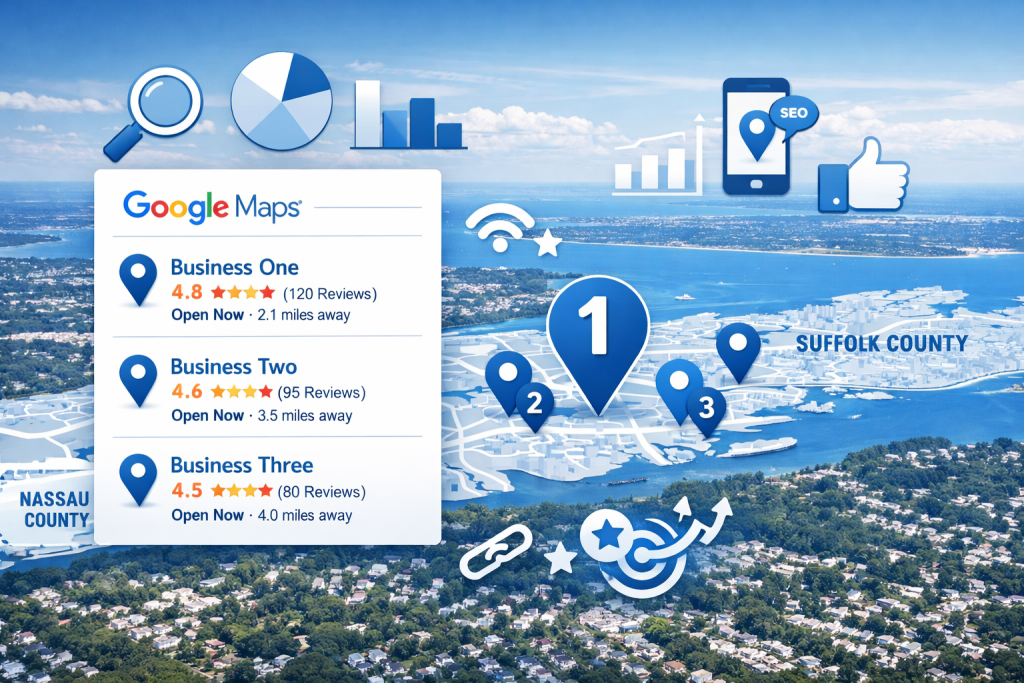
Local SEO for Long Island: How to Rank in Your Market and Keep That Ranking
Local SEO is the set of signals a business sends to Google showing it is real, active, trusted by people in its area, and the right answer for a given search. For Long Island businesses in Nassau and Suffolk counties, ranking in 2026 comes down to consistent execution across your Google Business Profile, reviews, location-specific pages, and citations.
How does local search actually work?
When someone searches "plumber near me" or "divorce attorney Garden City," Google runs two calculations at once. First, which businesses are relevant and located in this area. Second, which of those businesses are the most trustworthy and authoritative.
Relevance and proximity are table stakes. You need a verified Google Business Profile with accurate location and category information and a clear description of your services. Without it, you will not appear in local results regardless of how good your website is.
Trust is where most businesses fall short. Google measures it through review signals (volume, recency, sentiment), engagement data (clicks, calls, direction requests), website signals (content quality, relevance, technical health), and entity authority (whether authoritative sources reference your business). Getting relevance right is easy. Consistently excelling on trust is the actual work of local SEO.
Which Google Business Profile settings actually matter?
Most business owners claim their GBP, fill in the basics, and stop. That is started, not done.
Categories matter more than most people realize. Your primary category is the most important classification signal in local search. "HVAC Contractor" is more specific and more effective than "Air Conditioning Service." "Divorce Lawyer" outperforms "Lawyer." Review your categories against what your customers actually search for.
The Services tab is underused. Many businesses leave it sparse or generic. A landscaping company that lists "lawn maintenance," "irrigation installation," "fall cleanup," and "spring aeration" is more likely to appear for those specific queries than one that lists "landscaping services." Match your services to the words your customers use.
Photos drive engagement, and engagement drives ranking. GBP listings with recent photos get more views and more click-throughs. Add 5 to 10 new photos per month: exterior, interior, team at work, completed projects, equipment. Real documentation, not stock photos. Google can distinguish.
Posts keep your listing active. GBP posts signal to Google that your listing is maintained. Listings not updated in 30 or more days show measurable impression decay. A brief post once a week takes 10 minutes and prevents that decay.
Why are reviews the ranking factor you can most control?
Of all local ranking signals, review generation is where consistent action produces the most predictable results. You cannot directly control PageSpeed on an old hosting plan or manufacture local links overnight. You can ask your last 10 customers for a review right now and have them by end of week.
Two review metrics matter most in 2026: velocity (new reviews per month) and recency (when the most recent ones came in). A business with 50 reviews from 2023 is losing ground to a competitor with 30 reviews where 20 arrived in the last 90 days. Google’s local algorithm heavily weights recent engagement.
Set up a repeatable review request process. For service businesses, send a text or email 24 hours after a completed job with a direct Google review link. One sentence, "We’d really appreciate it if you had a moment to leave us a Google review," outperforms elaborate requests. For businesses with ongoing client relationships, ask after a positive interaction or milestone. Include the direct link, not a request to find your listing.
Respond to every review. Positive ones first: a brief, genuine response (not a template) tells future customers that real people are behind the business. Negative ones need more care: acknowledge specifically, do not make excuses, offer to make it right offline. Future customers read your responses as carefully as they read the reviews.
How do location pages give Long Island businesses an edge?
One of the highest-value and least-used strategies for Long Island service businesses is location-specific landing pages. If you serve multiple towns or zip codes, a single homepage trying to rank for "plumber Long Island" competes against a massive keyword. Separate pages for "plumber Smithtown," "plumber Commack," and "plumber Hauppauge" compete in narrower queries with less competition and higher intent.
These pages must do more than paste the same service description with a different town name; that approach was never effective and is actively penalized now. Each page should reflect genuine knowledge of the area: specific services relevant to local housing stock, local landmarks as geographic references, and specific customer outcomes from that area if available. The level of effort separates pages that rank from pages that don’t.
For Nassau County, where competition density is higher, hyper-local pages by neighborhood or zip code compound the advantage. A dentist in Mineola may benefit from separate pages targeting Williston Park, Garden City, and Carle Place, each positioned differently based on demographics and proximity to competing practices. For Suffolk County businesses with broader service areas, town-level pages covering your 15 to 20 mile radius are typically the right level of granularity.
Is citation building still worth the effort?
Citations, mentions of your business name, address, and phone number across directories and websites, help Google establish that your business is real and where it operates. They also feed AI search visibility, since systems like Gemini and ChatGPT use entity consistency to decide how confidently they can recommend a business.
The priority list for Long Island businesses: Google Business Profile, Yelp, Bing Places, Apple Maps, the Better Business Bureau, the relevant industry directory for your niche (Avvo for attorneys, Healthgrades for healthcare, Houzz for home services), your local Chamber of Commerce (Nassau or Suffolk County), and any Long Island-specific business directories.
Consistency is the critical variable. Your business name, address, and phone number must appear identically across all citations. Small variations ("Ave." vs. "Avenue," different phone formatting, an old address) create entity confusion that undermines the trust signal. A citation audit comparing your listing across directories is worth doing annually at minimum.
NewSunSEO works with businesses across Long Island, from home services in Huntington to professional practices in Garden City, on the full spectrum of local SEO strategy. If you want to understand where your local presence stands and what it would take to rank more consistently, reach out here.
Wondering if your own business shows up in ChatGPT, Gemini, or Perplexity? Run a free BizScoreAI scan to check your AI Visibility Score and get a prioritized list of fixes.
Keep your social presence active across platforms with Feedsta, an AI social media manager that creates, schedules, and analyzes your posts, so your brand stays visible where customers research your business.
Related coverage
Want help with this in Myrtle Beach or Long Island? Talk to us.
NewSunSEO
Grow in Google and AI Search
AI-SEO, local search, paid ads and websites from one team, with offices on Long Island and in Myrtle Beach.
- AI-SEO
- Local AI-SEO
- AI Consulting
- PPC
- Web Design
- Web Development
- Long Island Office(631) 320-1700
- Myrtle Beach Office(843) 492-7131
Request a Free Proposal
Tell us about your business and where you want to grow.
We will reply by email to talk through your goals and what a proposal would include.
We use your details only to reply to you and send what you asked for. See our Privacy Policy.

