



More visibility into what is working and what is not: Google appears to be issuing more manual action penalties in recent weeks than it has over the months before that, with thin content, scaled content and pure spam showing up most often in the cases now being reported.
The increase has caught the attention of practitioners who handle these penalties, and it is showing up as a noticeable uptick in threads on the Google Webmaster Help Forums. The shift is modest compared with the manual action surges of a decade ago, but it is the first clear rise many have seen in years, and it tracks with Google’s larger push against scaled content abuse.
What is driving the recent increase
Manual actions are penalties a human reviewer at Google applies through Search Console after spotting a violation of Google’s spam or quality policies. They differ from algorithm updates, which adjust rankings automatically across the index. The recent cluster of cases leans heavily on a small set of policy names.
- Thin content with little or no added value. Pages that offer little unique value, such as thin affiliate pages, scraped content, or doorway pages designed to funnel visitors.
- Spam sites manipulate search rankings rather than help visitors.
- Scaled content abuse. Pages generated in bulk, often with automation or AI tools, that add little original value to the web.
One long-time consultant shared that requests for help went from essentially none to several per week, which is meaningful because she no longer advertises manual action consulting. The trend is most pronounced in cases involving legitimate, long-running businesses whose content has been diluted by low-quality or auto-generated pages, often added by outside SEO vendors chasing quick wins.
How manual actions differ from algorithmic penalties
Manual actions hit a site directly in Search Console, with a specific policy named and a path to reconsideration. Algorithmic penalties arrive as ranking drops with no formal notice and no reconsideration request, and recovery happens as the algorithm revisits the site. Both can be severe, but manual actions are the more visible of the two because Google tells the site owner exactly what triggered the review.
When a manual action lands on a site, the damage can be total. Entire sites can be removed from Google’s index, and individual businesses have reported traffic losses of 90% or more overnight. Recovery requires fixing the underlying issue, documenting the cleanup, and submitting a reconsideration request that convinces the reviewer the violations will not return.
What kinds of manual actions are appearing now
The cases now being discussed across forums and in consultation requests line up with a recurring set of Google policies. Each entry below maps to a named action that can appear in Search Console’s Manual Actions report.
Scaled content and thin content actions
- Thin content with little or no added value. Pages that offer little original information, such as thin affiliate pages, scraped posts, or doorway pages targeting long-tail queries.
- Scaled content abuse. Programs that produce large amounts of low-value content, often with automation, across many pages or sites.
- Sites built to manipulate search rankings rather than help users.
- Spammers post aggressively or break the rules repeatedly across much of the site.
Link and redirect actions
- Unnatural links to your site. A pattern of artificial links pointing at the site, often bought or exchanged.
- Artificial outbound links placed to manipulate other pages.
- Cloaking and sneaky redirects. Showing different content to Google than to visitors, or redirecting visitors in unexpected ways.
- Sneaky mobile redirects. Redirecting only mobile visitors, often to content Google never sees.
- Cloaked images. Images shown to Google that differ from, or obscure, what visitors see.
User-generated and hosted content actions
- User-generated spam. Spam posted in comments, profiles, or forum threads.
- Many pages on this free hosting service are spammy.
- Third-party spam on a hosted site. Spam published through forums, uploads, or other user-contributed areas of a site the owner controls.
Technical and policy actions
- Structured data issue. Markup that violates Google’s guidelines, such as hidden, irrelevant, or misleading content.
- Hidden text and keyword stuffing. Text hidden from visitors or keywords repeated excessively.
- Back button hijacking. Interfering with browser history so visitors cannot use the Back button as expected.
- AMP content mismatch. AMP pages that differ materially from the canonical page they represent.
- Site reputation policy. Third-party content on the site that conflicts with Google’s site reputation policy, often on user-hosted pages.
What the forum threads show
A sweep of recent posts on the Google Webmaster Help Forums surfaces a steady flow of new threads, which is the kind of pattern that suggests a cluster rather than isolated cases. The threads commonly report thin content, scaled content, and pure spam actions, with several site owners describing multiple reconsideration requests before any visible progress.
The two cases appearing most often are Thin content with little or no added value and Major spam problems, the latter frequently tied to blog sections that have accumulated years of low-effort posts. Multiple site owners reported removing thousands of URLs before submitting a reconsideration request, which is consistent with Google’s documentation that bulk cleanup is often required before a penalty is lifted.
Why this is happening now
Google has stated that scaled content abuse is a focus area, and human reviewers appear to be catching what the algorithms have been filtering for some time.
The cleanup pattern is also visible in the data being shared: in many of the cases now being reviewed, the offending pages trace back to a handful of common SEO shortcuts, including programmatic page generation, AI-written articles without original research, and doorway pages built around long-tail queries. When those shortcuts are applied at scale, the resulting pages tend to share structural tells that a quality reviewer can flag quickly.
For site owners, the practical upside is straightforward. Clearing out the thin, templated, or auto-generated content and replacing it with material grounded in first-hand experience is the same path that would have worked five years ago, and it is the path that the manual action reviewers are asking sites to walk before approving a reconsideration request.
How site owners can respond
The right response depends on whether a manual action is already in Search Console or whether the risk is simply higher.
If a manual action is already in place
- Read the policy named in the Manual Actions report and audit the affected pages against it.
- Remove or rewrite the offending content rather than noindexing it, since the action is on the content itself.
- Document the cleanup with dates, URLs, and a written summary of changes.
- Submit a reconsideration request that shows the cleanup work and explains how the issue will be prevented from returning.
- If the first reconsideration is rejected, address the specific gap named in the response before resubmitting.
If the site is at risk but unpenalized
- Audit the blog and any programmatic sections for thin, templated, or auto-generated pages, and consolidate or remove them.
- Confirm that any AI-assisted content is reviewed, edited, and grounded in original information.
- Check backlink profiles for patterns of paid or exchanged links and disavow where appropriate.
- Make sure structured data accurately describes what is on the page and follows Google’s guidelines.
Where this fits in the bigger picture
An increase in long-tail traffic losses suggests Google is applying the content filtering it has signaled.
FAQ
What is a Google manual action?
A manual action is a penalty a human reviewer at Google applies through Search Console after determining that a site violates Google’s spam or quality policies. The Manual Actions report names the specific policy and provides a path to reconsideration.
How does a manual action differ from an algorithm update?
A manual action targets a specific site, names the policy violated, and can be appealed through a reconsideration request. An algorithm update adjusts rankings across the index automatically, with no formal notice and no reconsideration process.
What kinds of manual actions are being reported right now?
Recent reports from consultants and forum posts most often name thin content, scaled content abuse, pure spam, and major spam problems. Link-related actions and structured data issues also appear, but content quality is the dominant theme in the cases being reviewed.
Related coverage
- Google AI Search Box, Local Sponsorships and Review ROI in 2026
- Search Everywhere Optimization: Why Google Alone Isn’t Enough in 2026
- Google’s New AI Search Guidance: Why Non-Commodity Content Is the Only Strategy That Matters
SEOScanPRO
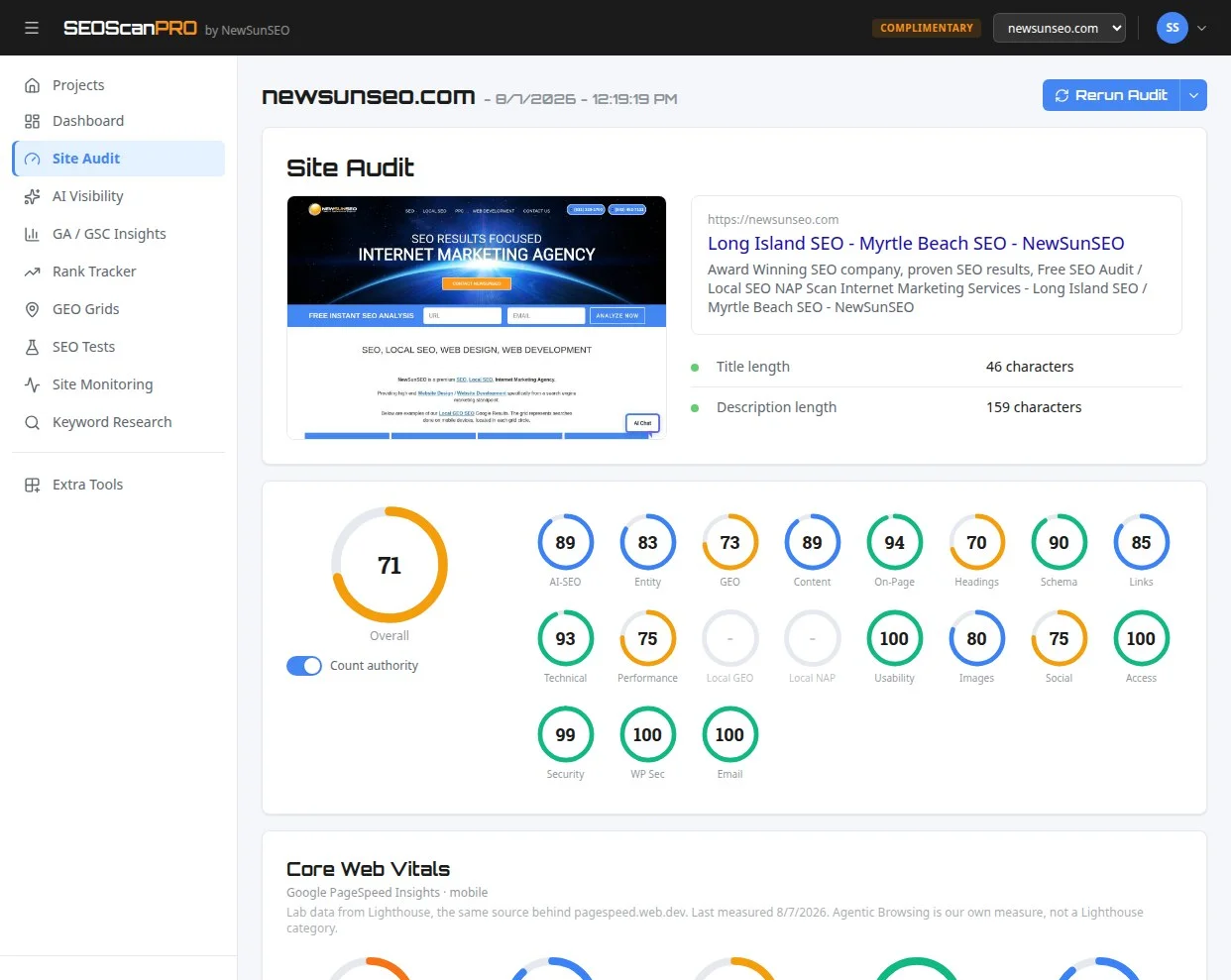
The SEOScanPRO site audit tool runs a full technical audit of a site and shows the measured result behind every check. Open the site audit tool.
Want help with this in Myrtle Beach or Long Island? Talk to us.
NewSunSEO
Grow in Google and AI Search
AI-SEO, local search, paid ads and websites from one team, with offices on Long Island and in Myrtle Beach.
- AI-SEO
- Local AI-SEO
- AI Consulting
- PPC
- Web Design
- Web Development
- Long Island Office(631) 320-1700
- Myrtle Beach Office(843) 492-7131
Request a Free Proposal
Tell us about your business and where you want to grow.
We will reply by email to talk through your goals and what a proposal would include.
We use your details only to reply to you and send what you asked for. See our Privacy Policy.

