


New internal Google Search data gives site owners a clearer picture of how long crawling, indexing, and serving usually take, and how long the slowest cases can stretch. The numbers were drawn from Google’s own systems and presented at a recent Search Central event, with the caveat that many of these processes are linked, so delays stack up across stages.
What the new Google Search timeline data covers
The breakdown is grouped into three phases: crawling, indexing, and serving. Each process has a typical time and a slowest observed time, and several of the slowest cases stretch into months or never complete at all. Because the stages depend on each other, a slowdown in one place pushes out everything downstream.
How long crawling takes in Google Search
Crawling is where Google first finds a page and later revisits it. The numbers below show the typical case and the slowest case for each crawling step.
- Discovery (new URL): typical about 20 hours; slowest weeks to never.
- Refresh (known URL): typical about 30 days; slowest weeks to never.
- Sitemap processing: typical about 24 hours; slowest up to 14 days, or never for low quality sitemaps.
- robots.txt update: typical about 24 hours; slowest about 25 hours.
- Crawl capacity update: typical 4 hours to 1 to 2 weeks; slowest 1 to 3 weeks, including time spent in recovery.
- Crawl demand update: typical about 20 hours; slowest weeks to months.
- Crawl capacity drops: can fall in seconds when Google backs off, for example when a server struggles under load.
How long indexing takes in Google Search
Indexing is the pipeline step that converts a fetched page into a format search can return.
- Rendering: typical seconds to render, then hours in the queue; slowest days to weeks.
- Meta annotations: typical 45 to 90 minutes; slowest 1 to 4 days.
- Link annotations: typical minutes to 1 to 3 weeks; slowest months.
- Indexing end to end: typical about 1.5 hours; slowest months, or never for low quality pages.
- Removal: typical 1 to 3 weeks; slowest months.
- Canonicalisation change: typical 1 to 3 weeks; slowest months when signals conflict.
- Site move: typical 1 to 3 months; slowest 6 months to over a year, while a small site move can be done in a few weeks.
- Structured data updates: typical hours to 1 to 2 weeks; slowest weeks, or never for low quality structured data.
- Images: typical hours to days; slowest weeks to months.
- Videos: typical hours to days; slowest weeks to months, with deep analysis on top.
How long serving takes in Google Search
Serving is what users see in results, from snippet text and titles to images and the way manual actions or core updates play out.
- Removal in Search Console (by the owner): typical about 2 hours; slowest about 24 hours.
- Snippet update: typical 1 to 2 days; slowest several weeks to months.
- Title update: typical 1 to 2 days; slowest several weeks to months.
- Text result image update: typical 1 to 2 weeks; slowest several weeks to months.
- Manual action removal: typical 1 to 2 weeks; slowest 4 to 6 weeks, or much longer for dormant sites.
- Core update recovery: typical 3 to 6 months to recover; slowest 6 months to about a year, waiting on the next core update.
- Spam update change: typical 1 to 2 weeks and continuous; slowest months, landing in batch refreshes.
Core updates themselves take 2 to 4 weeks to roll out, and spam updates roll out in 1 to 2 days.
Why the slowest cases matter for site owners
The typical numbers look fast, but the slowest cases carry most of the planning risk. A page that relies on a refresh, a canonicalisation change, a site move, or a structured data update can sit in limbo for months, and several of these processes can end in never for low quality pages. Recovery from a core update is the longest serving timeline in the data, often 6 months to a year between updates.
Because crawling, indexing, and serving are linked, a slow discovery or refresh can quietly push indexing and serving timelines further out. Crawl capacity is the most volatile input, since it can drop in seconds when a server is overloaded. Sitemap quality, robots.txt freshness, and on-page quality all feed into the slowest tail of these numbers.
The presentation also noted that end to end indexing counts as complete only after every critical sub-process finishes successfully, which is why a single stuck step can hold up the whole chain. For site owners planning launches, migrations, or recovery work, the slowest column is the safer number to plan around.
FAQ
How long does Google Search take to crawl a new URL?
Typical discovery of a new URL takes about 20 hours, and the slowest cases can take weeks or never happen at all, especially for low quality pages.
How long does Google indexing take end to end?
End to end indexing typically takes about 1.5 hours once a page is crawled, but the slowest cases stretch into months or never complete when quality signals are weak or processes stall.
How long does a Google core update recovery take?
Recovery after a core update typically takes 3 to 6 months, and the slowest cases run 6 months to about a year, since recovery usually has to wait for the next core update.
Related coverage
- Google AI Search Box, Local Sponsorships and Review ROI in 2026
- Search Everywhere Optimization: Why Google Alone Isn’t Enough in 2026
- Google’s New AI Search Guidance: Why Non-Commodity Content Is the Only Strategy That Matters
SEOScanPRO
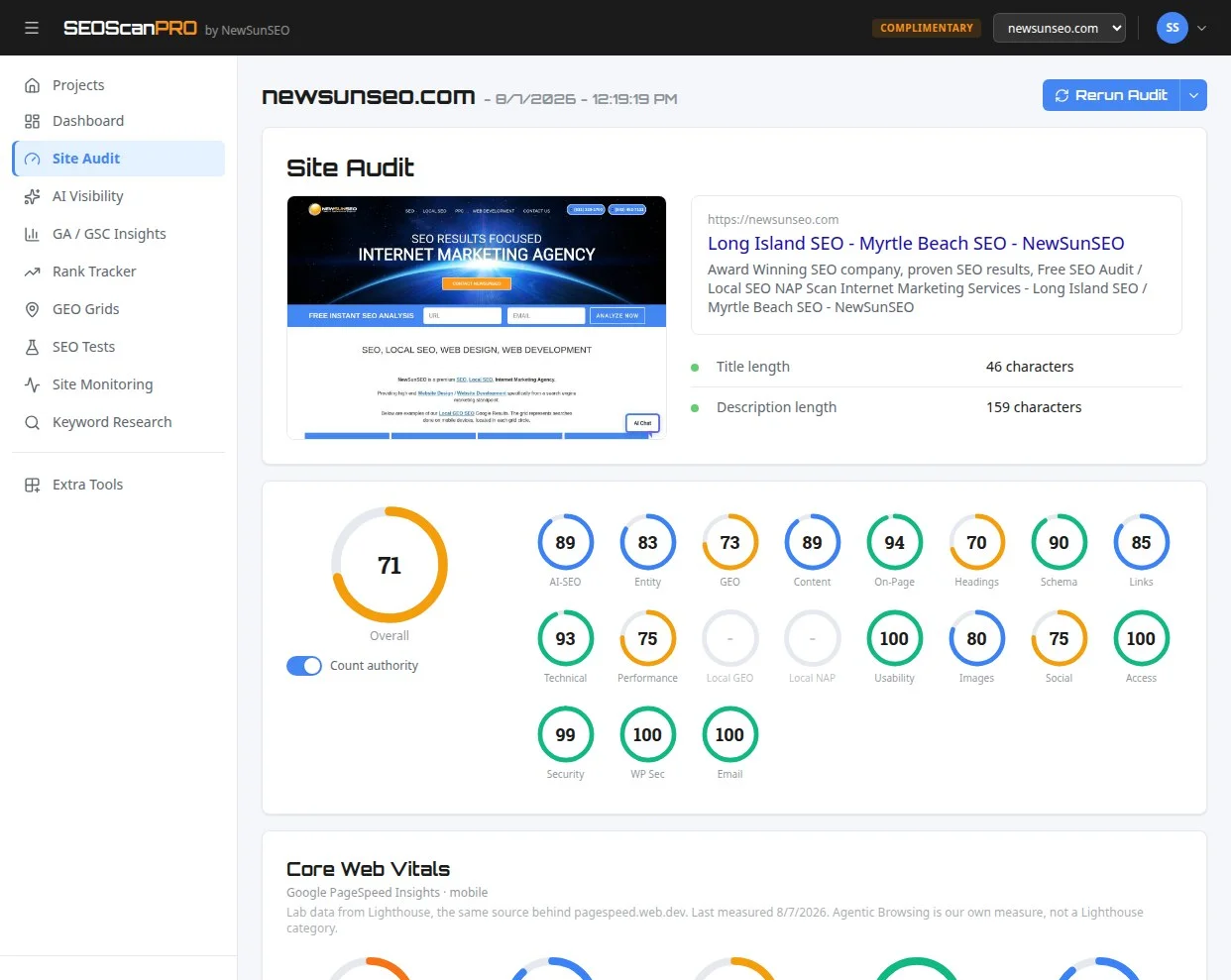
The SEOScanPRO site audit tool runs a full technical audit of a site and shows the measured result behind every check. Open the site audit tool.
Want help with this in Myrtle Beach or Long Island? Talk to us.
NewSunSEO
Grow in Google and AI Search
AI-SEO, local search, paid ads and websites from one team, with offices on Long Island and in Myrtle Beach.
- AI-SEO
- Local AI-SEO
- AI Consulting
- PPC
- Web Design
- Web Development
- Long Island Office(631) 320-1700
- Myrtle Beach Office(843) 492-7131
Request a Free Proposal
Tell us about your business and where you want to grow.
We will reply by email to talk through your goals and what a proposal would include.
We use your details only to reply to you and send what you asked for. See our Privacy Policy.

