


What just changed in Google Search results
Readers and SEO professionals gain stronger protection against large-scale scraping of Google search results, now that Google has confirmed a widespread rollout of google.com/goto redirect links. The new redirect layer, which routes clicks through Google’s own domain before reaching a destination page, makes it materially harder for scrapers, AI companies, and rank-tracking tools to harvest raw search results at scale.
The mechanism replaces the direct outbound links that previously appeared in search results with a server-side redirect that cannot be decoded without following the chain. A Google spokesperson confirmed the rollout, stating that the company has a long history of deploying technical measures against evolving forms of abuse and regularly takes steps to protect its services and users.
How the google.com/goto redirect works
When a user hovers over a result in Google Search, the destination URL now passes through a google.com/goto? parameter instead of pointing straight at the target page. Clicking the link triggers a server-side redirect to the actual destination.
The technical design has two practical consequences:
- Links cannot be decoded client-side. The destination URL is hidden inside the redirect, so tools that previously parsed the HTML of a search results page to extract outbound URLs now have to follow the redirect to learn where a result points.
- Each results page carries hundreds of links. Following the redirect for every result on every page is expensive, which sharply raises the cost of scraping at scale.
This is not the first time Google has wrapped outbound links in a tracking parameter. The google.com/goto behavior was first observed in testing in July 2026. The current rollout takes that test to general availability.
How widespread the rollout is
One rank-tracking provider, Nozzle, reported nearly 100% rollout of the new redirect format across several residential IP providers. A chart shared publicly showed a sharp spike in the share of fetched results pages that contained only goto links, climbing over roughly four months of testing.
Independent testing in several browsers also confirmed that the redirects are live in real search sessions, not just in headless scraping environments.
Why Google is doing this
The change targets AI companies, training pipelines, and answer engines that have increasingly harvested large volumes of live Google results.
- AI companies have built training pipelines and answer engines that pull from current Google search output.
- Scraping services. Third-party SERP APIs resell structured access to Google’s index at scale.
- Search engine result page (SERP) APIs. Several commercial providers have been engaged in prolonged legal disputes with Google over the right to scrape and resurface its results.
By shifting to opaque server-side redirects, Google makes its anti-bot stance enforceable in the protocol itself rather than dependent on terms-of-service enforcement alone.
What this means for SEO tools and rank tracking
For rank-tracking and SEO audit platforms, the redirect adds a new step to every results-page fetch. Tools that captured raw outbound URLs will need to follow the redirect chain to recover the destination. That works for small samples but does not scale cheaply when a tool needs to process hundreds of links per page across thousands of locations or keywords.
Rank position across a service area is exactly the kind of measurement this change touches, since a geo grid report follows hundreds of queries from many locations. Tools that already follow redirect chains cleanly will keep working; tools that shortcut by parsing HTML will see broken data. SEOScanPRO’s GEO Grids follow the full redirect chain, so the rank data behind each grid point reflects the live result, not a stale link.
How the ecosystem will adapt
Third-party tools have adapted to every prior Google anti-scraping change, and this one will be no different. The cost of scraping will rise, and some SERP-data products may raise prices or narrow their scope, but a system that follows the redirect can still recover the underlying data.
What site owners and SEOs should do
For most site owners, nothing changes. Clicks from Google Search still land on the correct page, the redirects are fast, and users will not notice the difference. The two things worth watching are referrer data in analytics and SERP-data product pricing.
- Referrer data in analytics. Some redirect implementations can change the referrer string that arrives at the destination page, which affects how traffic source is attributed in tools like Google Analytics.
- Rank-tracking accuracy. If an in-house rank tracker suddenly reports wildly different positions, the redirect chain is the first thing to check.
For teams that depend on third-party rank data, ask the provider how they handle google.com/goto and how recently they re-validated their data pipelines against the live format.
FAQ
What is google.com/goto in Google Search results?
It is a redirect parameter that Google has rolled out across search results. When you click a result, the link now routes through a google.com/goto? URL and then server-side redirects to the actual destination page, instead of pointing straight at the destination.
Why is Google adding the goto redirect to search results?
The redirect is an anti-scraping measure. By hiding destination URLs inside a server-side redirect, Google makes it much more expensive for scrapers, AI companies, and SERP-data providers to harvest large volumes of search results. A Google spokesperson confirmed the rollout and described it as part of ongoing technical measures to protect Google services and users.
Does the google.com/goto redirect affect SEO or site traffic?
For site owners and SEOs, the user-facing impact is minimal. Clicks still land on the correct page, and the redirects are fast. The main effects are on third-party tools that scrape search results, which now have to follow redirect chains to recover destination URLs, and on referrer data that some analytics tools may receive differently.
Related coverage
- Google AI Search Box, Local Sponsorships and Review ROI in 2026
- Search Everywhere Optimization: Why Google Alone Isn’t Enough in 2026
- ChatGPT SEO: 8 Proven Strategies to Show Up in AI Search Results (2026)
SEOScanPRO
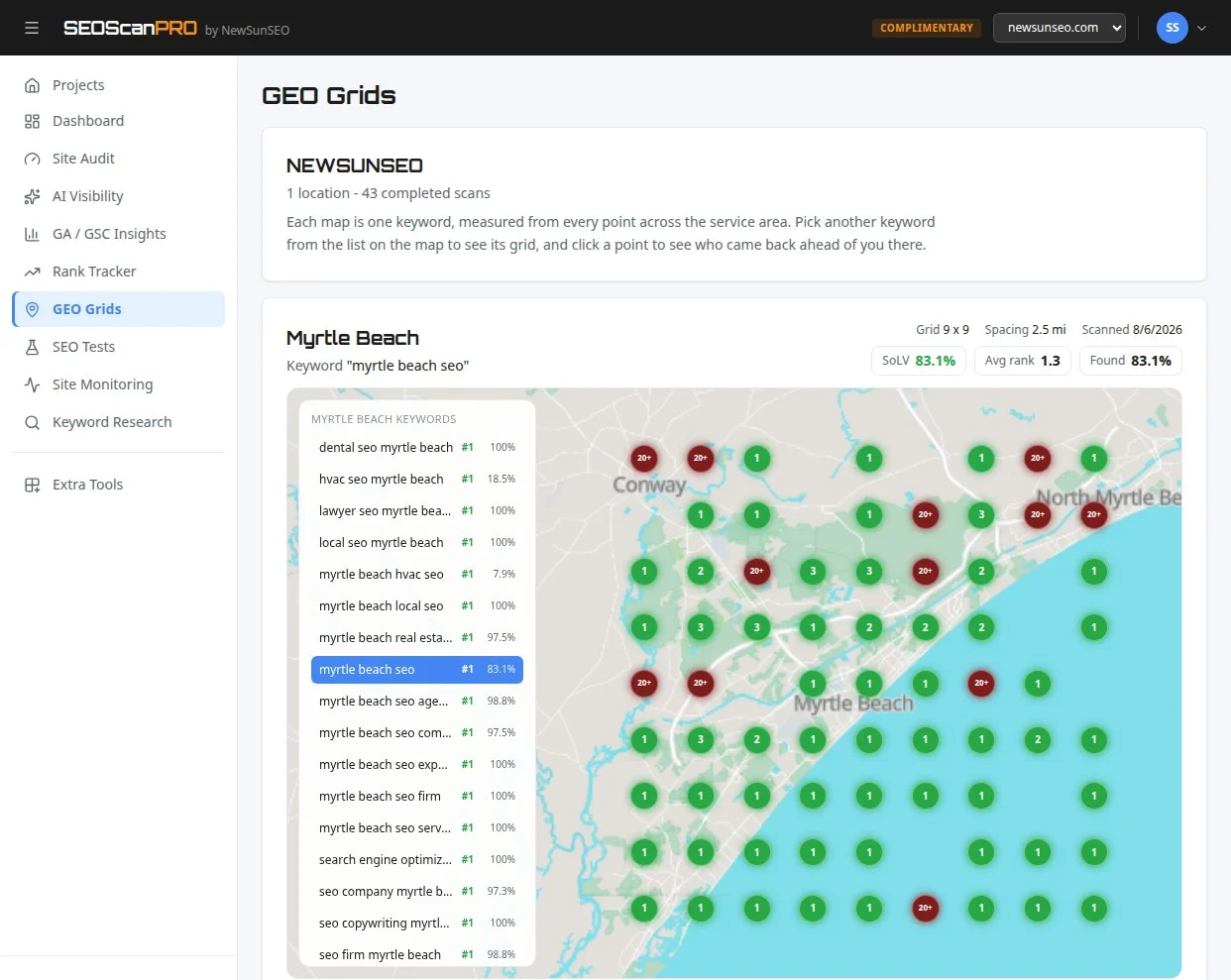
SEOScanPRO’s geo grid tool runs a full technical audit of a site and shows the measured result behind every check. Open the geo grid tool.
Want help with this in Myrtle Beach or Long Island? Talk to us.
NewSunSEO
Grow in Google and AI Search
AI-SEO, local search, paid ads and websites from one team, with offices on Long Island and in Myrtle Beach.
- AI-SEO
- Local AI-SEO
- AI Consulting
- PPC
- Web Design
- Web Development
- Long Island Office(631) 320-1700
- Myrtle Beach Office(843) 492-7131
Request a Free Proposal
Tell us about your business and where you want to grow.
We will reply by email to talk through your goals and what a proposal would include.
We use your details only to reply to you and send what you asked for. See our Privacy Policy.

