


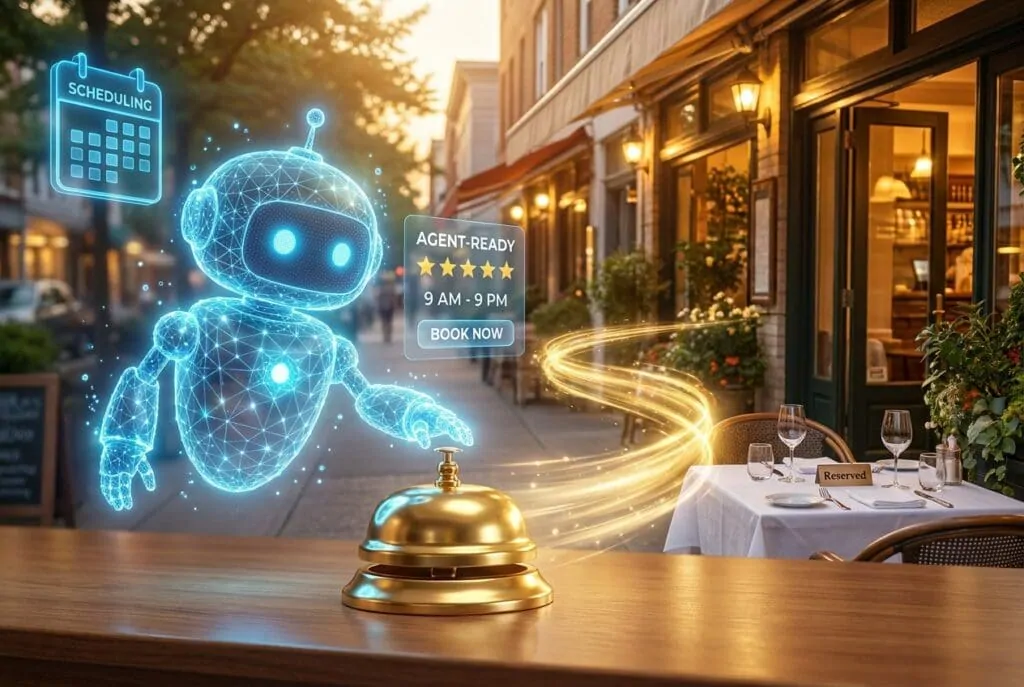
Google Search is no longer just a search engine that returns blue links or AI summaries. It’s becoming a task-completion machine-one that books tables, schedules appointments, and files forms on behalf of the user, without ever sending them to your website. For a Long Island restaurateur, plumber, or retailer, that changes where the lead really happens. If your business isn’t visible in the agentic layer, you’re invisible when the AI makes a decision.
Why It Matters
Agentic AI marks a shift from “AI that finds” to “AI that acts.” The same interface that once showed your address and a blue phone number can now complete a reservation, place an order, or add you to a customer’s calendar. Google has confirmed that roughly 46% of all searches carry local intent (a statistic it has cited for years through internal data shared on Think with Google), and now those intent-rich moments are being handed directly to AI agents.
For brick-and-mortar businesses in Nassau and Suffolk counties, the local pack and organic rankings aren’t the only battleground. The AI agent will pull from your Google Business Profile, structured data, and verified third-party sources to decide whether to surface your business-and then act. If an agent can’t find a booking link, a menu, or a price list, it will move on to a competitor that provides one.
What’s New / How It Works
Agentic AI lets a user say, “Book a dinner for four on Friday at an Italian place in Huntington that has outdoor seating,” and the AI agent takes it from there. It pulls live availability from the restaurant’s reservation system (if connected), checks the weather forecast for the outdoor request, and confirms the booking-all inside Search. The user never visits the restaurant’s website; the agent becomes the customer.
Under the hood, this builds on Google’s existing ecosystem: the Knowledge Graph, Google Business Profile APIs, and integrations like Reserve with Google and Things to Do. What’s new is the agent layer that chains actions: it plans a sequence of steps, calls external systems, and handles payment or form-filling. Google’s official blog described this evolution as moving from finding answers to getting things done without leaving Search.
For local businesses, three infrastructure pieces matter most: a fully populated Google Business Profile with up-to-date attributes, a booking or ordering endpoint that speaks to Google’s APIs, and on-page structured data (LocalBusiness, Menu, Event schema) that helps the agent understand your products and availability. Miss any of these, and the agent sees a gap it can’t bridge.
The Numbers
- 46% of all Google searches are local in nature, per Google’s longstanding internal data (cited on Think with Google). Agent actions will layer on top of that massive base.
- Zero-click searches hit 68% in early 2026, meaning users already rarely click through to websites. Agentic AI pushes this further: the transaction happens in the AI interface.
- Structured data matters more than ever. Google’s Search Central documentation confirms that without correct schema markup, AI agents can’t reliably interpret opening hours, prices, or availability.
- Early adoption is happening in dining, hospitality, and home services-the very categories that define Main Street Long Island.
“With AI agents, you can go from searching to getting things done, without leaving Search.”
- Google’s official blog, October 2024
Agentic AI doesn’t just find your business-it decides whether your business gets booked.
What Comes Next
Google is expanding agent actions across Maps, Shopping, and local verticals including automotive services, healthcare scheduling, and legal consultations-all through the same AI infrastructure it laid out at I/O 2026. Third-party integrations (OpenTable, Calendly, and vertical SaaS tools) are being certified to feed the agent layer. The direction is clear: AI agents will become the gateway to local commerce, and Google is treating them as a core product, not an experiment.
At the infrastructure level, Google is also encouraging businesses to adopt the new AppointmentLink and Availability structured data types, which let an AI agent discover real-time slots and pricing without crawling a site’s complex booking flow. For Long Island businesses, this means the plumbing estimate, the yoga class sign-up, or the Saturday haircut will be booked through an agent-if the connection is in place.
What This Means for You
If you run a service business on Long Island, the playbook for visibility is expanding. Ranking in the local pack is still essential, but now you also need to be “agent-ready.” Start by claiming and fully optimizing your Google Business Profile-fill out every attribute, add the correct business category, and verify that your booking or ordering links work end to end. Our local SEO services team can audit your profile and the surrounding citation network to make sure AI agents pick up accurate data.
Second, your website must speak a language machines understand. Adding structured data (LocalBusiness, Service, Menu) and making sure your appointment link resolves correctly is no longer optional. Our SEO copywriting approach includes schema-informed content that feeds both human readers and AI agents.
We dove deep into the bigger AI search shift in our post on Google AI Search 2026, and if you’re worried about traffic loss, our breakdown of zero-click searches hitting 68% will give you context. The throughline is the same: visibility is moving into the AI layer, and the businesses that provide clean, structured, real-time data will win.
Don’t forget that AI agents don’t only read your Google Business Profile-they aggregate signals from your entire web presence, including social media. Feedsta.ai can keep your social profiles active, consistent, and enriched with the kind of real-time posts that AI agents index. And before you make any changes, run a free visibility scan at BizScoreAI to see how your business shows up today in ChatGPT, Gemini, and Perplexity-the same AI surfaces that will soon be acting on your behalf.
The Bigger Picture
Agentic AI isn’t a distant R&D concept; it’s the next major chapter in local search, rolling out across Google’s products right now. For Long Island business owners, the message is simple: the AI is no longer just a librarian handing out your business card-it’s becoming the concierge that makes the reservation. That concierge needs clean, complete, and trustworthy information. The owners who provide it today will be the ones the agent recommends-and books-tomorrow.
Frequently Asked Questions
What is agentic AI in the context of Google Search?
How will agentic AI affect my restaurant or service business on Long Island?
Do I need to change my website for AI agents to work?
What’s the difference between AI Overviews and AI agents?
Will I lose website traffic if AI agents handle bookings?
How can I check if my business is visible to AI agents?
Is this something I need to worry about right now?
Want help with this in Myrtle Beach or Long Island? Talk to us.
NewSunSEO
Grow in Google and AI Search
AI-SEO, local search, paid ads and websites from one team, with offices on Long Island and in Myrtle Beach.
- AI-SEO
- Local AI-SEO
- AI Consulting
- PPC
- Web Design
- Web Development
- Long Island Office(631) 320-1700
- Myrtle Beach Office(843) 492-7131
Request a Free Proposal
Tell us about your business and where you want to grow.
We will reply by email to talk through your goals and what a proposal would include.
We use your details only to reply to you and send what you asked for. See our Privacy Policy.

