


Two publisher complaints filed against Brave allege unauthorized copying of journalism, access to paywalled material and substitution of publisher advertising.
Case Status and Central Allegations
The New York Times Company filed its federal complaint against Brave Software on November 2, 2026. The Daily News, Chicago Tribune and Orlando Sentinel publishers filed a separate complaint against Brave the same day in the Southern District of New York. The complaints allege that Brave copied protected journalism, distributed or exposed it through search and AI services, bypassed access restrictions and replaced publisher advertising.
Known
- Two complaints were filed on November 2, 2026, in the Southern District of New York.
- The New York Times filing identifies more than 10 million registered copyrighted works, including material from The New York Times, The Athletic, Cooking, Games and Wirecutter.
- The other filing identifies more than 2 million articles contained in the plaintiffs’ registered newspaper issues.
Alleged
- The complaints say Brave did not receive permission or compensation before accessing, copying or distributing publisher content.
- They say Brave has not disclosed its crawler’s name and has not offered site owners a way to block that crawler specifically.
- They say content copied into Brave’s index can be returned through Ask Brave and API endpoints, including verbatim passages and detailed summaries.
- They say Brave’s browser can display paywalled articles without a login or subscription and can replace publisher advertising with Brave Ads.
Not Established by the Complaints
- Separate observed site behavior from legal conclusions and refer legal questions to publisher counsel.
What the Publisher Complaints Allege
The complaints quote Brave as saying its index contains more than 30 billion webpages, with millions of new pages added each day. They also quote Brave documentation describing four API areas relevant to the dispute: News Search, Web Search, LLM Context and Answers.
The LLM Context endpoint returns extracted page passages and source metadata without another crawl of the page, according to Brave documentation quoted in the complaints. The Answers service powers Ask Brave. The publishers allege that Anthropic, Perplexity, Mistral, xAI and Cohere paid Brave for real-time index content used to train models, ground answers to queries or both.
The New York Times says its tests returned extensive article text rather than short snippets. It reports one Ask Brave response containing more than 400 verbatim words from a paywalled article, another containing nearly 700 words and a third containing approximately 87 percent of the article. A separate LLM Context request returned 1,291 of 1,295 words from an article verbatim.
Both suits target the browser’s Paywall blocker setting. The publishers also describe advertising substitution, including subscription prompts removed and advertisements sold through Brave Ads. The New York Times filing includes a comparison in which a subscription banner visible in Google Chrome was absent in Brave.
What Each Complaint Seeks
Each complaint contains five counts: direct copyright infringement, contributory copyright infringement, vicarious copyright infringement, circumvention of technological access controls under the Digital Millennium Copyright Act and unjust enrichment under New York law. The access-control count concerns paywalls and other technical measures used to control access, while the unjust enrichment count concerns the alleged advertising substitution.
The New York Times says it sent an August 11, 2025 letter from its intellectual-property counsel and an April 13, 2026 letter from outside counsel. It describes the letters as unanswered. The April letter sought an end to the conduct and removal of the intellectual property. It argued that the alleged willful infringement warranted enhanced statutory damages of up to $150,000 per infringement. The source material does not specify the full relief requested in the second complaint.
How Agencies Can Triageze Client Website Concerns
| Client Question | Evidence to Collect | Expected Reviewer | Documented Outcome |
|---|---|---|---|
| Which automated access rules apply to protected pages? | Current crawler instructions, access rules and related configuration records | Site owner and publisher counsel | A dated record of the rules reviewed and any changes referred for approval |
| How does the site handle authentication and paywall access? | Subscription and access-control settings, supported-user access records and documented test results | Product owner and publisher counsel | Documented behavior for authorized, unauthorized and non-subscribed sessions |
| How are publisher ads and subscription prompts delivered? | Ad configuration, creative records and screenshots showing the delivered page | Ad operations lead | A record of what was displayed, including replacement or removal where approved for testing |
| What requests reached protected URLs? | Server access logs, request timestamps, URLs, user agents and response records | Hosting support or security lead | A preserved log set covering the review period |
| Did referrals or traffic change? | Referral reports, analytics records and dated traffic comparisons | Analytics lead | A dated comparison with the relevant traffic or referral change documented |
| Which records should be retained? | Access logs, configuration history, screenshots, referral records and review notes | Publisher counsel and records owner | A retained evidence set with its scope and date range recorded |
Escalation for Agencies
Route legal interpretation and demands to publisher counsel. Route server evidence, configuration records and access failures to hosting support or the site’s security lead. Keep the agency review focused on recorded behavior. Separate observed site behavior from legal conclusions and refer legal questions to publisher counsel.
What to Do Now
- Review the client site’s crawler instructions and access rules.
- Document the handling of authentication, subscription access and paywalled pages.
- Capture the current ad and subscription-prompt configuration with dated evidence.
- Preserve server logs, referral records, analytics exports and relevant configuration history.
- Refer legal questions, access-control decisions and evidence-retention requests to the appropriate publisher reviewer.
What This Means for You
The complaints provide concrete subjects for an agency review: an unidentified crawler, a browser paywall feature, advertising substitution, search and AI endpoints, and requests for copies of article text. The documented result should describe the site’s observed behavior, the records collected and the questions referred for legal or technical review.
SEOScanPro runs a full technical audit of a site and shows the measured result behind every check. Its on-page analysis can provide a documented starting point for the site-review process.
FAQ
Who Sued Brave Over Alleged Content Scraping?
The New York Times Company filed one complaint against Brave Software, while the publishers of the Daily News, Chicago Tribune and Orlando Sentinel filed a separate complaint. Both complaints were filed on November 2, 2026, in the Southern District of New York.
What Does the New York Times Allege About Brave’s Web Index?
The complaint says Brave’s index contains more than 30 billion webpages, with millions added daily. It also says Brave has not disclosed its crawler’s name or provided a way for site owners to block that crawler specifically.
What Relief Is the New York Times Seeking?
The New York Times seeks an injunction and damages. Its complaint also describes an April 13, 2026 letter from outside counsel that sought an end to the conduct and removal of the intellectual property. The letter argued that the alleged willful infringement warranted enhanced statutory damages of up to $150,000 per infringement.
SEOScanPro
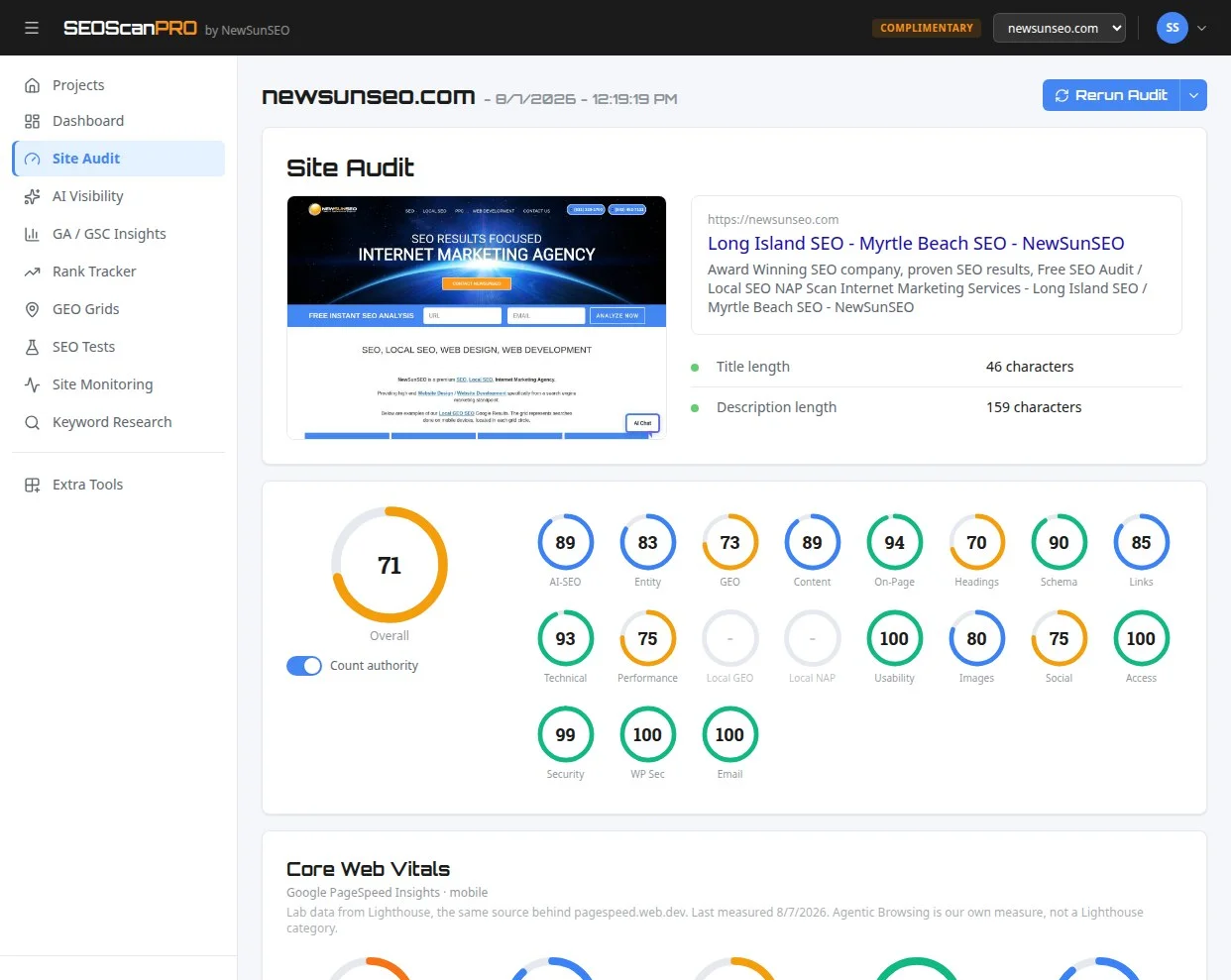
SEOScanPro runs a full technical audit of a site and shows the measured result behind every check. Open the site audit tool.
Sources
Want help with this in Myrtle Beach or Long Island? Talk to us.
NewSunSEO
Grow in Google and AI Search
AI-SEO, local search, paid ads and websites from one team, with offices on Long Island and in Myrtle Beach.
- AI-SEO
- Local AI-SEO
- AI Consulting
- PPC
- Web Design
- Web Development
- Long Island Office(631) 320-1700
- Myrtle Beach Office(843) 492-7131
Request a Free Proposal
Tell us about your business and where you want to grow.
We will reply by email to talk through your goals and what a proposal would include.
We use your details only to reply to you and send what you asked for. See our Privacy Policy.

