


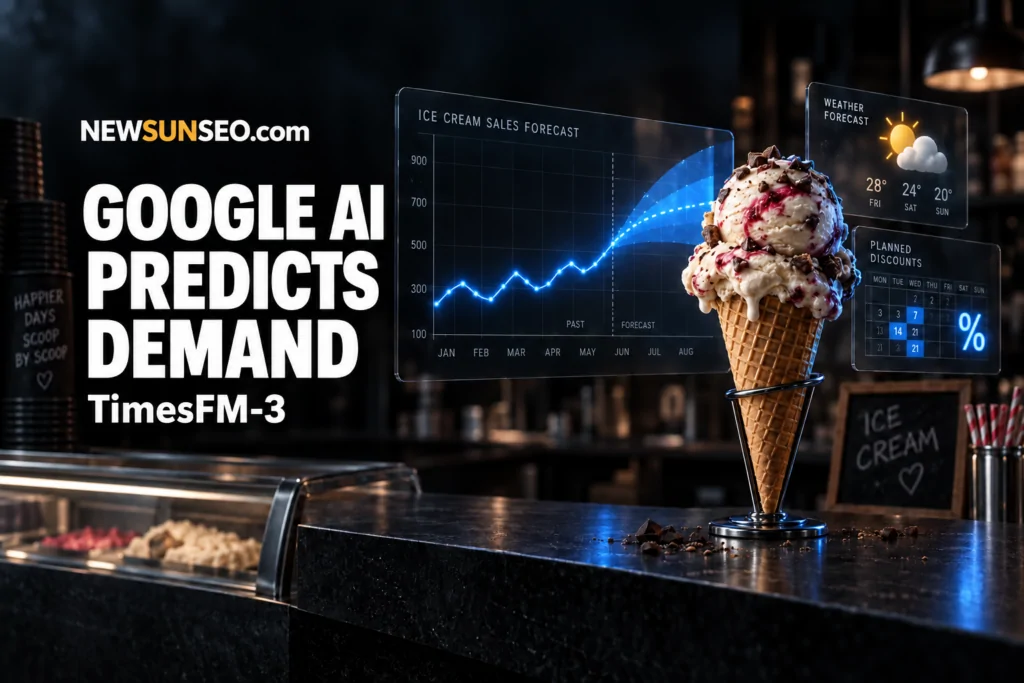
Retail, finance, and operations teams can now generate demand forecasts that weigh planned promotions, weather, holidays, and related products together, using Google Research’s new AI forecasting model, TimesFM-3. The model reads a time series such as daily sales and factors in supporting data and known upcoming events to sharpen each prediction. Google released it with support for multiple variables at once, a capability its earlier versions lacked.
What does TimesFM-3 forecast and how?
Most real forecasts depend on more than one number. Google frames this with a retail chain predicting ice cream sales: a useful forecast also considers related products like waffle cones or syrup, along with past foot traffic, weather, discount campaigns, and holidays. TimesFM-3 is designed to bring those signals into one prediction.
The model is built on a Transformer, the same base architecture as its predecessors. It groups 32 consecutive data points into a single patch and normalizes each series to a common scale, so measurements of very different magnitudes can be compared directly.
TimesFM-3 processes data in two alternating directions. Along the time axis, it looks for patterns within a single series and only draws on past values, which avoids leaking future information. Across series, it compares all variables at a given point in time and learns how they relate. That lets it pick up effects like how a discount on one product changes sales of another.
How large is the model and what data does it use?
TimesFM-3 has 330 million parameters and was trained on real and synthetic time series totaling more than one trillion data points, according to Google. Like earlier versions, it works zero-shot and needs no extra training for a new task.
The model handles three types of supplementary data. It predicts multiple related variables at once, such as different ice cream flavors. It incorporates factors known only for the past, such as historical foot traffic. It also uses known future events like planned discounts or weather forecasts. Rather than a single point estimate, TimesFM-3 outputs nine values per time step to capture the range and uncertainty of each prediction.
Why does one-shot forecasting matter?
Earlier versions predicted the future one block at a time. Google says that approach was slow, compute-heavy, and let errors compound as each prediction built on the last. TimesFM-3 marks all future time steps as blanks and fills them in a single pass.
The ice cream example shows the effect. A model that only knows past sales continues the usual weekly pattern and stays blind to planned promotions. When TimesFM-3 receives the discount schedule, it learns from history how much promotions lift demand and expects roughly 20 percent more units on each promotion day.
How does it perform against other models?
On the Gift-Eval, FEV-Bench, and Time benchmarks, TimesFM-3 ranks first among all pretrained forecasting models in both point accuracy and uncertainty calibration, according to Google. Competitors include Amazon’s Chronos-2, the Toto-2.0 family, and Google’s own TimesFM-2.5. Even limited to a single variable, TimesFM-3 matches or beats the field, and adding more data widens the gap. On FEV-Bench, Chronos-2 comes close to TimesFM-3’s single-variable mode but falls well behind the full version. On the Time benchmark, the Toto-2.0 family follows in second, and TimesFM-2.5 lands well behind the pack.
Where can you use TimesFM-3?
TimesFM-3 is available on GitHub and Hugging Face, and Google plans to add it to BigQuery in the coming weeks. TimesFM-2.5 currently handles single-variable forecasting there through the AI.FORECAST command. Since the family launched in 2024, Google says it has been deployed in retail, finance, manufacturing, healthcare, and the sciences. Every version through TimesFM-2.5, released in September 2025, could process only one data series at a time, which makes the multivariate support in TimesFM-3 a significant step forward.
Google is also building forecasting models beyond time series. In early August, Google DeepMind released WeatherNext Cyclones, an open-source system for tropical cyclones that predicts storm tracks and intensity about a day further out than leading operational models.
FAQ
How big is TimesFM-3 and does it need training for new tasks?
TimesFM-3 has 330 million parameters and was trained on real and synthetic time series totaling more than one trillion data points, according to Google. It works zero-shot, so it needs no extra training to handle a new forecasting task.
What kinds of data can TimesFM-3 factor into a forecast?
It predicts multiple related variables at once, uses factors known only for the past such as historical foot traffic, and incorporates known future events such as planned discounts or weather forecasts. It outputs nine values per time step to express uncertainty.
Where can you access TimesFM-3?
TimesFM-3 is available on GitHub and Hugging Face, and Google plans to add it to BigQuery in the coming weeks. TimesFM-2.5 currently handles single-variable forecasting in BigQuery through the AI.FORECAST command.
Want help with this in Myrtle Beach or Long Island? Talk to us.
NewSunSEO
Grow in Google and AI Search
AI-SEO, local search, paid ads and websites from one team, with offices on Long Island and in Myrtle Beach.
- AI-SEO
- Local AI-SEO
- AI Consulting
- PPC
- Web Design
- Web Development
- Long Island Office(631) 320-1700
- Myrtle Beach Office(843) 492-7131
Request a Free Proposal
Tell us about your business and where you want to grow.
We will reply by email to talk through your goals and what a proposal would include.
We use your details only to reply to you and send what you asked for. See our Privacy Policy.

