


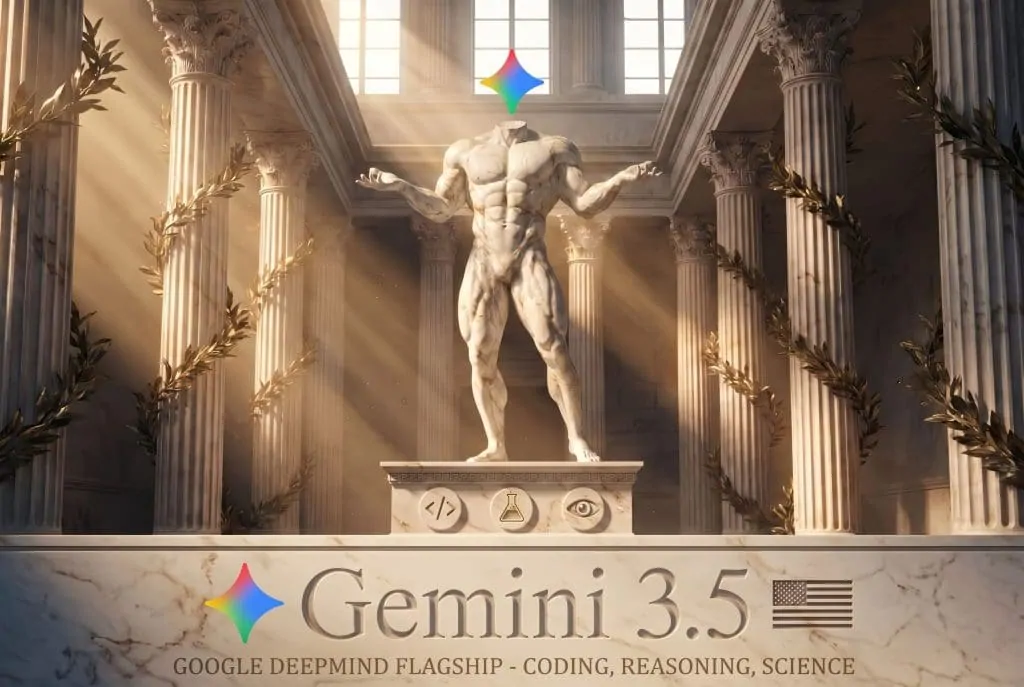
Google has pushed back the release of Gemini 3.5 Pro, its most powerful AI model, past the original June 2026 launch window. The delay, confirmed by a company spokesperson, stems from internal benchmarks showing the model’s coding abilities still aren’t good enough. The news sent Alphabet shares down roughly 4% in intraday trading, as investors and small businesses alike recalibrate their expectations for Google’s AI roadmap.
Why It Matters
Gemini 3.5 Pro was supposed to be the flagship follow-up to Gemini 3.1 Pro, which launched in February. At the Google I/O developer conference in May, CEO Sundar Pichai announced the model with confidence, and Gemini 3.5 Flash shipped that same day. Pro was promised to arrive “the following month.” That deadline passed without a model, a launch date, or a revised schedule, leaving small business owners who plan around AI tools guessing.
The stakes are high because Google’s AI products underpin everything from ad platforms to coding assistants that an increasing number of businesses rely on. The Gemini app itself has surpassed 750 million monthly active users, and the company crossed a $4 trillion valuation earlier this year largely on AI optimism. When the centerpiece model of that momentum hits a wall, it signals that even the largest tech firms are wrestling with the practical limits of quickly shipping capable AI.
What's New / How It Works
In late June, Google refreshed the training data used for Gemini in an effort to boost its coding performance. The results were disappointing, according to multiple reports. Internally, engineers and AI researchers have described the setback as frustrating, and some discussions have even considered scrapping previous base models and starting over. Coding is not the only trouble spot: token efficiency, the model’s ability to handle long-horizon tasks, and agentic features have all been flagged as structural issues that need fixing.
The heavy internal focus on coding makes sense. As of April, 75% of all new code at Google is now AI-generated and approved by engineers, up from 50% last fall. For the company’s own development velocity, reliable code generation is critical. Competitors are pushing hard on coding too. Chinese lab Zhipu recently released GLM-5.2, which rivals Anthropic’s Opus 4.8 on coding benchmarks at roughly one-fifth the cost. OpenAI shipped GPT-5.6, its most advanced model, last week. Google’s delay hands rivals more time to move ahead.
The Numbers
- June 2026: Original launch target for Gemini 3.5 Pro, announced at Google I/O in May. The window passed with no release.
- ~4%: Intraday stock drop for Alphabet after Bloomberg reported the delay.
- 75%: Share of new code at Google that is AI-generated, up from 50% last fall.
- 750 million: Monthly active users on the Gemini app.
- $4 trillion: Alphabet’s valuation threshold crossed earlier this year on AI sentiment.
- Competitive benchmark: Zhipu’s GLM-5.2 matches Opus 4.8 on coding tasks at a fifth of the cost.
"We’re currently testing 3.5 Pro, an upgraded Flash model, and other models with partners, and we’re productively engaged with the U.S. government," a Google spokesperson told Reuters.
What Comes Next
Google says it is “shipping quickly across a wide range of models while keeping them highly cost-effective for customers.” An upgraded Flash model is also in testing alongside 3.5 Pro, so small business users can expect incremental improvements even if the flagship model remains on hold. No firm release date has been set, though some internal sources have speculated a possible mid-July window if ongoing refinements succeed.
The launch now also depends on regulatory cooperation, not just technical readiness. A series of national security reviews and export control orders have complicated frontier AI launches industrywide. OpenAI delayed GPT-5.6 at the government’s request, and Anthropic temporarily disabled its most advanced models in June before adding safeguards. Google’s spokesperson confirmed the company is “productively engaged with the U.S. government,” meaning the final shipping schedule must clear two sets of gates: internal benchmarks and government review.
What This Means for You
The Gemini 3.5 Pro delay shows that AI roadmaps often slip past their announced dates. If you were waiting for Google’s next model to power your content or coding workflows, the wait is now longer. The smarter move is to build your processes around tools already available, such as earlier Gemini versions or competing models, and track market updates without relying on a release date.
Meanwhile, other AI-powered platforms can fill the gap. Feedsta.ai, an AI social media management tool, helps you keep your social profiles active and consistent without waiting for a model upgrade. And BizScoreAI lets you run a free visibility scan to see how often AI assistants like ChatGPT, Gemini, and Perplexity recommend your business, giving you a clear picture of your presence in AI-driven search. These tools let you move forward while the big model vendors sort out their pipelines.
If you’re producing content in-house, solid fundamentals still beat model hype. A partner who understands how AI and human editorial judgment work together can help. Our SEO copywriting service helps businesses create content that performs in both traditional search and AI-powered experiences. And as Google works through its coding performance issues, more affordable open models are stepping up. Check out our recent look at Moonshot AI’s Kimi K3, a 2.8-trillion-parameter open model that rivals top closed systems, a development that offers small businesses new options without waiting for Gemini Pro.
The Bigger Picture
Google’s delay with Gemini 3.5 Pro is not the first major AI timeline slip. Coding remains difficult, even for companies that generate as much code as Google does. The most useful AI for your business is the one you can use today, not one that might arrive next quarter.
Google's flagship AI model missed its window because coding wasn't good enough, and now business owners must plan around what ships, not what's promised.
Frequently Asked Questions
Why has Google delayed Gemini 3.5 Pro?
What is Gemini 3.5 Pro?
How does this delay affect Google's competitive position?
What does this mean for small businesses using AI tools?
When will Gemini 3.5 Pro be released?
How did the delay affect Alphabet's stock?
What other models can small businesses use instead of waiting for Google's flagship?
Want help with this in Myrtle Beach or Long Island? Talk to us.
NewSunSEO
Grow in Google and AI Search
AI-SEO, local search, paid ads and websites from one team, with offices on Long Island and in Myrtle Beach.
- AI-SEO
- Local AI-SEO
- AI Consulting
- PPC
- Web Design
- Web Development
- Long Island Office(631) 320-1700
- Myrtle Beach Office(843) 492-7131
Request a Free Proposal
Tell us about your business and where you want to grow.
We will reply by email to talk through your goals and what a proposal would include.
We use your details only to reply to you and send what you asked for. See our Privacy Policy.

