


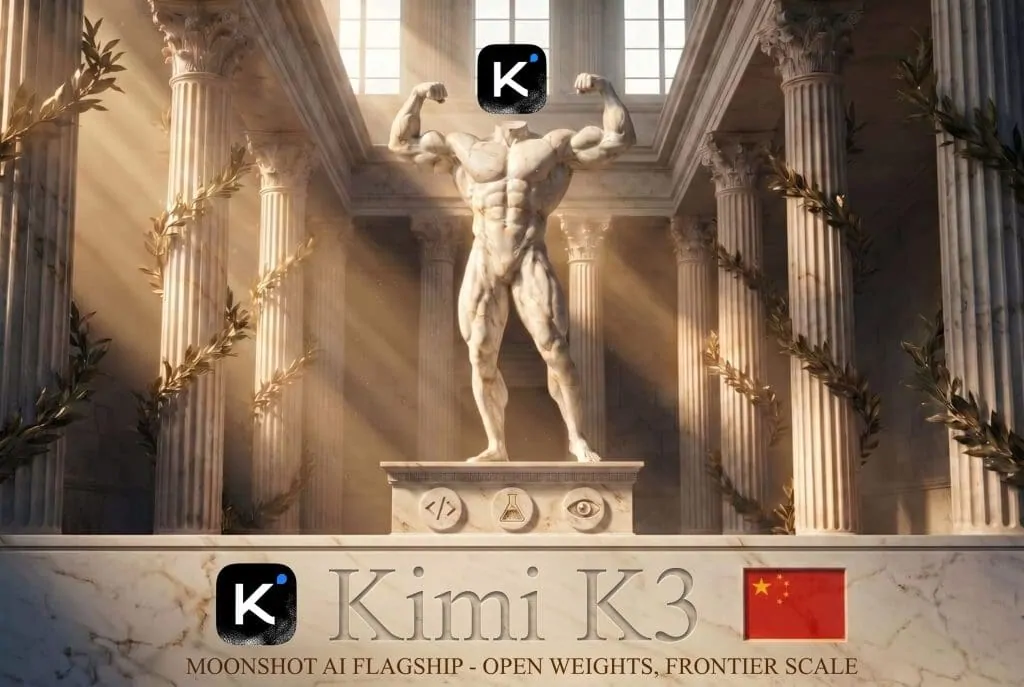
Chinese AI lab Moonshot AI has released Kimi K3, a 2.8-trillion-parameter model that independent benchmarks show trading blows with closed-source heavyweights like Anthropic’s Opus 4.8 and OpenAI’s GPT-5.5. The model is being called the largest open-weight AI model ever made, and its full weights are promised for July 27, 2026. For the first time, a model you can download and run yourself has closed the performance gap with the most advanced proprietary systems.
Open-source AI now matches some proprietary models in capability, letting businesses use comparable AI without vendor lock-in.
Why It Matters
Moonshot AI was once a top player in China’s AI market, but it lost ground dramatically after DeepSeek’s R1 model arrived in early 2025. The Kimi platform slid from third to seventh in monthly active users, and the company had to pivot hard toward open source. Kimi K3 is the result. It arrives at a moment of intense debate about whether businesses should pay for closed-source AI or build on open models they can control.
According to a Financial Times report, Kimi K3 will be the largest open-weight AI model from China, with a parameter count between 2 trillion and 3 trillion. That scale is roughly 75 percent larger than DeepSeek’s V4 Pro, which sits around 1.6 trillion parameters. For a small business owner, this matters because open models like K3 lower the barrier to powerful AI: you can fine-tune them on your own data, host them privately, and avoid the recurring API bills that pile up with services like ChatGPT Enterprise or Claude.
How Kimi K3 Works and What's Inside
Kimi K3 is a frontier-class large language model with 2.8 trillion total parameters. That raw size gives it an unusually deep ability to store knowledge and reason through long problems. The model also brings a 1-million-token context window, enough to ingest an entire book in one prompt, and native multimodal input, meaning it can process images alongside text.
Moonshot built K3 around two architectural innovations it has previously published as open research. The first is Kimi Delta Attention (KDA), a hybrid linear attention mechanism that the company says enables up to 6.3x faster decoding when handling million-token contexts. The second is Attention Residuals (AttnRes), a drop-in replacement for standard residual connections that delivers roughly 25% higher training efficiency at an extra cost of only 2%. Together with a sparse mixture-of-experts design, 16 activated experts out of 896, the architecture lets the model scale to this parameter count while keeping inference costs in check.
On the official Kimi blog, Moonshot also notes that KDA required changes to conventional prefix caching, so the team contributed a KDA-aware caching implementation directly to the vLLM inference engine, making the model usable on day zero.
The Numbers
Early benchmarks, including results from independent evaluator Artificial Analysis and the LMSYS Arena project, paint a consistent picture: Kimi K3 is a top-tier model that sits just behind the very best closed-source systems and ahead of most others.
- 57 on the Artificial Analysis Intelligence Index, comparable to Opus 4.8 and GPT-5.5, and still behind Claude Fable 5 and GPT-5.6 Sol.
- 1,687 on GDPval v2, a real-world task benchmark covering 44 occupations and nine industries. That puts K3 third, behind Fable 5 Max (1,815) and GPT-5.6 Sol Max (1,747.8), and ahead of Opus 4.8 (1,600).
- #1 in Frontend Code Arena with a score of 1,679 and a 76% pairwise win rate, beating Fable 5 (63%) and GPT-5.6 Sol (58%).
- 53% on AutomationBench-AA and #1 on that benchmark, measuring real-world task automation across 8 tests. K3 led in four of them, including BrowseComp and SpreadsheetBench 2.
- 1,547 Elo on AA-Briefcase, a long-horizon agentic knowledge-work test, placing K3 second behind Fable 5 Max.
- $3 per million input tokens, $15 per million output tokens, with cached input dropping to just $0.30 per million; at blended usage that works out to about $5.40 per million tokens, well below the roughly $9 for Opus 4.8.
"Parameters are like neural connections in the human brain, and nearly 3 trillion of them means the model can store more knowledge and patterns in its brain, understand more, think deeper, and answer more accurately," a Moonshot AI executive told Xinhua, China's state news agency.
What Comes Next
Moonshot has committed to releasing the full model weights by July 27, 2026. When that happens, any developer or business with enough GPU capacity will be able to download, fine-tune, and run Kimi K3 themselves. The company is also raising fresh capital at a valuation of $31.5 billion, signaling that it plans to keep scaling. Meanwhile, the Kimi Code CLI, an open-source coding agent that competes with Claude Code, received two updates on the same day as K3’s release, adding background task management, nested subagents, and deeper IDE integration.
In a striking proof-of-concept, the company had K3 design a tiny physical chip over a 48-hour autonomous agent run, reading documentation, running verification loops, and iterating on failures, producing a functional 4mm² design that hit 100 MHz timing convergence and simulated 8,700 tokens per second. That kind of long-horizon agentic behavior is where Moonshot sees the next competitive frontier.
What This Means for You
You do not need to train a 2.8-trillion-parameter model to benefit from it. The open weights release means software companies can build specialized AI tools on top of K3, and those tools will trickle down to businesses like yours. If you have ever hesitated to build a custom chatbot or content assistant because the API costs felt unpredictable, an open model you can self-host, or that a provider can run for you at lower cost, changes the math.
In the meantime, you can already put AI to work with services that handle heavy lifting. Feedsta.ai uses AI to manage your social media presence, creating and scheduling posts so you stay visible without spending hours on content. BizScoreAI gives you a free visibility score that shows how often AI assistants like ChatGPT and Gemini recommend your business, helping you understand where you stand in the new AI search landscape. And when you are ready to turn AI-generated ideas into content that ranks, our SEO copywriting service can help you craft it, or you can get in touch with us to talk about how AI fits into your overall digital strategy. If you want to dig deeper into how AI search is reshaping the long game, read our look at why SEO remains a long-term play amid AI search.
The Bigger Picture
Kimi K3 marks the moment when open-source AI stopped playing catch-up. A model built in Beijing, using techniques the team published openly and contributed back to the developer community, now sits on the same bench as the most advanced closed systems from San Francisco. For a small business owner anywhere, that means the AI model you use to answer customers, draft proposals, or analyze market data does not have to come from a single vendor with a monthly fee. The tools are becoming more capable, more open, and more affordable all at the same time, and that is a trend worth watching closely.
Frequently Asked Questions
What is Kimi K3?
How does Kimi K3 compare to GPT-5 and Claude Opus 4.8?
Is Kimi K3 open source?
How much does it cost to use Kimi K3?
Can a small business run Kimi K3 on its own servers?
What is the significance of the 2.8 trillion parameter count?
What makes Kimi K3's architecture different?
Want help with this in Myrtle Beach or Long Island? Talk to us.
NewSunSEO
Grow in Google and AI Search
AI-SEO, local search, paid ads and websites from one team, with offices on Long Island and in Myrtle Beach.
- AI-SEO
- Local AI-SEO
- AI Consulting
- PPC
- Web Design
- Web Development
- Long Island Office(631) 320-1700
- Myrtle Beach Office(843) 492-7131
Request a Free Proposal
Tell us about your business and where you want to grow.
We will reply by email to talk through your goals and what a proposal would include.
We use your details only to reply to you and send what you asked for. See our Privacy Policy.

