


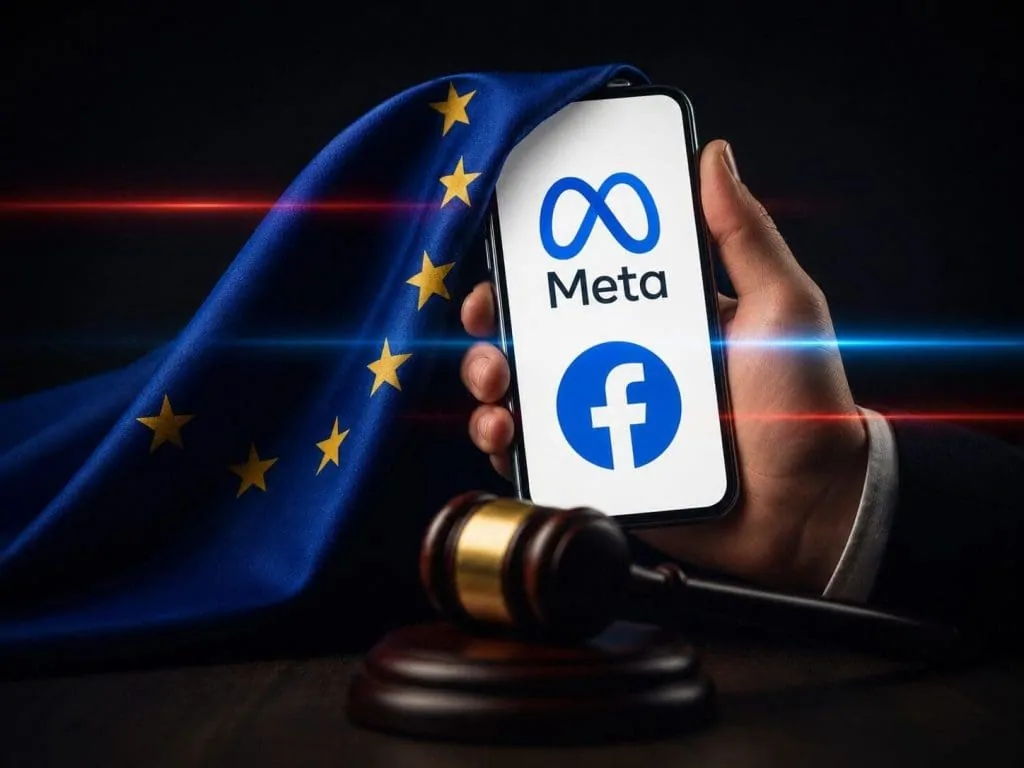
The European Commission on Friday, July 10, issued a preliminary order directing Meta Platforms to modify features on Facebook and Instagram that regulators say drive addictive use, including highly personalized recommendations, autoplay, and infinite scroll. If Meta fails to comply, the company faces fines of up to 6% of annual revenue, roughly $12 billion based on fiscal 2025 figures, under the European Union’s Digital Services Act (DSA).
What the European Commission Is Targeting
The order targets Meta’s platform design. Commission officials determined that Meta failed to conduct adequate risk assessments of how its design choices affect users, including minors and vulnerable adults. The investigation reviewed internal data on how long young users spend on Instagram and Facebook at night, and how format-specific optimization, including the design of Reels and Stories, may encourage compulsive behavior.
“These features fuel the user’s urge to keep scrolling and shift the brain into ‘autopilot mode,’ contributing to unhealthy habits and compulsive use,” the commission said in its press release.
What Changes Is the Commission Demanding?
- Removal of infinite scroll and autoplay from the core feed experience.
- Introduction of mandatory screen time breaks.
- Adjustment of recommendation algorithms to be “less engagement oriented.”
- A formal reassessment of push notifications and personalized content systems, including how those systems handle data on nighttime use by minors.
The order is preliminary. Meta has the right to present its case before the European Commission issues a final ruling.
How Has Meta Responded?
Meta rejected the preliminary findings. A company spokesperson said the commission “doesn’t accurately take into account the significant steps we’ve taken to protect teens,” pointing to the rollout of Teen Accounts, a feature that lets parents restrict access to Facebook and Instagram during nighttime hours.
Meta also highlighted existing parental controls and time management tools. Regulators, however, argued that voluntary safeguards are insufficient because the underlying platform design continues to encourage compulsive use.
How Does This Fit the DSA Enforcement Picture?
The DSA, which took effect in August 2023, requires large online platforms to assess and mitigate systemic risks to physical and mental well-being, including harms linked to addictive design. The Meta action follows earlier DSA enforcement against other major platforms:
- A roughly $140 million fine against Elon Musk’s X platform.
- An accusation of “addictive design” violations against TikTok.
Where Else Is Meta Facing Pressure?
Meta faces more than 2,400 related lawsuits in the United States. Earlier in 2026, the company lost a product liability trial in Los Angeles and was hit with a $375 million judgment in New Mexico over findings that the company knowingly harmed children’s mental health and enabled child sexual exploitation.
The Trump administration has separately pushed back against the DSA, with senior State Department officials describing the law as “Orwellian censorship” and lobbying European counterparts to soften enforcement.
What Comes Next?
The preliminary findings open a formal proceeding in which Meta can submit evidence and argument before the commission issues a final decision. If the order is upheld, Meta will be required to implement the changes within a set timeframe or face the maximum fine.
The case is one of several recent confrontations between European regulators and major U.S. technology companies, with Brussels signaling that the DSA will remain an active enforcement tool across the social media sector.
FAQ
What did the European Commission order Meta to do?
On July 10, the European Commission issued a preliminary order directing Meta to modify Facebook and Instagram features, including removing infinite scroll and autoplay from the core feed, adding mandatory screen time breaks, and adjusting recommendation algorithms to be “less engagement oriented.”
What penalty could Meta face under the DSA?
If Meta does not comply with the order, the company could face fines of up to 6% of its annual revenue, roughly $12 billion based on fiscal 2025 figures, under the European Union’s Digital Services Act.
How did Meta respond to the preliminary order?
Meta rejected the preliminary findings, with a spokesperson saying the commission “doesn’t accurately take into account the significant steps we’ve taken to protect teens,” and pointed to Teen Accounts, existing parental controls, and time management tools.
Related coverage
- European Commission Orders Meta to Alter Addictive Features on Facebook and Instagram
- Meta pulls Instagram AI image tool after privacy backlash
Want help with this in Myrtle Beach or Long Island? Talk to us.
NewSunSEO
Grow in Google and AI Search
AI-SEO, local search, paid ads and websites from one team, with offices on Long Island and in Myrtle Beach.
- AI-SEO
- Local AI-SEO
- AI Consulting
- PPC
- Web Design
- Web Development
- Long Island Office(631) 320-1700
- Myrtle Beach Office(843) 492-7131
Request a Free Proposal
Tell us about your business and where you want to grow.
We will reply by email to talk through your goals and what a proposal would include.
We use your details only to reply to you and send what you asked for. See our Privacy Policy.

