


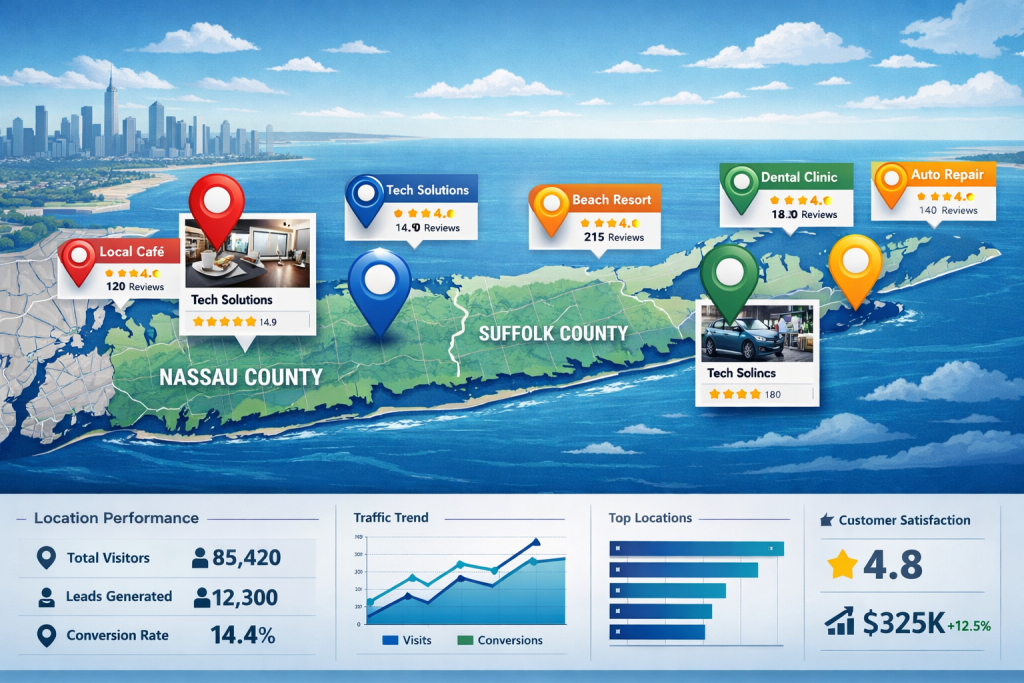
Managing local SEO across multiple locations or a large enterprise operation across Nassau and Suffolk introduces architecture, management, and risk challenges beyond single-location SEO. Each location functions as a separate local entity, with its own Google Business Profile, reviews, location landing pages, and citation footprint that must be maintained independently.
The structural problems specific to multi-location and enterprise local SEO and the approaches that work in the Long Island and New York metro market are outlined below.
What Are the Core Challenges of Multi-Location Local SEO?
The most common structural mistake in multi-location local SEO is treating multiple locations as the same business with different phone numbers. Google doesn’t see it that way. Each location is a separate local entity with separate relevance signals. A dental practice with offices in Hempstead, Massapequa, and Babylon needs three separate Google Business Profiles, three separate sets of location-specific reviews, and three separate location landing pages on the website, not a single page listing all three addresses.
How Should Location Pages Be Differentiated?
Location landing pages need to be genuinely differentiated. Not "We serve Massapequa, [same content as Hempstead page]," because Google’s duplicate content detection handles this appropriately. Each location page should include: the specific address and contact information for that office, the specific practitioners or staff at that location, local landmarks and directions, and any services or specialties particular to that office. The effort is significant, but so is the payoff. Each location can rank in its own local 3-pack independently.
How Do You Manage Reviews at Scale?
For a single location, review management is a discipline. For five locations, it’s a system. Each Google Business Profile listing accumulates its own reviews independently, meaning a business with four Long Island locations needs four separate review generation workflows and four sets of consistent responses.
The problem enterprises encounter most often is uneven review distribution. Three locations have strong review profiles; one is lagging. The lagging location ranks poorly in its market while the others perform well. Regular auditing of review velocity across all locations, not just the total company average, is necessary to catch and correct these imbalances before they compound.
Review response at scale usually requires either dedicated staff time or a structured delegation process. Each response needs to feel genuine, not templated. A templated response that begins "Thank you for your feedback! We are pleased to serve you!" applied to every review across every location is detectable as automation and reduces the trust signal reviews are supposed to provide.
Why Does Enterprise Citation Management Matter?
NAP (Name, Address, Phone) consistency is important for a single business. For a multi-location enterprise, it’s a data management problem. A business with 8 locations that has been operating for 10 years has almost certainly accumulated inconsistent citations across directories, old phone numbers, former addresses, and different business name variations ("XYZ Plumbing" vs. "XYZ Plumbing Co." vs. "XYZ Plumbing Services LLC"). Each inconsistency weakens the entity signals for that location.
A systematic citation audit, checking each location against the major directories (Google, Yelp, Bing Places, Apple Maps, BBB, Chamber of Commerce) and correcting inconsistencies, is foundational work before any other local SEO effort. It’s unglamorous, but it’s the prerequisite. AI-driven search results are particularly sensitive to entity consistency because they’re cross-referencing sources to build confidence before making a recommendation. Multiple sources agreeing on your information amplifies your AI visibility.
How Do You Report on Enterprise Local SEO?
Single-location local SEO success is relatively easy to measure: calls, direction requests, website traffic from local search, conversion rate. For multi-location enterprises, the reporting challenge is aggregating these metrics in ways that show overall performance while also surfacing individual location underperformance.
The most useful reporting framework for enterprise local SEO tracks: GBP search impressions and action rates per location, review velocity and average rating trend per location, local pack ranking for core keywords per location market, and conversion metrics (calls, form fills) attributed to each location. Rollup numbers are useful for executive reporting; location-level breakdowns are essential for identifying where to invest effort.
Long Island enterprises with complex multi-location setups, including healthcare systems, large service contractors, and franchise networks, face a level of local SEO management that requires either significant in-house resources or a partner with the infrastructure to handle it at scale. NewSunSEO works with organizations across both Nassau and Suffolk on enterprise local SEO programs. Contact us here if you want to discuss what that looks like for your specific situation.
Wondering if your own business shows up in ChatGPT, Gemini, or Perplexity? Run a free BizScoreAI scan to check your AI Visibility Score and get a prioritized list of fixes.
Keep your social presence active across platforms with Feedsta, which may help create, schedule, and analyze posts so your brand can stay visible where customers research your business.
FAQ
Why does multi-location local SEO require separate Google Business Profiles?
Google treats each location as a separate local entity with independent relevance signals. A business with multiple Long Island offices, such as a dental practice in Hempstead, Massapequa, and Babylon, needs a distinct Google Business Profile, a distinct set of location-specific reviews, and a distinct location landing page for each office in order to rank in that location’s local 3-pack.
What should each location landing page include?
Each location page should include the specific address and contact information for that office, the specific practitioners or staff at that location, local landmarks and directions, and any services or specialties particular to that office. Duplicating content from one location page to another is detectable by Google’s duplicate content detection and undermines rankings.
What metrics should enterprise local SEO reporting track?
Useful enterprise local SEO reporting tracks GBP search impressions and action rates per location, review velocity and average rating trend per location, local pack ranking for core keywords per location market, and conversion metrics such as calls and form fills attributed to each location. Rollup numbers serve executive reporting, while location-level breakdowns are required to identify where to invest effort.
Want help with this in Myrtle Beach or Long Island? Talk to us.
NewSunSEO
Grow in Google and AI Search
AI-SEO, local search, paid ads and websites from one team, with offices on Long Island and in Myrtle Beach.
- AI-SEO
- Local AI-SEO
- AI Consulting
- PPC
- Web Design
- Web Development
- Long Island Office(631) 320-1700
- Myrtle Beach Office(843) 492-7131
Request a Free Proposal
Tell us about your business and where you want to grow.
We will reply by email to talk through your goals and what a proposal would include.
We use your details only to reply to you and send what you asked for. See our Privacy Policy.

