


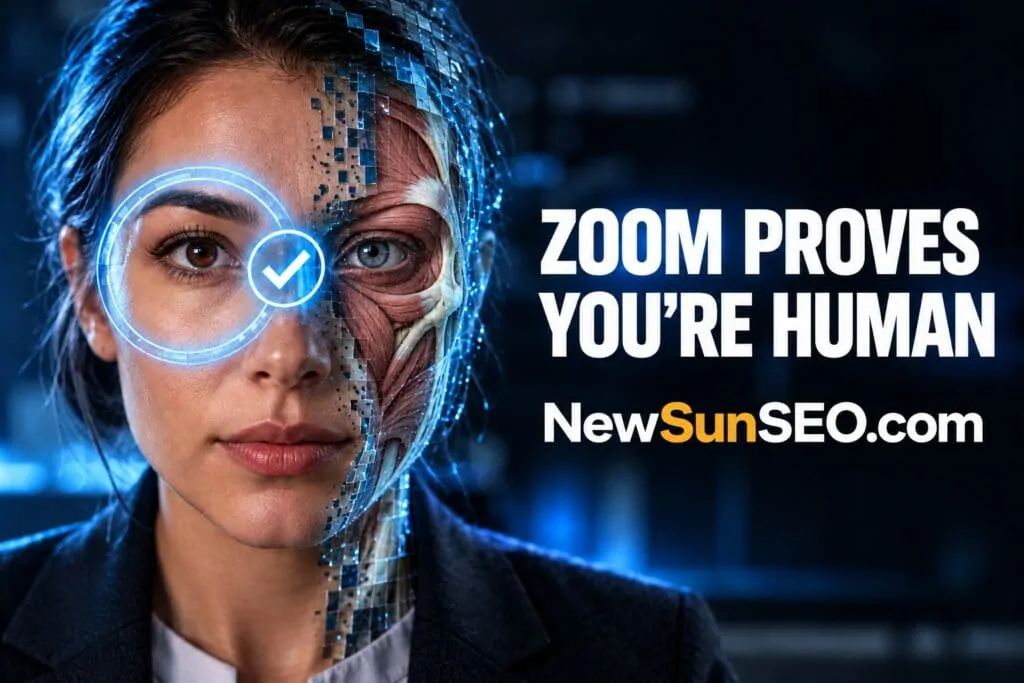
The integration can help distinguish a real participant from an AI-generated impersonation before a meeting creates potential business risk.
World, the project backed by OpenAI CEO Sam Altman, says World ID for Zoom is generally available through the Zoom Marketplace. The system uses biometric verification and cryptography, and it is aimed at conversations where a convincing video feed could lead to a payment, contract, credential exchange or other sensitive decision.
How the Zoom proof of human badge works
The badge appears after three images match:
- An image captured by World’s iris-scanning Orb during identity verification.
- A live selfie taken through the World ID app.
- The video frame that other participants see in the Zoom meeting.
World describes this as a three-way cryptographic match. The Orb image acts as the reference point, while the selfie checks that the person is physically present and the live Zoom feed connects the verification to the current call. If the match succeeds, the Human Badge may appear on the participant’s Zoom tile for everyone in the meeting.
Participants first complete verification through an Orb, connect their verified World ID to Zoom and take a selfie when prompted during the meeting. World’s product documentation states that the app does not share biometric data with Zoom. The app receives a yes-or-no verification signal, while Zoom sees the user name and unique-human status rather than biometric details.
World said hosts can set how long a Human Badge remains active before reauthentication is required. Hosts can also request proof during a meeting and, in a forthcoming release, place verification in a waiting-room process before participants enter.
Why the launch matters for agencies and client websites
Choose appropriate controls for each type of client meeting and make participant verification a separate decision.
The source material does not say that a badge proves a participant’s job title, authority to spend money or identity within a particular company. It may verify that a real, unique human is present. Agencies should therefore treat it as one layer around a meeting policy, not as the final control on a payment or account change.
The system is also different from scanning a video frame for signs of manipulation. Deepfake detection tries to infer whether a frame is fake, which can change as generation methods change. World’s approach instead may compare a live person with a previously verified biometric reference and the current Zoom feed.
The business risk behind the feature
Two incidents cited in the source article show why a video meeting can no longer be treated as proof of identity by itself. In 2024, an employee at engineering firm Arup reportedly transferred about $25 million after scammers impersonated executives during a video conference. In February, hackers suspected of being linked to North Korea reportedly used fabricated video feeds in fake Zoom meetings to trick crypto and fintech companies into installing malware.
World’s announcement cited a 2025 Gartner survey of cybersecurity leaders in which 62% of respondents said their organization had been subjected to a deepfake attack in the previous year. It does show that security teams are reporting deepfake attacks at a scale that makes identity signals relevant to enterprise meeting controls.
The financial focus also reflects where organizations are testing the product. Bain Capital, OpenExchange, Outtake, Pantera Capital and VanEck Funds were named as initial design partners for World’s broader verification technology. World ID for Zoom had previously been in a limited beta with VanEck Funds.
What to do now
- Ask the agency which client meetings need verification. Start with calls that involve payments, account access, contracts, credentials or confidential business information.
- Keep the client’s existing approval rules in place. Use a Human Badge as part of the meeting rather than as a substitute for the client’s permission checks or approval workflows.
- Ask what data the client’s team must share. World states that biometric data is not shared with Zoom and that the integration passes only a verification signal to the World ID app.
- Review how long verification remains active. World says organizations and hosts can configure how long a Human Badge stays active before a participant must reauthenticate.
What the badge proves and what it does not
A Human Badge may indicate that the system matched a verified Orb image, a live selfie and the person’s current Zoom video feed. It is intended to help address synthetic impersonation and make a human presence visible in the meeting.
Use the feature with client approval rules and account security.
According to World, World ID for Zoom is designed to prove that a real and unique human is present and protect sensitive, high-stakes conversations (Cointelegraph).
FAQ
What is the Zoom proof of human badge?
Participants who have passed World ID verification may see a Zoom proof of human badge next to their name. According to World ID verification, a real, unique human may be present in the meeting.
How does World ID verify someone on a Zoom call?
World ID compares three images: an image captured by the Orb, a live selfie taken through the app and the video frame shown in Zoom. According to World ID, all three may need to match for the Human Badge to appear.
Why are financial firms early users of the Zoom deepfake badge?
Financial firms were named as design partners. The source article also cites a 2024 Arup case involving about $25 million and malware campaigns against crypto and fintech companies.
Sources
Want help with this in Myrtle Beach or Long Island? Talk to us.
NewSunSEO
Grow in Google and AI Search
AI-SEO, local search, paid ads and websites from one team, with offices on Long Island and in Myrtle Beach.
- AI-SEO
- Local AI-SEO
- AI Consulting
- PPC
- Web Design
- Web Development
- Long Island Office(631) 320-1700
- Myrtle Beach Office(843) 492-7131
Request a Free Proposal
Tell us about your business and where you want to grow.
We will reply by email to talk through your goals and what a proposal would include.
We use your details only to reply to you and send what you asked for. See our Privacy Policy.

