



Pages from private AI chat sessions were appearing in Google search results, and the cause traced back to a single technical SEO mistake: the platform hosting those chats had not told search engines to stay away. Site owners publishing any kind of AI generated content can use the same incident as a checklist for keeping unintended pages out of the index.
What actually happened
Shared conversation pages from Anthropic’s Claude product were indexed by Google and visible in search results. The pages were created when a user clicked the share button on a Claude chat, which generated a public URL. That URL was then crawled and stored by Google like any other public web page.
The issue was not that the chats were leaked or hacked. The pages were designed to be shareable. The problem was that the robots.txt file and related meta directives on Anthropic’s share domain did not block crawlers from indexing those shared chat URLs. Anyone with the link could view the conversation, and Google could index it.
Why it is a technical SEO issue, not a security one
Search engines rely on two main signals to decide what to crawl and index. The first is the robots.txt file at the root of a domain, which tells compliant crawlers which paths they are allowed to request. The second is the robots meta tag on individual pages, which tells crawlers whether a page should be indexed and whether its links should be followed.
If either signal is missing or misconfigured, search engines will treat a publicly accessible page as fair game. That is what happened with the shared Claude pages. The URLs were live, the content was rendered, and nothing in the site configuration asked Google to leave them alone.
What the indexing exposed
Once the pages appeared in search results, the indexed content often included the full conversation between the user and the AI assistant. In many cases the user’s prompts contained personal details, business strategies, draft code, medical questions, or other information the user had assumed was private to the chat session.
This is a useful reminder for any platform that generates pages from user content. If a feature produces a URL, search engines will eventually try to crawl it. The only protection is to block them in advance.
What site owners should check on their own properties
Sites publishing AI generated, user generated, or other dynamically created pages should run a few practical checks.
Audit every path that creates a public URL
Map out every place a user action produces a new page. Shared previews, printable views, draft pages, test environments, and internal search results all count. Each of these is a potential entry point for a crawler.
Verify robots.txt coverage
Open the robots.txt file at the root of every subdomain that serves user content. Confirm that any path generating dynamic pages from user input is disallowed for major crawlers. A site that allows crawling of internal search results, for example, often ends up with thousands of low-quality URLs in the index.
Check the robots meta tag on templates
Page level directives matter too. Templates for shared links, preview modes, and logged in views should carry a noindex robots meta tag. A block in robots.txt stops crawling but still allows indexing in rare edge cases; a noindex tag is the stronger signal.
Use X-Robots-Tag headers where useful
For pages that return non-HTML responses, such as PDFs or API responses that render as pages, an X-Robots-Tag HTTP header can carry the same noindex instruction.
Set canonical URLs carefully
If a shared chat page is supposed to exist but not appear in search, give it a canonical tag pointing back to the main domain or to a noindexed parent. This helps search engines understand the page’s role.
Monitor the index for unexpected URLs
Run a site: search in Google for the registered domain regularly. Look for URLs that match patterns like /share/, /preview/, /draft/, or query strings that should never have been crawled. Any unexpected URL in the index is a signal that a block is missing.
The wider lesson for AI generated content
Any product that uses an AI model to generate text on demand faces the same risk. A chatbot, a content generator, a study helper, and a customer support assistant all produce strings that can be turned into URLs. If those URLs go live without index control, search engines will treat them as regular web pages.
For business owners, the takeaway is simple. Treat every dynamic page the same way a privacy-aware publisher treats a draft: assume it will be crawled, and configure the site to say otherwise. The cost of blocking crawlers from a path that should never be indexed is small. The cost of failing to block them, once a sensitive conversation lands in the search results, is much larger.
FAQ
Why were Claude chat pages showing up in Google search?
Shared Claude conversation URLs were publicly accessible, and Anthropic’s share domain did not block search engine crawlers or carry a noindex directive. Google indexed the pages like any other public content.
Was the Claude indexing a data breach?
No. The shared pages were designed to be viewable by anyone with the link. The problem was that they were also being indexed by Google, which made them discoverable to anyone using search.
How can site owners stop their dynamic pages from being indexed?
Block crawler access to the relevant paths in robots.txt, add a noindex robots meta tag to page templates, use X-Robots-Tag headers for non HTML responses, and audit the index regularly for unexpected URLs.
Related coverage
- Anthropic Just Released Claude Security: A Guide for Agencies and Site Owners
- What Is Google Gemini? A Guide for Business Owners
SEOScanPRO
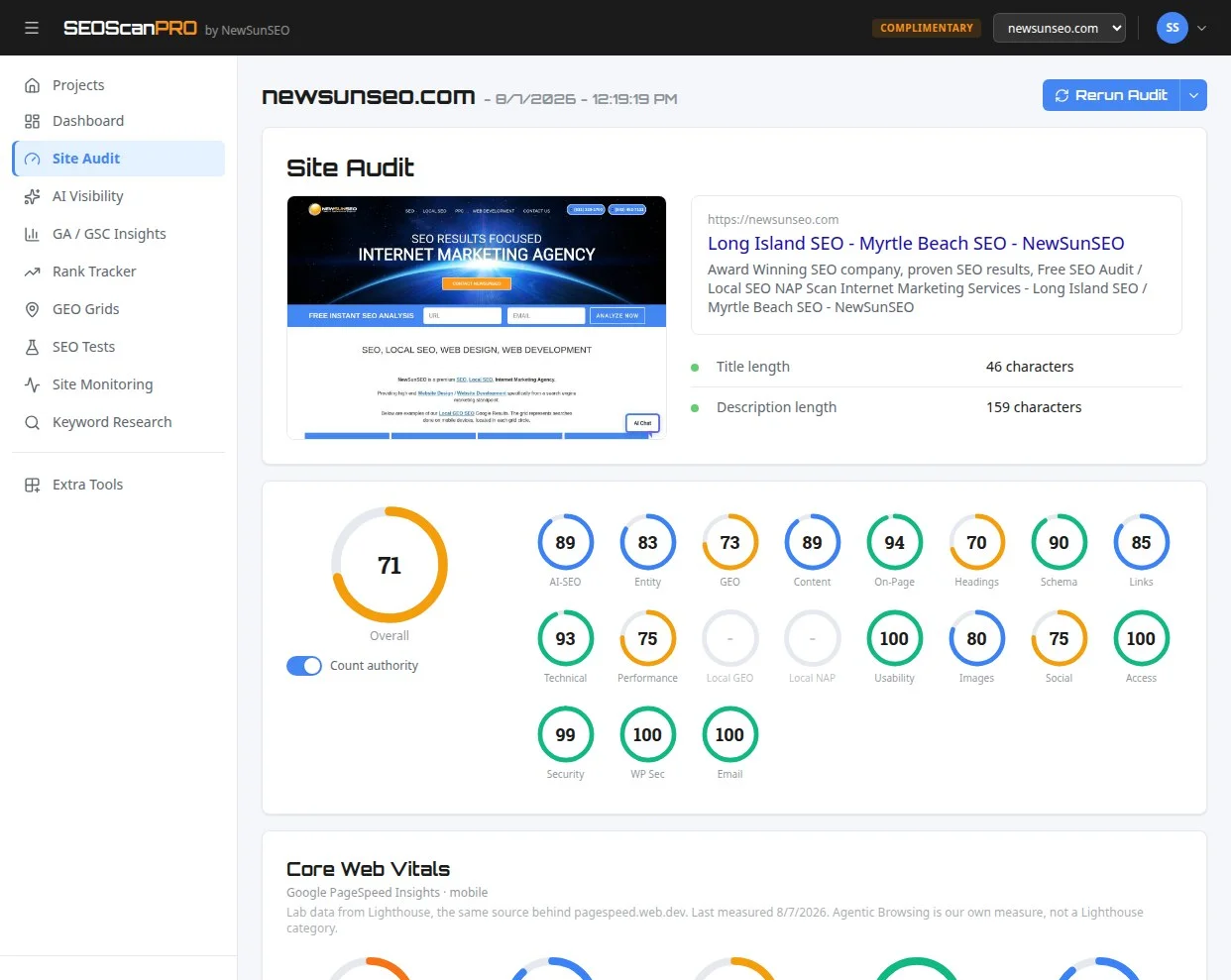
SEOScanPRO’s site audit tool runs a full technical audit of a site and shows the measured result behind every check. Open the site audit tool.
Want help with this in Myrtle Beach or Long Island? Talk to us.
NewSunSEO
Grow in Google and AI Search
AI-SEO, local search, paid ads and websites from one team, with offices on Long Island and in Myrtle Beach.
- AI-SEO
- Local AI-SEO
- AI Consulting
- PPC
- Web Design
- Web Development
- Long Island Office(631) 320-1700
- Myrtle Beach Office(843) 492-7131
Request a Free Proposal
Tell us about your business and where you want to grow.
We will reply by email to talk through your goals and what a proposal would include.
We use your details only to reply to you and send what you asked for. See our Privacy Policy.

