



Readers searching Google may soon see a new gate before any results load: a human-verification prompt that forces a quick check before the page renders. The latest test, spotted in early September 2026, asks users to click a Continue button that only activates after Google confirms the request came from a real person, adding another layer to the company’s ongoing effort to stop automated scraping of its search results.
What the new prompt looks like
When the verification step appears, the Continue button starts gray and stays disabled for a few seconds. Once Google finishes its check, the button turns blue and becomes clickable, allowing the search to proceed. The behavior has been confirmed in screenshots and posts on X from people who encountered it during regular browsing, including a private-browsing test that reproduced the same gate on the third page of results.
This sits alongside the methods Google has been layering on over recent months. In early August 2026, Google tested requiring a sign-in to prove the searcher was human before returning results. That older test came with the company’s broader push on goto redirects, sign-in gates, and the familiar CAPTCHAs that have long flagged suspicious traffic. The new Continue-button variant does not require an account, only a short verification window, which makes it less intrusive for signed-out and private-browsing users while still raising the cost for bots that scrape at scale.
Why Google keeps adding these gates
Search results pages are a primary target for scraping because they contain structured data, local packs, ads, and ranking signals that downstream tools and competitors want to harvest. A single bot can pull thousands of queries per minute from a residential or datacenter IP range, and that volume distorts click-through rates, skews rank-tracking data, and feeds AI training pipelines without contributing real ad revenue. By inserting a verification step, Google forces every request through a check that automated clients struggle to pass at scale, which reduces the throughput of unauthenticated scraping and protects the quality of the data behind the results page.
The pattern matches a wider industry move toward proof-of-human gates on high-value endpoints. Cloudflare’s Turnstile and similar services now sit in front of many large sites, and AI companies building web crawlers have faced increasing pressure to identify their traffic and respect rate limits. Google’s take is its own implementation, tuned to search specifically, and it gives the company a way to throttle suspect sessions without fully blocking them.
What it means for SEO tools and rank tracking
For anyone running rank trackers, local-grid reports, or AI-visibility audits, a Google verification step is a direct threat to data collection. Tools that hit Google from datacenter IPs at high frequency are the most likely to get flagged, and a Continue-button gate that requires a real browser session can quietly turn into a missed data point or a tracked-keyword gap. This is exactly the kind of friction that makes local visibility reporting harder, since the difference between ranking well in one suburb and being invisible in the next can vanish when the data behind the report stops coming in cleanly.
Rank tracking at the service-area level, where position varies by town, is the part most exposed. A geo grid report needs hundreds of queries from a single session to map which neighborhoods a business shows up in, and a verification wall in the middle of that run breaks the dataset. SEOScanPRO’s GEO Grids run this kind of location-by-location rank check and show the measured result behind every cell, so the underlying method stays visible when Google’s gates start to bite.
How to read the rollout
Tests like this rarely ship to everyone at once. Google tends to roll verification experiments to small slices of traffic, often by browser, language, or geography, and watches how bots and humans respond before deciding whether to expand, adjust, or retire the prompt. The fact that the Continue-button variant has now been seen in at least two languages and across different browsing modes suggests it is past the very earliest probe stage, but the gray-to-blue delay, the lack of sign-in, and the placement on later result pages all point to a flow Google is still tuning.
For SEOs, the practical read is straightforward: assume that scraping-style rank tracking will keep getting harder, and that the tools which survive the change will be the ones built around real-browser sessions, residential IP diversity, and slower query cadences. Audit dashboards that show the raw signal behind each metric, rather than a smoothed average over a noisy dataset, will be the ones that stay trustworthy as Google tightens the front door.
FAQ
What is the new Google human verification prompt?
It is a test where Google shows a Continue button that stays gray for a few seconds while it verifies the request, then turns blue and becomes clickable before search results load.
Do you need to sign in for the new Google verification?
No. Unlike the earlier August 2026 test that required sign-in, the Continue-button variant only asks for a short verification check and does not require a Google account.
Why is Google adding human checks to search results?
Google is layering verification steps, including sign-in gates, CAPTCHAs, goto redirects, and the new Continue button, to block bots from scraping search results at scale and protect the data behind the results page.
Related coverage
- Google AI Search Box, Local Sponsorships and Review ROI in 2026
- Search Everywhere Optimization: Why Google Alone Isn’t Enough in 2026
- ChatGPT SEO: 8 Proven Strategies to Show Up in AI Search Results (2026)
SEOScanPRO
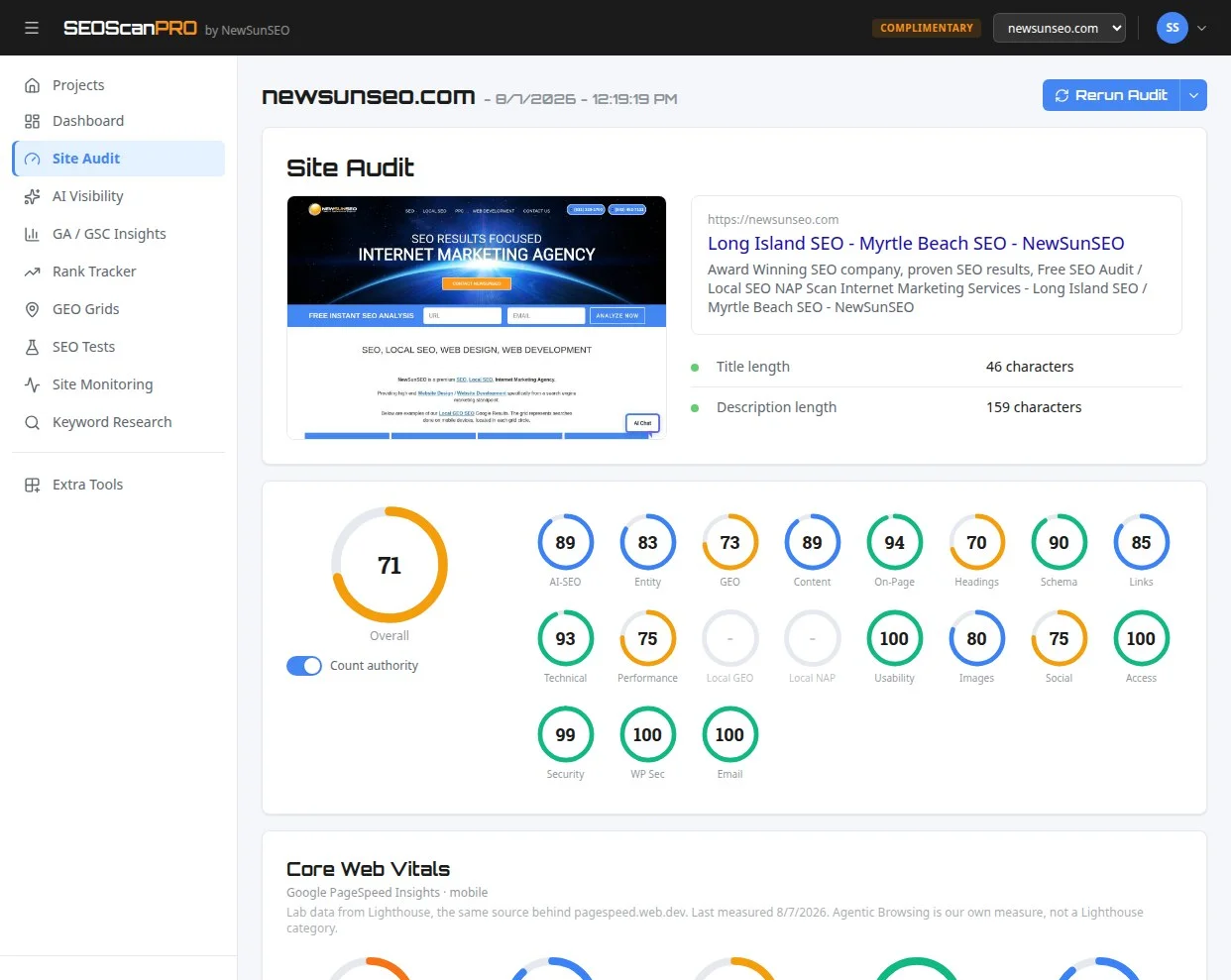
SEOScanPRO’s site audit tool runs a full technical audit of a site and shows the measured result behind every check. Open the site audit tool.
Want help with this in Myrtle Beach or Long Island? Talk to us.
NewSunSEO
Grow in Google and AI Search
AI-SEO, local search, paid ads and websites from one team, with offices on Long Island and in Myrtle Beach.
- AI-SEO
- Local AI-SEO
- AI Consulting
- PPC
- Web Design
- Web Development
- Long Island Office(631) 320-1700
- Myrtle Beach Office(843) 492-7131
Request a Free Proposal
Tell us about your business and where you want to grow.
We will reply by email to talk through your goals and what a proposal would include.
We use your details only to reply to you and send what you asked for. See our Privacy Policy.

