



A clearer path to recovery is now available for sites that dropped in search after submitting links to the disavow tool. Google has confirmed the tool still has measurable effects on a site’s visibility, while reiterating that most sites do not need to use it at all. When a ranking drop lines up with a disavow submission, the right next steps are cleaning up the file and ruling out broader causes such as spam updates or technical issues.
What Google actually said about the disavow tool
On Reddit, a Google search relations team member addressed a site owner whose rankings fell after links were added to the disavow file. The response pushed back against the idea that the tool is useless: “There’s a lot of hate on the disavow tool here, but it has its place and time. It does have effects.”
The same response clarified what the tool will not do. Disavowing a small number of links will not on its own remove a site from search results. The tool influences how Google treats specific incoming links, not the overall health of a site.
Why the site in question actually dropped
The Reddit thread that prompted the response involved a site tied to selling guest posts and link placements through services such as Fiverr. That context matters, because Google treats paid link schemes as a spam signal separate from any single disavow entry.
Two other causes were cited as more likely explanations for the drop.
- A Google spam update ran around the same time as the ranking change. Recovery from a spam update can take many months to appear in rankings.
- Major technical problems on the site, beyond small mistakes such as a wrong canonical tag. The example given was accidentally blocking the entire site from crawling.
What to do when a site drops after disavowing links
When rankings drop shortly after updating a disavow file:
- Rewrite the disavow file so it contains only the links that genuinely need to be disavowed. That file may end up empty.
- Check whether a spam update ran during the same period, since recovery timelines after an algorithmic change are measured in months, not days.
- Audit technical issues on the site, focusing on large problems such as site-wide crawl blocks, not minor tags.
Broad or imprecise disavow submissions can obscure the real cause of a ranking decline.
How Google has framed the disavow tool over time
Google has consistently told site owners not to use the disavow tool by default. Past statements include that most sites do not need to disavow backlinks and that disavowing links can waste time. Google has also said the tool hurts many more sites than it helps and has reinforced its advice that publishers should leave it alone.
That history makes the latest statement a refinement rather than a reversal. The tool still works, but only when applied to a specific set of links that a site owner can justify. Blanket disavow files, especially those built by third-party tools without review, tend to do more harm than good.
When the disavow tool is the right call
The disavow tool fits a narrow set of situations:
- A site has a manual action for unnatural links and the file is required as part of reconsideration.
- A site knows it built or acquired low-quality links it cannot remove and wants Google to ignore those specific links.
- A site is cleaning up after a negative SEO attack that left behind a large set of spammy links.
Outside those cases, the safer path is to leave the disavow file empty and focus on producing content that earns links naturally. For those who want to see how Google views their backlink profile, an SEO audit reveals which links are most likely to be counted and which may be dragging on visibility.
What a clean disavow file looks like
A practical disavow file is short and specific. It lists only domains or URLs that the site owner has confirmed are spammy or paid and cannot be removed. Anything vague, included on automated advice, or copied from a competitor’s profile is a candidate for removal from the file. After every update, rankings should be monitored so that any negative effect shows up early and can be traced back to a specific change.
FAQ
Does the Google disavow tool still work?
Yes. Google has confirmed the disavow tool does have effects on how specific links are treated, while noting that disavowing a handful of links will not remove a site from search on its own.
When should a site use the disavow tool?
The tool is meant for cases such as a manual action for unnatural links, links the site owner cannot remove, or cleanup after a negative SEO attack. Most sites do not need to use it.
What should a site owner check after rankings drop following a disavow submission?
Review the disavow file so it only contains links that truly need to be disavowed, check whether a spam update ran during the same period, and audit for large technical issues such as site-wide crawl blocks.
Related coverage
SEOScanPRO
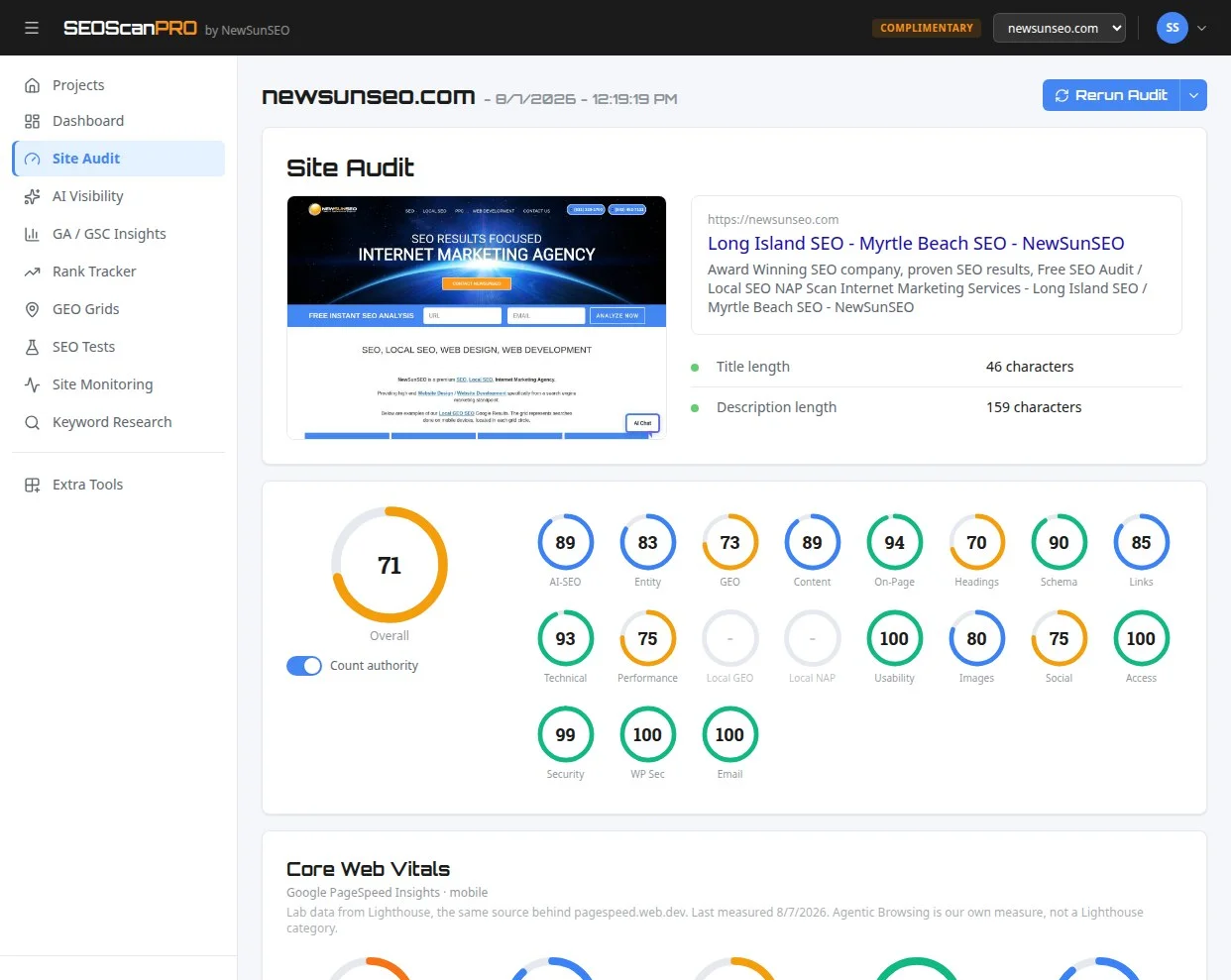
SEOScanPRO runs a full technical audit of a site and shows the measured result behind every check. Open the site audit tool.
Want help with this in Myrtle Beach or Long Island? Talk to us.
NewSunSEO
Grow in Google and AI Search
AI-SEO, local search, paid ads and websites from one team, with offices on Long Island and in Myrtle Beach.
- AI-SEO
- Local AI-SEO
- AI Consulting
- PPC
- Web Design
- Web Development
- Long Island Office(631) 320-1700
- Myrtle Beach Office(843) 492-7131
Request a Free Proposal
Tell us about your business and where you want to grow.
We will reply by email to talk through your goals and what a proposal would include.
We use your details only to reply to you and send what you asked for. See our Privacy Policy.

