


Google finished rolling out its August 2026 spam update, a global change aimed at neutralizing manipulative link practices and doorway pages that distort ranking signals. The rollout, which began in early August 2026, targeted spam patterns Google’s automated systems have learned to recognize at scale, and its effects rippled across search results in the days and weeks that followed.
What was the scope of the August 2026 spam update?
The update was global in reach and applied across all languages, consistent with how Google has framed its recent spam-fighting iterations. Google said the rollout was expected to take a few weeks to complete, after which the company’s systems would continue to identify and downgrade further spam signals automatically. As with prior spam updates, the changes could surface in a mix of ranking drops, recovery patterns, and shifts in how individual pages are surfaced for queries.
What specific spam practices did the update target?
Google’s spam policies cover a wide range of behaviors, and the August 2026 update leaned on the same policy backbone used in previous spam iterations. Two areas were emphasized in coverage of the rollout: manipulative link practices, and large-scale article directories and link exchanges.
- Manipulative link practices. The update was framed as a response to sites that buy, sell, or trade links purely to pass ranking signals, as well as large-scale article directories and link exchanges designed to inflate a site’s authority.
- Doorway pages. Pages built primarily to funnel users to a target page, often with keyword-stuffed templates and minimal unique value, remained a focus of the spam-fighting effort.
Google has been clear that its automated systems do most of the detection work, and that improvements to those systems are what allow spam updates to roll out without manual review of every affected site.
How did the update affect rankings?
Ranking volatility is the visible signal that a spam update has landed, and the August 2026 rollout produced noticeable movement across verticals. Site owners tracking positions reported clusters of pages falling, others recovering, and a general reshuffling of where pages surfaced for competitive queries. The pattern matches what search teams have come to expect from a broad spam update: a wave of changes that settle as Google’s systems re-evaluate the web’s link graph and doorway-style content.
For sites that have followed Google’s longstanding guidance on links and thin templated pages, the update was a chance to see competitors drop. For sites whose backlink profiles or content structures crossed the spam line, the update was the moment those choices caught up to them.
What should site owners do next?
A short checklist covers the bases: audit your backlink profile for paid links, link exchanges, and directory placements that exist only to pass authority.
- Audit your backlink profile. Look for paid links, link exchanges, and directory placements that exist only to pass authority. Disavow files remain a tool of last resort, but the audit itself is always worthwhile.
- Review templated and doorway-style pages. If a page exists primarily to redirect users or to capture a query before sending them somewhere else, it is a candidate for consolidation, improvement, or removal.
- Watch Search Console closely. Indexing reports, manual action notifications, and query-level performance charts will tell you whether the update touched your site, and how.
- Compare ranking positions before and after the rollout window. A geo grid view of where a business appears, and where it disappears, makes the impact of a broad update easier to see than a single city-wide average. Rank position mapped across a service area is what a geo grid report shows, and SEOScanPRO’s GEO Grids do this.
Why does Google keep running spam updates?
Spam updates are part of a longer pattern. Google’s ranking systems rely on signals that spammers try to manipulate, and the company treats each iteration as a chance to harden detection against new patterns. The August 2026 update extended that work, and Google’s stated plan is to keep refining automated detection so future spam signals are caught without a manual rollout.
For legitimate sites, the takeaway is consistent: the cleaner the link profile, the thinner the doorway pages, the less a spam update will ever have to say about your rankings. The opposite is also true, and August 2026 was the moment many of those opposite sites felt it.
FAQ
What is the Google August 2026 spam update?
It is a global spam-fighting update Google confirmed and rolled out across August 2026, designed to neutralize manipulative link practices and doorway pages that game ranking signals.
How long did the August 2026 spam update take to roll out?
Google said the rollout was expected to take a few weeks, after which the company’s systems would identify and downgrade further spam signals automatically.
What should site owners do after the August 2026 spam update?
Review backlink profiles for paid or artificial links, audit doorway-style pages that exist only to funnel users to a target page, and watch Search Console for indexing and ranking changes over the following weeks.
Related coverage
- Google March 2026 Core Update: What Your Business Rankings Need to Survive
- Local Search Ranking Signals in 2026: What Determines Which Businesses Show Up First
- Google AI Search Box, Local Sponsorships and Review ROI in 2026
SEOScanPRO
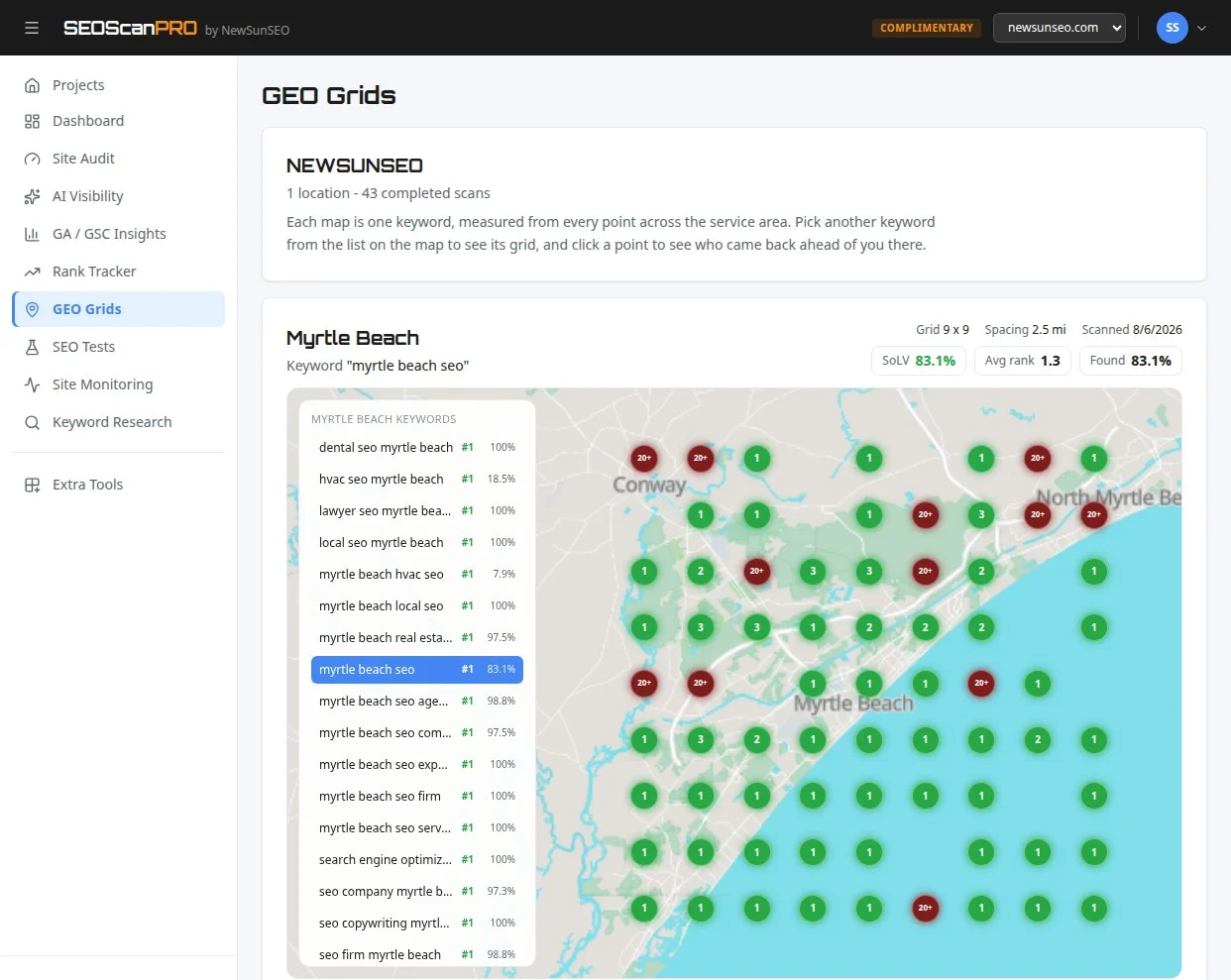
SEOScanPRO’s geo grid tool runs a full technical audit of a site and shows the measured result behind every check. Open the geo grid tool.
Want help with this in Myrtle Beach or Long Island? Talk to us.
NewSunSEO
Grow in Google and AI Search
AI-SEO, local search, paid ads and websites from one team, with offices on Long Island and in Myrtle Beach.
- AI-SEO
- Local AI-SEO
- AI Consulting
- PPC
- Web Design
- Web Development
- Long Island Office(631) 320-1700
- Myrtle Beach Office(843) 492-7131
Request a Free Proposal
Tell us about your business and where you want to grow.
We will reply by email to talk through your goals and what a proposal would include.
We use your details only to reply to you and send what you asked for. See our Privacy Policy.

