


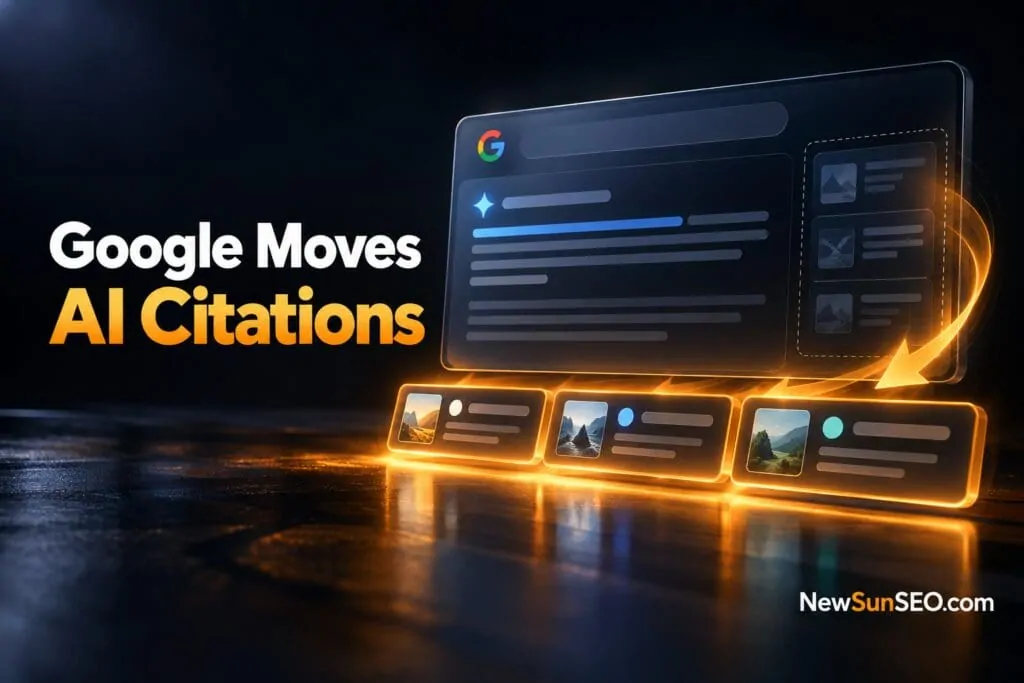
Google is running a new desktop test that moves AI Overviews citation cards from the right side of the answer to a stacked panel at the bottom. The change gives each source link a larger, more clickable area, and a recent screenshot shows the right-side citation bar is removed in the test.
What the new layout looks like
In the test, inline links inside the AI Overview still work the way they normally do on hover. The difference is the citation panel itself. Instead of sitting in a column on the right, the citations appear in a row at the bottom of the response. A “show all” control expands the list, and the expanded view shows the full set of citation cards, each with a larger hit area than the inline icons inside the answer.
The earlier right-side design is familiar: citation cards stacked vertically next to the AI text, then a “show more” option to expand the list. The bottom placement replaces that right column, so the right side of the response is empty until a user opens the citation list at the bottom.
How this test fits Google’s earlier attempts
Google has tried variations on citation placement at least twice before. The first run appeared in September 2025, and a follow-up test was visible in March 2026. The current test is the third known attempt, and the screenshots suggest it is a cleaner version of those earlier experiments, with a more prominent area for the cards and the option to expand to see every source.
Why bottom placement could matter for clicks
Citation cards on the right side of an AI Overview compete for attention with the AI text itself and with any knowledge panel or image block that loads next to the answer. Moving them below the answer gives the cards a dedicated space, separated from the generated response, which can make each source link more inviting to click. The trade-off is that users only see the citations after they look for them, so the default view of an AI Overview in this test shows no visible citation cards at all, just the inline link icons inside the text, unless the bottom list is expanded automatically.
A practical middle ground would be to show the citation cards in both places, on the right and at the bottom, so users who scroll or who look at the right column both get the same set of source links. The screenshots from this test do not show that dual placement, only the bottom placement.
What it means for sites cited in AI Overviews
Citation placement changes how often users actually reach a source. A bottom panel with a “show all” expansion shifts the click decision to the end of the AI answer, after the user has read the response. Inline links inside the text still work on hover and still drive some clicks, but the visible cards that anchor a citation block in the right column are gone in this test. Sites that rely on AI Overview traffic should expect a different click pattern if Google rolls the bottom placement out broadly, with more weight on the expanded panel and on the inline link icons than on a permanent right-side card list.
What it takes to be cited in an AI Overview in the first place
Citation placement is only useful if a page is cited at all. AI Overviews pull from the same set of pages that Google already trusts for traditional search, with extra weight on clear answers, structured facts, and source pages that match the question being asked. Pages that state a direct answer early, label their data with dates and authors, and keep their schema and on-page signals consistent are more likely to surface in the citation list, whether that list sits on the right, at the bottom, or both. Tracking which queries trigger an AI Overview, which pages get cited, and how the citation block looks in each placement is the kind of detail an AI visibility report needs to capture. A tool like BizScoreAI can scan how a business listing reads to AI search and surface what an AI agent actually pulls from a site.
FAQ
What is changing in Google AI Overviews?
Google is testing a layout where the citation cards for an AI Overview are stacked at the bottom of the response on desktop, replacing the right-side citation bar that is normally visible next to the AI text.
Has Google tested this citation layout before?
Yes. Google has tried variations of bottom-placed citation cards at least twice before, in September 2025 and again in March 2026, and the current test appears to be a cleaner version of those earlier experiments.
Do users still see inline links in the new AI Overview test?
Yes. The screenshots show that inline links inside the AI answer still work on hover, and the citation cards at the bottom expand through a “show all” control. Without expanding that bottom list, the visible citations are only the inline icons in the text.
Related coverage
- Google Business Profile Citations vs. Paid Citation Services: What Actually Works in 2026
- Google Just Made AI Overviews More Link-Friendly: What This Changes for SEO in 2026
- AI Mode vs. AI Overviews: Two Behaviors, One Google
BizScoreAI

BizScoreAI scores how visible a business is to AI search and shows what its listing looks like to the engines people ask. Open the AI visibility scan.
Want help with this in Myrtle Beach or Long Island? Talk to us.
NewSunSEO
Grow in Google and AI Search
AI-SEO, local search, paid ads and websites from one team, with offices on Long Island and in Myrtle Beach.
- AI-SEO
- Local AI-SEO
- AI Consulting
- PPC
- Web Design
- Web Development
- Long Island Office(631) 320-1700
- Myrtle Beach Office(843) 492-7131
Request a Free Proposal
Tell us about your business and where you want to grow.
We will reply by email to talk through your goals and what a proposal would include.
We use your details only to reply to you and send what you asked for. See our Privacy Policy.

