


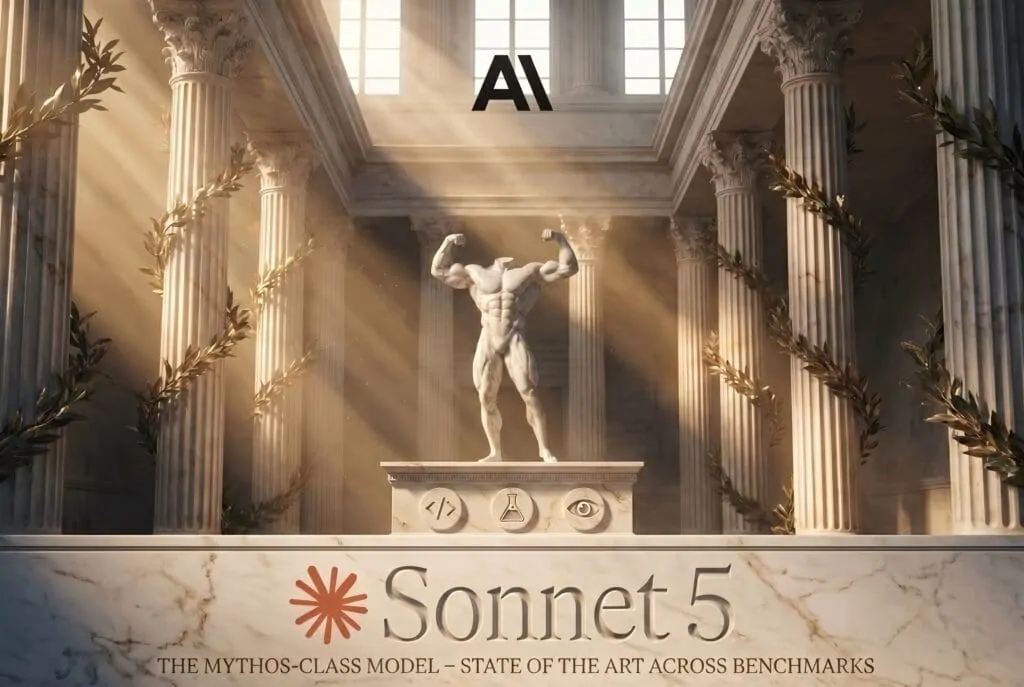
Anthropic released Claude Sonnet 5 as a cheaper, faster sibling to Opus 4.8, while more than one hundred American institutions regained access to the frontier system Mythos. Two expected arrivals, Claude Fable 5 and GPT-5.6-Sol, are still missing from the public catalog. Early benchmarks on Sonnet 5 will take days to settle, and the practical question is whether a lighter Opus-tier model changes deployment for coding and agentic workflows.
Sonnet 5 Arrives, and Mythos Returns to a Hundred Institutions
Anthropic frames Sonnet 5 as a modest step rather than a leap, despite the version number. Early benchmarks will need a few days to settle. For now, the practical question is whether a lighter, cheaper Opus-tier model changes how teams deploy Anthropic’s tools, especially for coding and agentic workflows.
Does regulation track the frontier, or the field?
Daniel Eth noted that the United States places more restrictions on its frontier AI than China does on its domestic frontier. The framing is fair only if you remember why: regulation becomes more necessary as capability approaches the frontier, and less necessary as it falls behind. American labs producing Chinese-tier results today generally face little constraint. The new restrictions look less anomalous when you measure them against capability rather than rhetoric.
This contextual point matters when comparing policy regimes side by side. Capability-based thresholds, the kind Rep. Nate Moran included in the proposed AI Incident Reporting Act, take the same idea seriously. A capabilities threshold is tricky to write, but in principle it tracks the thing that actually creates risk.
Did the DeepMind Pentagon contract expose the limits of internal dissent?
Andreas Kirsch argued that Google DeepMind and Demis Hassabis built their safety culture on trust and leadership rather than formal governance, and that the Pentagon contract stress-tested that bet. Six hundred employees signed a letter. The contract still contained enough weasel language that the Pentagon holds the power and can direct use however it chooses.
Kirsch’s read, supported by his work with UTAW and the Communication Workers Union on Unite recognition, is that employee influence only matters when workers are willing to strike or walk. That threshold was not crossed this time, and that is exactly why formal recognition matters for future fights.
How does the AI Incident Reporting Act handle preemption?
Charlie Bullock highlighted the AI Incident Reporting Act, introduced by Rep. Nate Moran. The bill addresses preemption directly and uses a capabilities-based definition of a covered model. Both choices are harder than they sound. Preemption keeps a patchwork of state laws from fragmenting compliance. A capabilities threshold keeps the rulebook from capturing systems that pose no meaningful risk. Bullock’s read is that the bill handles both reasonably well.
Why equal access is not the win for AI safety
One strain of AI policy argues that the best way to stop a bad actor with a dangerous model is to give good actors access to the same model. Some argue it is better than letting a bad actor hold a superior model, but it is still not safe.
Historically the bad actor had to work harder to find willing collaborators because most people do not want to be the bad guy. If a malicious actor can scale operations up to the limits of available funding, the loss of a required specialized skill set means there is no longer a talent gap to overcome. Open-weight models, at most, produce parity. They do not produce defense.
Some analysts argue that over time the offense-defense balance could shift toward defenders if access to powerful tools becomes widely distributed. That outcome is plausible, but it is not free.
How is the judiciary reshaping AI policy where Congress cannot?
AI policy so far has been driven by executive action while Congress struggled to legislate. The judiciary can move faster in some cases, and its decisions could reshape the terrain in unexpected ways. Dean Ball pressed this point: the most consequential legal questions in AI now run through the First Amendment. What fact patterns best show that creating, distributing, or using frontier AI counts as protected expression, and who has standing to litigate it.
Ball urged moving past the reflexive claim that code is speech and toward actual test cases. Sovereignty in the United States rests with the people, and the First Amendment is a wild leap of faith. Any plausible future in which people retain meaningful sovereignty over sufficiently advanced AI will require a range of controls. The hard tradeoff of the First Amendment has always been real. Reasonable people will still worry that strict First Amendment rulings make friendly regulation harder, but the descriptive answer seems to be that courts will not be the constraint. Politics will.
When models become speech, what breaks?
A second wave of commentary, including work from Preston Byrne, argues that AI models themselves should receive First Amendment protection, since a user of a large language model is both speaker and listener, and the entire context window is user-generated. If the argument holds, regulating how people use LLMs becomes the regulation of expressive conduct, and Congress may lack the power to constrain LLMs in private hands.
That claim sounds logically consistent but is fragile in practice. Plenty of speech-adjacent activity is regulated. Treating an AI model as fully protected speech would force sweeping changes across the regulatory state. Taken to its logical end, a court that insulated every model use from control would push the government toward restricting who can train a frontier system in the first place, and who can run one once trained.
What does Slaughter v. Trump change for an AI regulator?
The Supreme Court ruled 6-3 in Slaughter v. Trump that the President can fire, at any time and for any reason, most officers exercising substantial executive power, overruling Humphrey’s Executor. The Federal Reserve remains the historical exception.
Ben Rossen spelled out the implication for AI: an independent body that licenses major training runs, compels evaluations, restricts deployments, orders emergency pauses, and imposes penalties cannot have its leaders protected from at-will removal, because substantive rulemaking, investigation, enforcement, civil litigation, and in-house adjudication are all executive functions. The majority rejected the technocratic argument that independence itself justifies insulation, which by its logic reaches the FTC, the CFPB, and the NLRB.
Dean Ball disagrees and welcomed the ruling, advocating the open acknowledgment that bodies like the FTC and SEC are partisan. The opposing view holds that even the fiction of nonpartisan administration matters, because it forces the abuse of regulatory power into the shadows and imposes friction. Without that friction, financial and speech regulation become explicit partisan tools. The cost of legitimate government rises when agencies are visibly hunting the President’s opponents and favoring his allies.
What would an independent AI regulator now require?
Any serious proposal for a Frontier AI Commission with binding authority now has to reckon with Slaughter. Two paths remain. One is constitutional, which is slow and uncertain. The other is structural, accepting that independence will be partial and building procedural safeguards, staggered terms, for-cause limits on subsets of decisions, and judicial review, into the statute. Neither path is clean. Both are harder this week than they were last week.
What comes next on open weights, distillation, and the Mythos Moment?
The series will continue covering the Mythos Moment, the ad hoc licensing regime now in place, and the open questions around open-weight models and distillation. Several pieces in this thread explore what banning open source would even mean, whether open-weight models are categorically unsafe, and how a serious defense posture gets built when offense scales as cheaply as the underlying compute. Subsequent posts will work through the legal questions Judge Ball raised, the reporting duties the new bill would impose, and the practical limits of treating models as speech.
Want help with this in Myrtle Beach or Long Island? Talk to us.
NewSunSEO
Grow in Google and AI Search
AI-SEO, local search, paid ads and websites from one team, with offices on Long Island and in Myrtle Beach.
- AI-SEO
- Local AI-SEO
- AI Consulting
- PPC
- Web Design
- Web Development
- Long Island Office(631) 320-1700
- Myrtle Beach Office(843) 492-7131
Request a Free Proposal
Tell us about your business and where you want to grow.
We will reply by email to talk through your goals and what a proposal would include.
We use your details only to reply to you and send what you asked for. See our Privacy Policy.

